
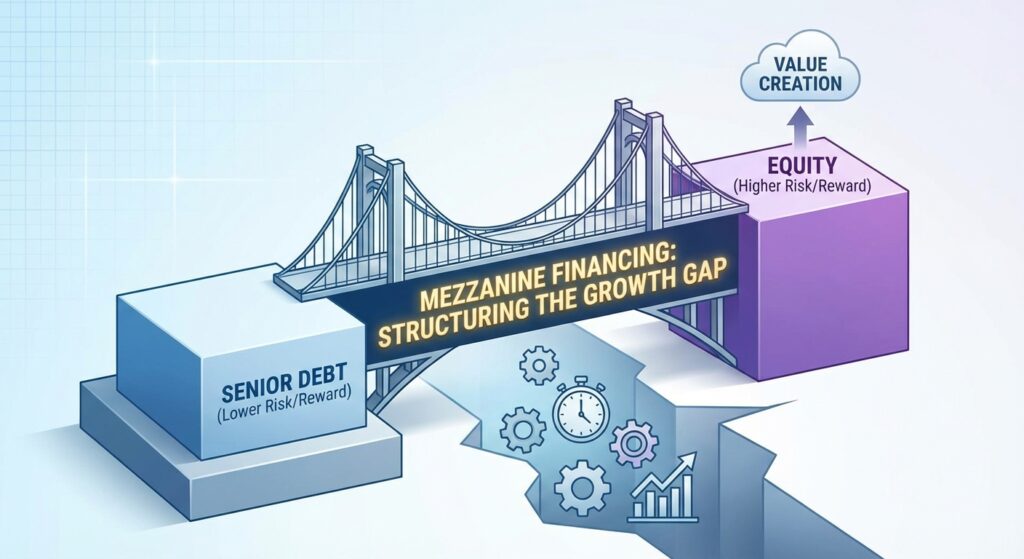
The Capital Challenge: You’ve Outgrown the Bank, But You’re Not Ready to Sell Equity
The growth stage is where the capital stack gets complicated. You have $3M–$8M in annual recurring revenue, a proven sales motion, and a clear acquisition or expansion target on the table. Your senior bank lender will stretch to 2.5x–3x EBITDA. The deal or initiative you’re sizing needs 4.5x–5.5x. That gap (the difference between what secured debt will fund and what the opportunity requires) is where mezzanine financing lives.
This is not a niche instrument. For founder-owned businesses, private equity-backed platforms, and founder-to-institutional transitions alike, mezzanine debt is frequently the most efficient way to close a specific funding gap without triggering the dilution and governance concessions that accompany a full equity raise. But it is not free capital, and it is not simple. Deploying it well requires understanding its components, its cost logic, and the specific conditions under which it outperforms the alternatives.
Where Mezzanine Sits in the Capital Stack
The capital stack, as described by corporatefinanceinstitute.com, organises financing sources by repayment priority and risk. Senior debt (term loans, revolving credit facilities) sits at the top: lowest risk, lowest cost, first claim on collateral. Equity sits at the bottom: highest risk, highest expected return, last claim on anything. Mezzanine occupies the subordinated middle layer. It is repaid after senior debt but before equity holders receive any distribution.
That subordinated position dictates its pricing. Where senior bank debt in the current market prices in the 7%–9% all-in range for solid middle-market credits, mezzanine typically commands 12%–18% all-in yield: blended across a cash-pay coupon, a PIK (payment-in-kind) component, and often a modest equity kicker via warrants or a co-investment right. As capitalxo.com notes, each layer’s pricing should follow a logical risk gradient. When it does not, something in the structure demands scrutiny.
The full cost of capital spectrum for a growth-stage business, mapped from cheapest to most expensive, looks roughly like this:
- Senior secured bank debt: 7%–9% all-in, tight covenants, collateral-dependent
- Senior secured private credit / unitranche: 9%–12% all-in, covenant-lite, higher leverage tolerance
- Mezzanine / subordinated debt: 12%–18% all-in (cash + PIK + equity kicker), flexible structure
- Preferred equity: 14%–20%+ required return, no mandatory cash pay, governance rights attached
- Common equity / minority institutional: 20%–30%+ required IRR, dilutive, board participation
Mezzanine is not the cheapest option. It is the most efficient option when the alternative is giving up equity at an inflection point, precisely the moment when incremental enterprise value creation is highest.
Structural Anatomy of a Growth-Stage Mezzanine Facility
Consider a concrete scenario: a $22M enterprise value professional services business with $4.5M EBITDA is acquiring a bolt-on for $12M. The senior lender will fund $11M (approximately 2.4x EBITDA). The owner can contribute $2M in rolled equity. That leaves a $1M gap, in a best-case structure. More realistically, the owner wants to contribute less equity, the seller wants a clean close, and the total gap is closer to $3.5M–$4.5M. That is a mezzanine tranche.
A representative mezzanine facility for this scenario would include the following components:
- Principal: $4M subordinated note
- Cash coupon: 10%–11% per annum, paid quarterly
- PIK toggle: Option to accrue 3%–4% of interest to principal in years one and two, preserving cash flow during integration
- Equity kicker: Warrants covering 2%–4% of fully diluted equity, struck at current enterprise value
- Term: 5–6 years, bullet maturity
- Prepayment: Call protection of 103%/102%/101%/par in years one through four
- Covenants: Incurrence-based (triggered by specific actions) rather than maintenance-based (tested quarterly), providing operational flexibility post-close
The PIK toggle is particularly important at the growth stage. Integration years are cash-intensive. Being able to accrue rather than cash-pay 3%–4% of the coupon in years one and two preserves operating liquidity without triggering a technical event. The trade-off is that PIK interest compounds on the outstanding principal, a cost that borrowers frequently underestimate in year-three cash flow models.
Mezzanine vs. the Alternatives: When Each Makes Sense
The decision between mezzanine, a unitranche, and a minority equity raise is not academic; it is a direct function of leverage capacity, ownership objectives, and timeline to a liquidity event.
Unitranche private credit is often the right answer when the combined leverage need is 4x–5x and the borrower has strong, recurring cash flows. A single lender, a single credit agreement, and a blended rate of 9%–12% frequently beats a senior/mezz split on cost and simplicity. The limitation: unitranche lenders apply their own leverage ceilings, and for transactions requiring 5x–6x or where the collateral base is thin, they will stop short of the need.
Preferred equity is appropriate when cash pay is a constraint, the business cannot service additional fixed obligations, but the owner is willing to accept some dilution in exchange for structural flexibility. Preferred equity carries no mandatory repayment schedule, which reduces default risk. The cost is governance: preferred holders typically require protective provisions and occasionally board observation rights.
Mezzanine is optimal when: the owner wants to preserve common equity upside, the business generates sufficient cash to service the coupon (or can use a PIK feature to defer), and the timeline to a refinancing or exit is three to six years. It is also optimal for founders approaching institutional transitions, as lendity.com notes, equity raised at a high-growth inflection point is among the most expensive capital a founder will ever access. Mezzanine buys time to let the equity accrete further before any institutional sale process begins.
The Gap Capital Playbook: From Quantification to Close
Step 1, Quantify the gap precisely. Map the full sources-and-uses table. Identify the maximum senior leverage your lender will provide, the equity the owner will contribute, and any seller note capacity. The residual is your mezzanine need. Size it with a 10%–15% buffer for transaction costs and working capital post-close.
Step 2, Build the credit narrative. Mezzanine lenders underwrite to free cash flow after senior debt service, not to enterprise value. Prepare a trailing twelve-month and forward twelve-month EBITDA bridge, a detailed integration plan with synergy assumptions clearly separated from base case projections, and a debt capacity analysis showing coverage ratios at 2x, 1.5x, and 1x EBITDA stress scenarios.
Step 3, Run a targeted process. Mezzanine is a relationship market. For sub-$10M tranches, approach four to six specialist sub-debt funds and BDCs (business development companies). For larger facilities, add insurance company private placement desks. Provide a confidential information memorandum, the last three years of audited financials, and a management presentation covering the business model, competitive position, and use-of-proceeds logic.
Step 4, Negotiate the structure, not just the rate. The equity kicker percentage, PIK optionality, prepayment schedule, and covenant package are all negotiating levers. Borrowers frequently over-focus on the headline coupon and under-negotiate the warrant coverage. A 1% difference in warrant strike price at a $30M enterprise value is worth more at exit than a 50-basis-point coupon reduction over five years. Model both scenarios before accepting a term sheet.
Key Takeaways
- Mezzanine is the gap-closing instrument between what senior lenders will provide and what growth-stage transactions actually require, typically 4x–6x EBITDA leverage territory.
- Total all-in cost matters more than the coupon: cash pay plus PIK accrual plus warrant dilution must all be modelled at exit to evaluate true cost versus an equity alternative.
- PIK toggles preserve cash during integration but compound on principal, model the year-three balance carefully before accepting a high PIK percentage.
- Incurrence covenants outperform maintenance covenants for operating flexibility; prioritise covenant structure in negotiations, not just pricing.
- The equity kicker is the highest-value negotiating point in a mezzanine term sheet, warrant coverage percentage and strike price have a larger impact on founder economics at exit than most coupon adjustments.


