
The Story: A Kurdish Immigrant, a Broken Factory, and a Government Loan
In 2005, Hamdi Ulukaya didn’t walk into a Sand Hill Road conference room with a pitch deck. He walked into a shuttered Kraft yogurt plant in New Berlin, New York, with an SBA loan, a government-backed debt instrument, and a vision for what Greek yogurt could become in America.
No cap table. No term sheet. No board telling him to grow at all costs.
By 2012, Chobani had crossed $750 million in revenue. Not a single dollar of venture capital had entered the building. When Ulukaya finally needed outside capital in 2014 to relieve manufacturing constraints, he chose $560 million in debt from TPG Capital: structured with warrant coverage rather than outright equity, preserving majority control and decision-making authority. As reported in The Creator’s Blueprint, Ulukaya’s stake today is estimated at 60–70% of a company now valued at $15 billion, generating nearly $2.85 billion in projected 2025 revenue.
That is the power of choosing debt deliberately, from a position of profitability, with a clear-eyed view of what equity would have cost.
The Decision: What Were the Real Options?
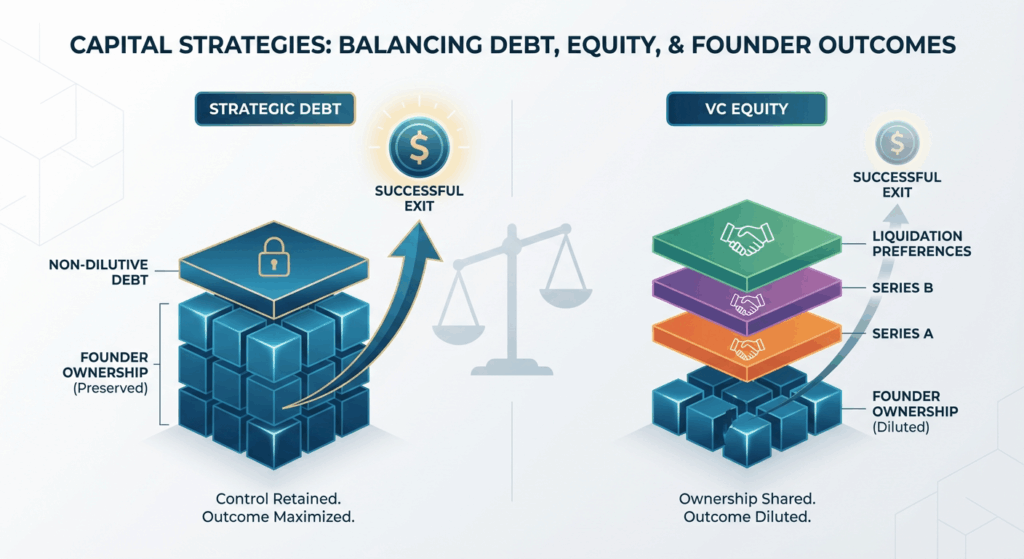
Ulukaya’s 2014 moment is a masterclass in leverage architecture. The conventional path (raise a Series B or C, bring in institutional equity, dilute to 30% ownership) would have handed governance to investors whose timeline and incentives rarely align with a 20-year builder’s vision.
Instead, Chobani’s debt structure gave TPG upside through warrants while Ulukaya retained the voting power that mattered. When TPG’s position became constraining by 2018, Ulukaya bought them out using the Healthcare of Ontario Pension Plan (HOOPP), long-duration capital with a 20-year horizon, not a five-year fund cycle. The equity IPO, filed in 2021 at a $7.5 billion target valuation, was quietly withdrawn when market conditions deteriorated. Ulukaya could afford to wait. Profitable companies always can.
This contrast, between founders who need liquidity and founders who choose their moment, is the defining variable in every capital structure decision. Debt, when deployed against real cash flow, doesn’t just preserve ownership. It preserves optionality.
For smaller operators, the same dynamic plays out at a different scale. SafePointe, a Florida-based AI weapons detection company founded by father-son duo Greg and Timothy Holifield, needed working capital to fulfill hardware-enabled SaaS contracts without strangling their equity structure ahead of a planned exit. According to TIMIA Capital’s published case study, the Holifields engaged TIMIA for a $1 million debt facility in September 2022: taken in three disbursements to match contract delivery timelines, and tripled their monthly recurring revenue within twelve months. The result: an acquisition by SoundThinking, Inc. (SSTI) in 2023, their fourth successful exit in fourteen years.
Greg Holifield put the cost comparison bluntly: “They think the interest rate is too high, but when there are no warrants associated with debt, it is truly fantastic money, and much cheaper than equity. I love this class of debt.” The equity investors who came in alongside TIMIA made 10x in nine months. TIMIA’s debt cost a fraction of that, and the Holifields kept more of the outcome.
The Outcome: When Non-Dilutive Capital Compounds
The Chobani and SafePointe stories are not outliers. Myagi, a retail sales enablement SaaS platform co-founded by Simon Turner, used a $2.5 million TIMIA facility in early 2021 to expand its referral-based sales model and customer success capabilities. Annual recurring revenue grew from $2.4 million to $4.4 million, an 83% increase, without an equity round. Two years later, Myagi was acquired by Rallyware. As TIMIA Capital documents, Turner reflected: “If I were building a software company again, I would really weigh up the impact, time, and challenges of bringing on venture capital, as well as all the expectations that come with it.”
Inkle, an all-in-one financial operations platform for VC-backed startups, tells a comparable story. Facing predictable seasonal growth windows, Inkle bypassed a seed round entirely in favor of revenue-based non-dilutive financing from Efficient Capital Labs (ECL). According to ECL’s published case study, founding team equity was preserved at approximately 90%, two rounds of dilution were avoided, and board control remained intact, all while Inkle scaled to serve 500+ companies globally. Co-Founder Ranvir Singh summarized it clearly: “With ECL, our founding team avoided two rounds of dilution, held onto control of our company, and kept our high growth trajectory intact without giving up equity.”
Across these four cases, a pattern emerges: founders who chose structured debt over equity rounds didn’t just preserve ownership percentages on paper; they preserved the economic outcome at exit. The pie wasn’t shared before anyone knew how big it would grow.
The Cautionary Counterpoint: When Debt Becomes the Trap
The Divvy Homes story offers the essential counterweight, and every founder considering leverage should internalize it before signing anything.
Divvy, a rent-to-own housing startup backed by a16z and Tiger Global at a $2.3 billion peak valuation, took on approximately $735 million in debt in October 2021, at the zero-interest-rate peak, to fund a capital-intensive model that required physically purchasing homes. When rates surged in 2022, the model broke. Three rounds of layoffs followed. In January 2025, Brookfield Properties acquired Divvy for roughly $1 billion.
As SaaStr analyzed in detail, the waterfall math was unforgiving: $735 million in debt repayment, plus transaction costs, plus liquidation preferences for preferred shareholders, consumed the entire $1 billion: leaving founders, employees, and common shareholders with zero proceeds. CEO Adena Hefets confirmed as much in a letter to shareholders.
The mechanism is critical to understand: debt doesn’t dilute your ownership percentage; it dilutes your outcome. Owning 15% of a $1 billion exit sounds transformative. Owning 15% of whatever remains after $735 million in debt is paid is a very different calculation. Divvy needed an exit well above its peak valuation just to generate a single dollar for common shareholders. That bar was never cleared.
The Lessons: A Framework for the Debt vs. Equity Decision
These stories, taken together, produce a framework worth carrying into every capital discussion:
1. Model the Waterfall Before You Sign
Every founder should be able to answer one question before accepting any capital: At what exit price do I personally make $0? Debt raises that floor. Equity preferences raise it further. Know both numbers before you borrow or dilute.
2. Debt Works When the Business Generates Cash to Service It
Chobani was profitable before Ulukaya touched debt at scale. SafePointe had recurring revenue and contracted customers. Myagi had ARR and a proven land-and-expand model. Debt amplifies what already works; it does not fix what doesn’t.
3. The Asset Must Outlast the Cycle
Divvy’s debt was priced for a zero-rate world and a rising housing market. When both assumptions failed simultaneously, the debt remained, immovable and indifferent. Match the duration and structure of your debt to the durability of your business model’s core assumptions.
4. Equity Dilution Reduces Your Slice. Debt Shrinks the Pie.
This is the most misunderstood distinction in founder finance. A 20% equity round feels painful on the cap table. But $735 million in senior debt can eliminate the entire pie at any exit below that threshold. Know which risk you are actually taking.
5. Patience Requires Profitability
Ulukaya could withdraw the Chobani IPO in 2022 because he didn’t need the liquidity. Founders who burn VC cash to fund operations surrender the right to wait. Profitable companies choose their moment. Unprofitable ones take whatever terms the market offers.
Key Insights
- Non-dilutive debt, deployed against real cash flow, is frequently cheaper than equity: SafePointe’s equity co-investors made 10x in nine months; TIMIA’s debt cost a fraction of that outcome.
- Founder control compounds over time: Hamdi Ulukaya’s majority stake in a $15 billion company was built by treating debt as a tool, not equity as a default.
- Debt doesn’t dilute your cap table; it dilutes your exit: The Divvy Homes waterfall wiped out founders and employees at a $1 billion sale price because senior claims consumed the entire proceeds pool.
- Patient capital partners outperform fund-cycle-driven VCs for operators building on 10- to 20-year timelines: pension funds, revenue-based lenders, and structured debt providers align more naturally with builder incentives.
- The critical question before any capital decision is: what is my $0 threshold?: If you cannot answer that number for every combination of debt and preference stacked above common equity, you are navigating blind.


