
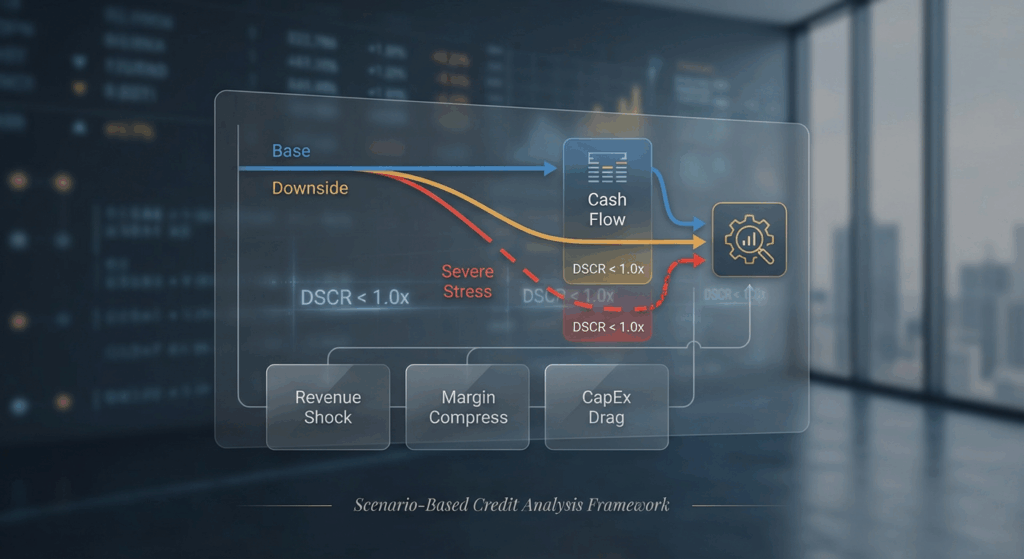
The Underwriting Question Every Lender Must Answer
Before a single dollar of credit is deployed, a disciplined underwriter must answer one foundational question: Can this borrower service its debt when conditions deteriorate, not just when conditions are ideal? Static underwriting, approving a loan based on trailing twelve-month (TTM) EBITDA at face value, is one of the most persistent and costly mistakes in private credit. It ignores the cyclicality embedded in nearly every industry, the fragility of management-adjusted earnings, and the speed with which covenant cushions can compress under stress.
Stress testing cash flows is the analytical discipline that separates defensive lenders from those who discover risk only after a borrower misses its first payment. For middle market direct lenders, where borrowers typically carry 4.0x–6.5x leverage and operate with limited financial flexibility, robust downside scenario modeling is not optional. It is the core of underwriting rigor. This framework walks through the methodology step by step, using a representative $10M EBITDA manufacturing company as a working example.
The Analytical Framework: Three-Scenario Cash Flow Architecture
Institutional lenders structure cash flow stress tests around three scenarios: a Base Case, a Downside Case, and a Severe Stress Case. Each scenario applies independent assumptions to revenue, margins, working capital, and capital expenditures, producing a distinct Debt Service Coverage Ratio (DSCR) and Free Cash Flow (FCF) profile under each condition.
The foundation of every scenario is Adjusted EBITDA, which must be normalized before any stress assumptions are applied. This means removing one-time items, owner compensation above market rates, non-recurring legal settlements, and COVID-era government subsidies that artificially inflated reported earnings. As Fitch Ratings’ credit methodology emphasizes, EBITDA-based leverage and coverage ratios are only analytically meaningful when the underlying cash flow figure reflects sustainable operating performance, not peak or managed earnings.
Example: $10M EBITDA Manufacturing Borrower
- Revenue: $65M TTM
- Reported EBITDA: $12M
- Normalized EBITDA (after removing $2M in non-recurring items): $10M
- Total Debt: $52M (First Lien Term Loan)
- Entry Leverage: 5.2x Normalized EBITDA
- Annual Debt Service (P+I): $6.5M
- Base Case DSCR: 1.54x
A 1.54x DSCR at entry appears adequate. But the critical underwriting work begins by asking: what does DSCR look like when revenue contracts 15% and margins compress simultaneously?
Walking Through the Calculations: Downside and Severe Stress
Using the manufacturing borrower above, a disciplined stress test applies independently calibrated revenue and margin shocks across two adverse scenarios.
Downside Case: Moderate Recession Conditions
- Revenue decline: –12% (to $57.2M)
- EBITDA margin compression: from 15.4% to 12.5%
- Stressed EBITDA: $7.15M
- Incremental working capital drag: –$0.5M
- Maintenance CapEx (held constant): –$1.2M
- Stressed FCF available for debt service: $5.45M
- Stressed DSCR: 0.84x: below 1.0x, indicating a debt service shortfall
Severe Stress Case: Deep Cycle Contraction
- Revenue decline: –22% (to $50.7M)
- EBITDA margin: compressed to 9.8%
- Stressed EBITDA: $4.97M
- Working capital outflow: –$0.9M
- CapEx: –$1.2M
- Stressed FCF: $2.87M
- Stressed DSCR: 0.44x: severe impairment territory
This analysis reveals that the credit, which appeared serviceable at entry, breaches debt coverage thresholds under even a moderate demand contraction. The underwriter must now evaluate whether covenant protections are set tightly enough to provide early warning, and whether recovery value supports the exposure if restructuring becomes necessary. Moody’s Analytics’ credit portfolio modeling framework underscores that variation in credit quality can increase rapidly and correlate with macro conditions, making scenario-based FCF stress testing indispensable for middle market lenders.
What Institutional Lenders Require: Standards, Red Flags, and Credit Performance Context
Experienced institutional lenders (including insurance company credit platforms and large direct lending funds) establish minimum stressed DSCR thresholds before approving a credit. A common institutional standard requires that the Downside Case DSCR remain at or above 1.10x–1.15x, with headroom to absorb further deterioration. A credit that falls below 1.0x DSCR in a moderate downside scenario typically requires either structural enhancements (additional collateral, equity cure rights) or is declined.
The case for rigorous stress testing is reinforced by credit performance data. As noted by PGIM’s large cap private credit research, larger-scale borrowers with stronger fundamentals and tighter documentation historically exhibit lower default rates and higher recovery rates, a direct validation of underwriting quality as a driver of credit outcomes. Similarly, AInvest’s 2026 risk management analysis found that nearly half of failed credit transactions could have been avoided through more rigorous pre-transaction scrutiny.
📊 Credit Performance Benchmarks
- Middle market leveraged loan default rates have historically ranged between 2% and 6% annually through credit cycles, with spikes during recessionary periods.
- First lien recovery rates in middle market restructurings generally average in the range of 60%–75%, depending on asset coverage and covenant structure at the time of default.
- Borrowers with DSCR below 1.10x at underwriting demonstrate materially higher rates of covenant breach and amendment activity within 24 months of closing.
- Fitch’s corporate credit framework explicitly uses EBITDA-to-interest expense and net debt-to-EBITDA as primary quantitative anchors for leverage and coverage assessment across all corporate rating categories.
Common red flags in cash flow stress testing:
- EBITDA margins that significantly exceed industry peer benchmarks without clear structural explanation
- Revenue concentration above 20% in a single customer or end market
- CapEx requirements that management systematically understates relative to asset age and maintenance history
- Working capital assumptions that assume perpetual improvement with no cyclical reversal
- Sensitivity analyses provided by the borrower that use narrow shock ranges and exclude macro recession scenarios
Underwriting Checklist: Cash Flow Stress Testing Diligence Points
- Normalize EBITDA first. Identify and remove all non-recurring, non-cash, and management-adjusted items before applying any scenario assumptions. Request three years of audited financials and a trailing twelve-month bridge.
- Define scenario assumptions independently. Do not use borrower-provided projections as the base for stress scenarios. Build your own revenue and margin assumptions anchored to industry data and historical cycle performance for the sector.
- Model working capital dynamically. Working capital typically deteriorates in a downturn, receivables extend and payables compress. Stress tests must reflect this, not hold working capital neutral.
- Separate maintenance CapEx from growth CapEx. Maintenance CapEx is non-discretionary and must be deducted in every scenario. Growth CapEx should be zeroed out in downside and severe stress cases.
- Calculate DSCR at each scenario level. Document results clearly: Base, Downside, and Severe Stress DSCR. Require a minimum 1.10x Downside DSCR as an institutional underwriting threshold.
- Test covenant headroom under stress. Map stressed EBITDA against the proposed financial maintenance covenant level. Ensure at least 20%–25% headroom in the Downside Case before tripping the covenant.
- Request lender-side quality of earnings report. Do not rely solely on borrower-commissioned QoE. Commission an independent QoE from a recognized accounting firm to validate normalized EBITDA and working capital assumptions.
- Document assumptions and sign-off. All scenario inputs, methodology choices, and results must be recorded in the credit memo with credit committee sign-off. Stress testing is only effective if it is institutionally enforced.
Key Takeaways
- Static underwriting is a structural liability. Approving a credit solely on TTM EBITDA without stress testing downstream cash flows is a systemic risk management failure, not a conservative lending posture.
- Normalize before you stress. Scenario analysis is only as reliable as the EBITDA baseline it starts from. EBITDA normalization and stress testing are sequential, not interchangeable, disciplines.
- Minimum DSCR thresholds must be institutionally enforced. A Downside Case DSCR below 1.10x should require compensating structural protections or result in credit decline, regardless of sponsor quality or market demand for the deal.
- Working capital and CapEx are the most frequently understated risks. These two line items consistently create the largest gap between projected and actual FCF in stressed environments and demand independent, conservative modeling.
- Covenant structure must be calibrated to the stress test output. Financial maintenance covenants set too loosely relative to stressed EBITDA provide no early warning signal, defeating their purpose as a lender protection mechanism.


