
The Billion-Dollar Exit That Paid the Builders Nothing
In January 2025, Divvy Homes (a rent-to-own real estate startup that raised from Andreessen Horowitz and Tiger Global, reached a $2.3 billion peak valuation, and helped 2,000 families move toward homeownership) was sold to Brookfield Properties for approximately $1 billion. A clean, nine-figure outcome by any external measure.
The founders received zero dollars. The employees received zero dollars. Most venture investors received zero dollars.
This wasn’t a product failure. It wasn’t a fraud scandal. It wasn’t even a bad business. As CEO Adena Hefets wrote in a letter to shareholders, after repaying outstanding debt, covering transaction costs, and satisfying liquidation preferences for preferred shareholders, there was simply nothing left. The line ran out of money before it reached the people who built the company.
This is what a capital structure story looks like when the math works against you. And it begins (and ends) with a single October 2021 decision: taking on approximately $735 million in debt financing at the absolute peak of the zero-interest-rate era, layered on top of hundreds of millions in preferred equity already carrying its own liquidation preferences. When rates surged in 2022 and Divvy’s model buckled, the debt didn’t care. It was still owed. Every dollar. With interest. First in line. saastr.com
The Decision Behind the Deal: When Debt Scale Outpaces Exit Reality
Divvy’s logic in 2021 was not irrational on its face. Debt was historically cheap, housing values were climbing, and the model (buy homes, rent them back, capture appreciation) was inherently capital-intensive. Equity would have cost far more in dilution. Debt seemed like the elegant solution.
But the critical error wasn’t choosing debt. It was choosing too much debt relative to the realistic range of exit outcomes. Every dollar of debt raises the minimum exit price at which founder equity is worth anything at all. At $735 million in debt plus preferred liquidation preferences, Divvy’s founders needed a $1.5 billion-plus outcome just for common shareholders to see a single dollar. The exit they got, $1 billion, was nearly exactly the threshold at which everything was consumed before it reached them.
The waterfall is unforgiving and unemotional. Debt holders are first. Transaction costs are second. Preferred liquidation preferences are third. Common shareholders (founders, employees, early believers) are last. At a $3 billion exit, everyone wins. At a $1 billion exit, only the lenders do.
The lesson isn’t “never use debt.” It’s “always model your waterfall at every plausible exit price and know exactly when your equity becomes worth zero.” Most founders never run that number. Most of their investors already have. saastr.com
What the Right Debt Structure Actually Looks Like
Contrast Divvy’s story with Chobani. In 2005, Kurdish immigrant Hamdi Ulukaya bought a shuttered Kraft yogurt plant in upstate New York using a government-backed SBA loan: no pitch deck, no cap table, no venture partners. By 2012, Chobani had hit $750 million in revenue without a single dollar of venture capital. creatorsblueprint.co
When Chobani finally needed outside capital to scale infrastructure in 2014, Ulukaya raised $560 million from TPG Capital, structured as debt with warrant coverage, not a straight equity round. He paid interest rather than giving up voting control. He remained the majority decision-maker. When TPG’s position became constraining by 2018, he brought in HOOPP (the Healthcare of Ontario Pension Plan, patient capital measured in decades, not quarters) to buy them out.
By April 2026, Chobani is valued at approximately $15 billion with an estimated $2.85 billion in projected annual revenue. Ulukaya’s estimated ownership stake of 60–70% is worth roughly $9–10 billion on paper. The debt was modest relative to cash flows, purposefully sized, and used to build real infrastructure, manufacturing plants, not marketing budgets. The company’s debt load, even with a $487 million raise in late 2025, is estimated at a manageable 2–3x EBITDA, well below the 5–7x leverage ratios typical in PE-sponsored deals. creatorsblueprint.co
The difference between Divvy and Chobani is not debt versus no debt. It’s discipline in sizing, patience in partnership selection, and relentless focus on underlying cash generation as the foundation for any leverage at all.
Smaller-scale stories make the same point. SafePointe, an AI-based weapons detection startup founded by Greg and Timothy Holifield, secured a $1 million non-dilutive debt facility from TIMIA Capital in September 2022. Within 12 months, SafePointe had tripled its monthly recurring revenue and was acquired by public safety technology firm SoundThinking (Nasdaq: SSTI). The equity capital providers who co-invested made 10x on their stake in nine months. TIMIA’s debt cost a fraction of that in effective terms, and the Holifields walked away with their fourth successful exit, founder value intact, liquidation preferences minimal. timiacapital.com
Myagi, a retail sales enablement SaaS platform, tells a nearly identical story. Co-founder Simon Turner chose a $2.5 million non-dilutive facility from TIMIA Capital in 2021 over a VC round he had been planning pre-pandemic. The capital helped Myagi grow annual recurring revenue from $2.4 million to $4.4 million over 18 months. The company was acquired by Rallyware in 2023, roughly two years after engaging TIMIA, with Turner’s ownership preserved and the exit proceeding without the complications of layered liquidation preferences from multiple VC rounds. timiacapital.com
The Framework Every Founder Should Run Before Signing
These stories converge on a set of principles that don’t require a finance degree, just the willingness to run the math before the term sheet is in front of you.
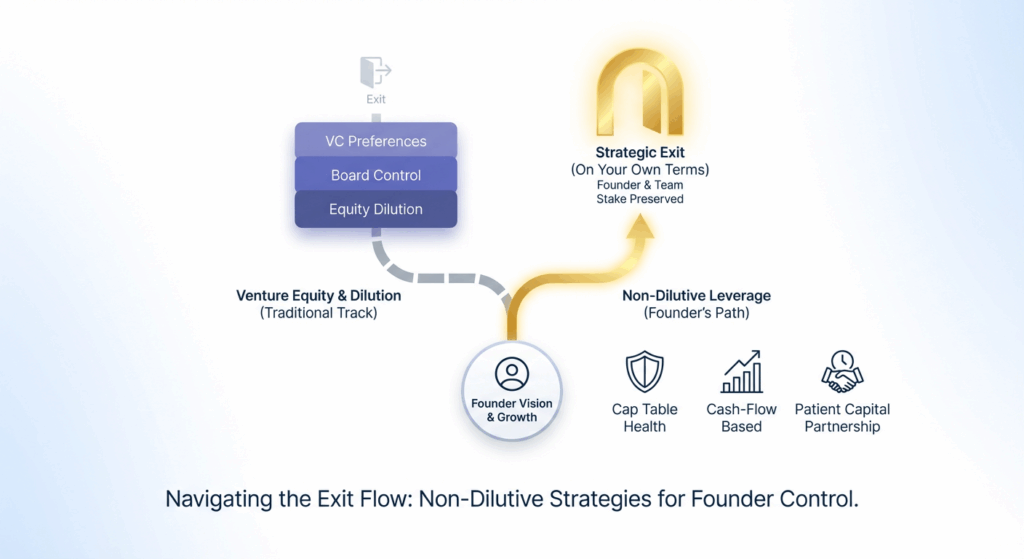
Debt reduces the pie before you eat it; equity reduces your slice. This is the most misunderstood concept in startup financing. Founders obsess over dilution, “I don’t want to give up another 15%”, and enthusiastically accept debt that, in a median exit scenario, is far more economically dilutive than the equity round would have been. Owning 100% of a company with $735 million in debt is worth zero at any exit below that threshold.
Size debt to your cash flows, not your ambitions. Chobani’s debt was serviceable because the underlying business was genuinely profitable. Divvy’s debt was catastrophic because the model was rate-sensitive and margin-thin. The debt doesn’t know the difference. It charges the same interest either way.
Know your zero point before you sign. Every founder should be able to answer one question at any given moment: at what exit price does my equity become worth nothing? If you can’t answer it, your lenders and your preferred shareholders can, and they already have.
Patient capital partners change the game. Pension funds, family offices, and revenue-based lenders are structurally different from VC funds with 10-year fund lives and return benchmarks. Chobani’s pivot to HOOPP gave Ulukaya a 20-year partner. SafePointe and Myagi’s use of TIMIA’s venture debt gave those founders an off-ramp without a VC board seat or an aggressive liquidation preference sitting ahead of them at exit.
Debt works best when it funds real, defensible constraints. Ulukaya built factories, physical, capital-intensive moats that competitors couldn’t replicate cheaply. Turner and the Holifields used debt to fund hardware and working capital gaps tied to contracted revenue. These are not speculative bets. They are capital efficiency plays with identifiable returns.
Key Insights
- The waterfall determines who wins at exit: not valuation, not vision, not revenue. Model it at every plausible exit price before you accept a dollar of debt or preferred equity.
- Debt is only non-dilutive on your cap table: economically, large debt shrinks the pool your equity draws from. Below a certain exit threshold, it is more dilutive than any equity round would have been.
- Right-sized non-dilutive capital creates asymmetric founder outcomes: SafePointe and Myagi used modest, revenue-backed debt to reach exits with founder value intact, avoiding the liquidation preference stacking that consumed Divvy’s common equity.
- The best capital partners match your time horizon: pension funds, family offices, and revenue-based lenders are structurally aligned with founder longevity in ways that fund-life-constrained VCs often are not.
- Underlying cash generation is the non-negotiable foundation: every successful leverage story in this piece rests on a business generating real margin. Debt does not transform an unprofitable model; it accelerates whatever trajectory already exists, for better or worse.


