
The Growth-Stage Acquisition Problem: You Have EBITDA, But Not Enough Firepower
Your business generates $4M in EBITDA. You have identified an add-on acquisition priced at $30M, roughly 7.5x your own earnings. Your senior bank lender will stretch to 3.5x EBITDA, handing you $14M. Your equity sponsor, if you have one, will deploy more capital, but only at a price: meaningful ownership dilution and a reset valuation conversation you are not ready to have.
Between $14M of senior debt and a reluctant equity check sits a $10–12M gap. That gap has a name: mezzanine capital. Understanding how to fill it (efficiently, on defensible terms, and without surrendering the equity upside you have spent years building) is one of the highest-leverage capital decisions a growth-stage operator can make.
This article walks through the mechanics, pricing, structuring playbook, and negotiation priorities for mezzanine financing in an acquisition context, using the capital stack framework as the organizing principle throughout.
Mapping the Capital Stack: From Banks to Equity
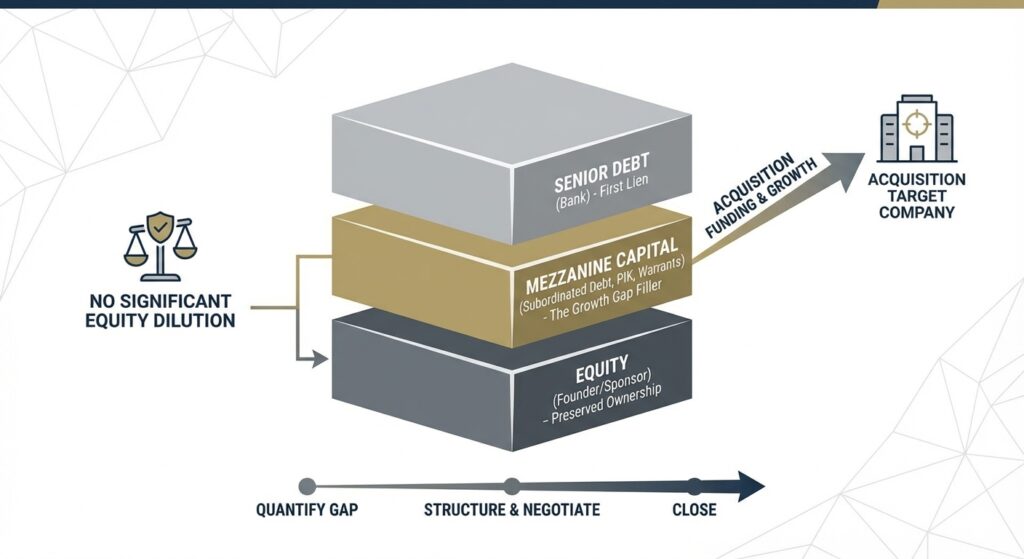
Before structuring a single tranche, operators need to see the full cost-of-capital spectrum laid out clearly. According to corporatefinanceinstitute.com, the capital stack organizes financing sources by repayment priority and corresponding risk-return expectations. Senior debt sits at the top, lowest cost, first claim on assets. Common equity anchors the bottom, highest cost, last in line. Mezzanine occupies the critical middle layer.
For a $30M acquisition on a $4M EBITDA business, the stack might be constructed as follows:
| Layer | Amount | % of Total | Approximate Cost | Priority |
|---|---|---|---|---|
| Senior Term Loan (Bank) | $14M | 47% | SOFR + 275–325 bps | First lien |
| Mezzanine Debt | $10M | 33% | 13–17% all-in (cash + PIK) | Second lien / subordinated |
| Equity (Sponsor / Rollover) | $6M | 20% | 25%+ IRR hurdle | Last in line |
As capitalxo.com notes, senior lenders evaluate their risk against the total leverage in the stack, not just their own tranche. Adding mezzanine debt increases total leverage, which is why senior lenders will require an intercreditor agreement defining what the subordinated lender can and cannot do, particularly around enforcement actions and payment blockage during a default. Negotiate the intercreditor before you finalize either tranche.
Mezzanine Structure Breakdown: PIK, Warrants, and the All-In Cost
Mezzanine financing is not a single instrument. It is a family of structures that can be tuned to match the cash flow profile of the borrower and the return expectations of the lender. Three components define almost every mezzanine deal:
1. Cash Interest vs. Payment-in-Kind (PIK)
Mezzanine lenders typically split their coupon between a cash-pay component and a PIK (Payment-in-Kind) component. PIK interest accrues to the principal balance rather than being paid in cash, preserving liquidity for the borrower during the early years of the investment. A common structure in the current market blends a cash coupon of 9–11% with PIK of 3–5%, producing an all-in cost of 13–16%. The cash/PIK split is one of the primary negotiation levers: a borrower with strong near-term free cash flow should push for more cash pay and less PIK, because PIK compounds against you over a 5–7 year hold.
2. Warrant Coverage (Equity Kickers)
Mezzanine lenders frequently attach warrants, the right to purchase equity in the borrower at a predetermined strike price, as a way to participate in upside. Warrant coverage is typically expressed as a percentage of the loan amount, often ranging from 1–5% of the fully diluted equity of the company. For a $10M mezzanine tranche on a business with a $30M enterprise value, a 3% warrant package represents approximately $900K of equity exposure at entry. Operators should model the dilutive impact of warrant exercise at multiple exit multiples before agreeing to coverage percentages or strike prices.
3. Covenant Package
Unlike senior bank debt, which typically carries a full maintenance covenant suite (leverage, coverage, and fixed-charge ratios tested quarterly), mezzanine debt more commonly uses an incurrence-based covenant package: covenants only tested when the borrower takes a specific action, such as paying a dividend, making another acquisition, or incurring additional debt. This distinction matters significantly for operational flexibility. Borrowers should understand precisely which covenants are maintenance-based and which are incurrence-based before signing, and should negotiate to push as many as possible to incurrence.
The Gap Capital Playbook: Quantify, Prepare, Run, Close
Executing a mezzanine raise is a distinct process from a bank financing or an equity raise. Here is the four-step tactical sequence:
Step 1: Quantify the Gap Precisely
Do not approach mezzanine lenders with a round number. The gap should be derived from a bottoms-up model: acquisition price, less senior debt capacity (based on a realistic leverage multiple your bank will confirm in writing), less equity you are genuinely willing to commit. What remains is the mezzanine need. Size the ask to cover that gap plus a 10–15% buffer for closing costs, working capital requirements, and integration expenses. Arriving with a vague range signals that your financial model is not tight, which weakens your negotiating position before the conversation begins.
Step 2: Build the Mezzanine-Specific Information Package
Mezzanine lenders underwrite downside more aggressively than equity investors. Your materials need to address three concerns directly: (a) can the combined business service all layers of debt at stressed EBITDA levels, (b) what collateral or enterprise value supports recovery if cash flows deteriorate, and (c) what is the realistic exit timeline and valuation range? A well-constructed mezzanine information memorandum includes a base case, a stress case (typically 20–25% EBITDA haircut), and a liquidation analysis, not just a growth projection deck.
Step 3: Run a Parallel Process
Approach three to five mezzanine providers simultaneously. The mezzanine lending market includes BDCs (Business Development Companies), dedicated mezzanine funds, and family office credit platforms. Running a parallel process generates competing term sheets, which is the single most effective tool for compressing pricing and improving non-economic terms such as PIK-toggle rights, prepayment penalties, and warrant coverage. Do not run senior debt and mezzanine sequentially, negotiate both concurrently and use each process to inform the other.
Step 4: Sequence the Close Correctly
Senior lenders must approve the intercreditor agreement before mezzanine proceeds are drawn. Sequence your closing so that the intercreditor is finalized and executed before the mezzanine term sheet is accepted as binding. Many deals have fallen apart at the closing table because the senior lender’s counsel had objections to intercreditor language that the borrower assumed was standard. Surface these issues during the process, not after you have announced the acquisition.
Negotiation Priorities: What to Fight For and What to Trade
Not every mezzanine term is equally consequential. Experienced operators focus their negotiating capital on the items that materially affect economics or operational flexibility, and trade away the rest efficiently.
- Fight hard on prepayment penalties. A standard mezzanine note may carry a no-call period of 2–3 years followed by a declining prepayment premium. Push to shorten the no-call to 18 months and compress the premium schedule. If the business performs well, you want the optionality to refinance into cheaper capital without a punitive exit fee.
- Fight hard on warrant strike price and coverage percentage. The strike price should reflect today’s enterprise value, not a discounted number the lender proposes as a concession. Model the equity dilution at your target exit multiple and know your walk-away point before you enter the room.
- Trade on reporting requirements. Mezzanine lenders often request monthly financial reporting. Quarterly reporting with a monthly cash flow certificate is a reasonable middle ground. Agree to it readily; it costs you administrative time, not economics.
- Trade on board observer rights. Many mezzanine lenders request a non-voting board observer seat. Granting this is generally harmless and often removed from a well-performing company’s board within two years anyway. Use it as a concession to win on pricing or warrant coverage.
As lendity.com observes in its capital stack analysis, every equity round (or in this context, every equity-linked instrument like warrants) should be modeled at multiple exit scenarios before signing. Model your cap table at three exit values: at deal cost, at 1.5x, and at 3x. Understand precisely what the mezzanine lender’s warrant position is worth at each scenario and negotiate accordingly.
Key Takeaways
- Mezzanine fills the capital gap between senior debt capacity and equity deployment; it is the instrument of choice when borrowers have proven EBITDA but need leverage beyond what banks will provide without surrendering material ownership.
- PIK interest preserves near-term cash flow but compounds against the borrower over time, negotiate the cash/PIK split based on your actual free cash flow projections, not the lender’s preference.
- Warrant coverage is real dilution: model it at multiple exit multiples before agreeing to a percentage, and treat the strike price negotiation with the same rigor you would apply to a priced equity round.
- Incurrence-based covenants provide meaningfully more operational flexibility than maintenance covenants, push to convert any maintenance tests in the mezzanine agreement to incurrence triggers, particularly on leverage ratios.
- The intercreditor agreement is structural, not administrative: it governs how the senior lender and mezzanine lender interact during stress, and its terms should be negotiated before either financing is finalized, not after.


