
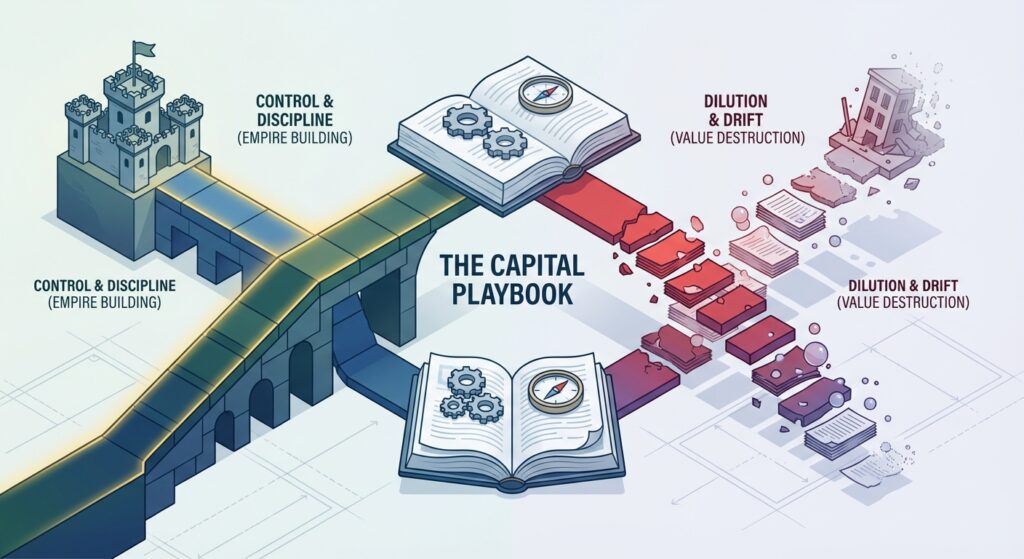
The Story: Two Founders, One Broken Factory, One Billion-Dollar Lesson
In 2005, a Kurdish immigrant named Hamdi Ulukaya walked into a shuttered Kraft yogurt plant in upstate New York and saw something no one else did: opportunity. He had no pitch deck, no cap table, no Silicon Valley connections. What he had was a government-backed Small Business Administration loan and a conviction that Americans deserved better yogurt.
He bought the plant. He launched Chobani. By 2012, just seven years later, the company had crossed $750 million in revenue. Without a single penny of venture capital. As detailed in a creatorsblueprint.co analysis of Chobani’s capital journey, Ulukaya’s use of debt-first financing was not a necessity born of rejection; it was a deliberate philosophy. Debt requires you to be profitable. Equity rewards storytelling. Ulukaya chose discipline.
Now contrast that with Divvy Homes. Founded in 2016, the rent-to-own housing startup raised over $400 million in venture equity from a16z and Tiger Global, reaching a $2.3 billion valuation by 2021. Then, in October of that year, the company layered on approximately $735 million in debt financing on top of a capital structure already loaded with preferred equity liquidation preferences. When interest rates surged in 2022, the model collapsed. Layoffs followed. New acquisitions froze.
In January 2025, Brookfield Properties acquired Divvy for approximately $1 billion. As reported by saastr.com, after repaying debt, covering transaction costs, and satisfying preferred shareholder liquidation preferences, the founders received zero proceeds. The employees received zero. Even most venture investors received zero. A billion-dollar exit. A complete wipeout for the builders.
The Decision: What the Capital Structure Actually Decides
These two stories are not really about yogurt or housing. They are about what happens when founders choose capital instruments that are structurally aligned (or misaligned) with their goals.
Ulukaya’s 2014 financing decision is particularly instructive. By then, Chobani was generating massive revenue but needed capital to close manufacturing and distribution gaps. Most founders at that inflection point raise an equity round, handing away 20–30% of their company. Ulukaya instead raised £560 million in debt from TPG Capital with warrant coverage, estimated at approximately 20% of the company, giving TPG meaningful upside participation while Ulukaya retained majority control and decision-making authority. Interest replaced dilution. Discipline replaced dependency.
Divvy’s structure operated on the opposite logic. Venture equity came with liquidation preferences, legal contractual rights that ensure preferred shareholders get paid first and fully before common equity sees a single dollar. Then the debt came on top. Each layer of capital stacked a new claim senior to the founders’ equity. The $1 billion exit price simply wasn’t tall enough to climb the capital stack.
This is the math that kills founders, and it is neither complicated nor accidental. It is the predictable result of piling high-cost, senior-claim capital onto an asset-heavy business operating in an interest-rate-sensitive environment. The structure didn’t fail because the business was worthless. The structure failed because the business was worth exactly $1 billion, and the capital stack cost more than that to satisfy before founders could collect.
The Outcome: Small Bets, Smart Structure, Maximum Retained Value
The power of non-dilutive capital doesn’t require billion-dollar scale to validate. Consider the case of SafePointe, a Florida-based AI weapons detection company founded by father-son duo Greg and Timothy Holifield. As documented by timiacapital.com, the Holifields secured a $1 million debt facility from TIMIA Capital in September 2022. Within 12 months, SafePointe had tripled its monthly recurring revenue and was acquired by public safety technology firm SoundThinking, Inc. (Nasdaq: SSTI). The founders retained the equity value they had built, and walked away with proceeds proportional to their ownership. It marked their fourth successful exit using this same non-dilutive financing strategy since 2010.
Similarly, Myagi, a retail sales enablement platform, used a $2.5 million non-dilutive debt facility from TIMIA Capital in 2021 to double down on its referral-based sales model and enhance its software capabilities. Rather than raising a dilutive equity round during a critical growth window, co-founder Simon Turner kept ownership concentrated. Two years later, Myagi was acquired by Rallyware. As timiacapital.com reports, Turner reflected: “Debt is a powerful tool for capital-efficient businesses when used under the right circumstances.”
At the earlier stage, Inkle, a financial operations platform for VC-backed startups, used non-dilutive growth financing from Efficient Capital Labs to fund seasonal expansion cycles without triggering another equity round. According to ecaplabs.com, the founding team retained approximately 90% of their equity, avoided two rounds of dilution, and maintained full board control, all while scaling to over 500 companies served. Co-founder Ranvir Singh noted the team was confident they could reach Series A metrics organically; they simply needed capital to move faster, not a new set of shareholders telling them how.
The Lessons: A Framework for Founders Facing the Same Fork in the Road
These stories converge on a small set of durable principles that cut across company size, industry, and market cycle.
1. Capital structure is destiny. The Divvy outcome was not caused by a bad product or bad management. It was caused by a capital architecture that placed too many senior claims ahead of founder equity. Every financing decision reshapes who gets paid first, and under what conditions founders get paid at all.
2. Debt disciplines; equity enables drift. Ulukaya’s willingness to use debt forced Chobani to be profitable before it scaled. Equity, especially at high valuations, creates permission to lose money at scale, a model that works until sentiment shifts and the next round doesn’t come.
3. Non-dilutive capital is most powerful at inflection points. SafePointe, Myagi, and Inkle all deployed debt at a specific moment: when growth was visible, revenue was predictable, and the equity cost of another round was disproportionate to the capital need. These are the windows where smart operators act.
4. Warrant coverage is not dilution; it is alignment. TPG received warrants in Chobani’s 2014 deal. That is not a failure of the debt model; it is a feature. Warrants give lenders upside participation without transferring board control or imposing liquidation preferences. The founder keeps the keys.
5. The counterfactual is the real measure. Ask not just “what did this financing produce?” but “what would the equity path have cost?” For Inkle, two avoided dilution rounds may represent tens of millions in ownership value at exit. For Chobani, a venture-backed alternative might have generated a larger valuation, and left Ulukaya with a fraction of it.
Key Insights
- Debt + preferred equity stacking is lethal in asset-heavy models. Divvy’s $735M debt layer on top of VC liquidation preferences created a capital stack that a $1B exit couldn’t clear, wiping out founders and common equity entirely.
- The SBA loan that built a $20B empire. Hamdi Ulukaya used government-backed debt, not venture capital, to launch Chobani, retaining the ownership that made him a billionaire while competitors diluted their way to irrelevance.
- Non-dilutive debt at revenue inflection points maximizes founder exit value. SafePointe tripled MRR and exited within 12 months of a $1M debt facility. The structure preserved equity; the debt did the heavy lifting.
- Warrant coverage differs fundamentally from equity dilution. Giving a lender upside through warrants preserves board control and avoids liquidation preferences, a structurally superior outcome for founders compared to raising a priced round.
- The right question is not “can we afford debt?”; it is “what does the equity path actually cost?” Founders who run the counterfactual comparison consistently find that non-dilutive capital, used at the right moment, produces materially better outcomes for those who built the business.


