
The Underwriting Challenge: When the Base Case Is Not the Question
Every borrower who walks into a credit process arrives with a best-case story. Revenue is growing, margins are expanding, and free cash flow will comfortably cover debt service. The CIM is polished, the management presentation is rehearsed, and the base-case model ties to the last three audited years. So where is the risk?
The risk lives in the downside, and in whether a lender has genuinely tested it. In middle market direct lending, where covenants are tighter and liquidity thinner than in broadly syndicated markets, the difference between a performing loan and a restructuring often comes down to how rigorously a lender stress tested cash flows before closing. According to PGIM’s January 2026 private credit case study, larger-scale borrowers with more resilient margins historically produce lower default rates and higher recovery rates, a finding that underscores how margin stability under stress is a core underwriting variable, not a footnote.
This article walks through the cash flow stress testing methodology used by institutional direct lenders, from building the model architecture to identifying the specific line items that most frequently cause credit deterioration.
The Analytical Framework: Three-Scenario Cash Flow Architecture
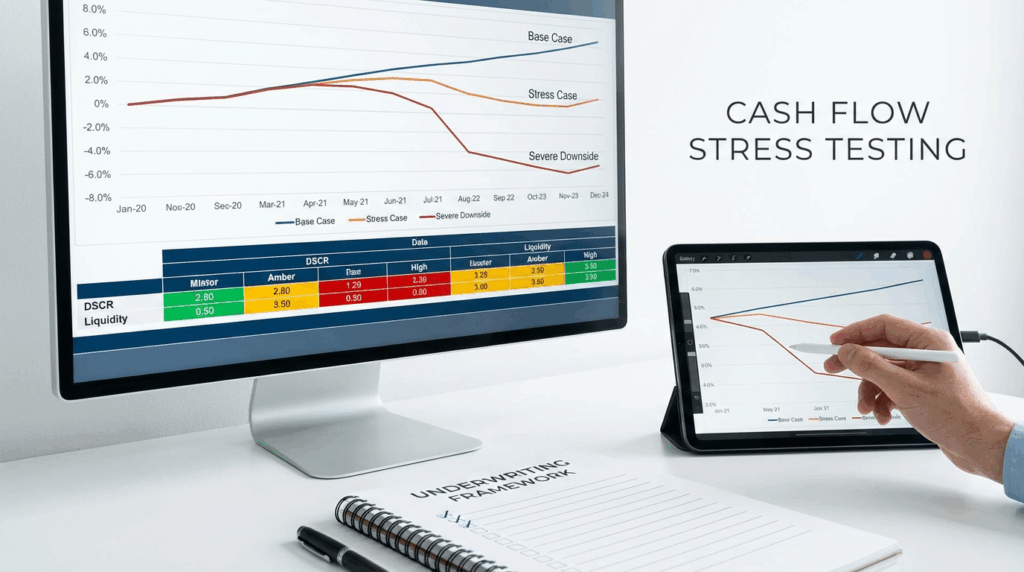
Robust stress testing is not a single downside case. It is a structured scenario architecture that isolates revenue risk, margin compression, and working capital drag independently before combining them. At Bond Capital, we build every credit model around three defined scenarios:
1. Base Case
Management projections, adjusted for normalized EBITDA (add-backs scrubbed), with organic revenue growth in line with industry benchmarks. This is the permission slip to look at the deal, not the underwriting thesis.
2. Stress Case (Moderate Downturn)
Revenue declines 10–15% from base; gross margins compress 200–300 basis points due to input cost pressure or pricing concessions; capex holds flat rather than flexing down. This scenario tests whether the business can service debt through a routine cyclical contraction without covenant breach.
3. Severe Stress / Downside Case
Revenue declines 20–30% from peak; EBITDA margins compress to trailing trough levels; working capital absorbs an additional 1–2% of revenue in cash. This scenario tests recovery, not just servicing. It answers the question: if this loan goes wrong, what does the lender get back?
Example: $10M EBITDA Manufacturing Company
Consider a specialty manufacturer with $50M in revenue, $10M in reported EBITDA (20% margin), and a proposed $45M senior secured term loan (4.5x leverage). The company produces industrial components with three customers representing 60% of revenue.
- Base Case: EBITDA of $10M; Debt Service Coverage Ratio (DSCR) of 1.85x (assuming $5.4M annual debt service at 7.5% PIK/cash blended rate plus amortization)
- Stress Case: Revenue falls to $43M; EBITDA compresses to $7.2M (16.7% margin); DSCR falls to 1.33x, still serviceable but thin
- Severe Stress: Revenue falls to $37M; EBITDA falls to $4.8M; DSCR drops to 0.89x, below 1.0x, meaning the company cannot service debt from operations alone
At 4.5x entry leverage, the severe stress scenario triggers a restructuring conversation inside 18 months. A disciplined lender either reprices, requires a more robust covenant package, or passes.
Walking Through the Calculations: Where Cash Flow Hides
Stress testing is only as good as the cash flow bridge between EBITDA and actual debt service capacity. The most commonly mismodeled items in middle market underwriting include:
Maintenance Capex vs. Growth Capex
Borrowers routinely present growth capex as discretionary and maintenance capex as minimal. Underwriters must independently verify maintenance capex as a percentage of fixed asset base, typically 3–6% of gross PP&E annually for manufacturing and distribution businesses. Understating maintenance capex overstates free cash flow and inflates DSCR by 15–25 basis points on a $10M EBITDA business.
Working Capital Seasonality
For businesses with seasonal revenue patterns, working capital swings can consume 30–60 days of cash in peak build periods. A stress test that ignores a November inventory build in a consumer products company will miss a liquidity squeeze that coincides with the highest debt service months.
Cash Taxes vs. Book Taxes
Sponsor-backed transactions frequently carry tax shield benefits from amortization of intangibles that reduce near-term cash taxes. Underwriters must model the step-up in cash taxes as these shields erode, typically in years 4–7 of a hold, because DSCR deteriorates mechanically even without an operational decline.
Key DSCR Calculation
DSCR = (EBITDA – Maintenance Capex – Cash Taxes – Change in Working Capital)
        ÷ (Scheduled Principal Amortization + Cash Interest Expense)
A 1.20x DSCR floor under stress is a common institutional threshold. Below 1.0x, the lender is funding operations, not earning a return on risk capital.
What Institutional Lenders Look For: Standards and Red Flags
Fitch Ratings’ published credit rating procedures emphasize that quantitative metrics (leverage, coverage, and liquidity) must be overlaid with qualitative assessments of management quality, competitive intensity, and sector volatility. For private credit lenders operating without the benefit of a public rating, this dual-lens discipline is even more important because there is no third-party check on the analytical work.
Moody’s Analytics’ framework for modeling credit portfolios highlights that correlation risk (the tendency for credits in the same sector or sponsor ecosystem to deteriorate simultaneously) is frequently underweighted in single-deal underwriting. A lender with five portfolio companies in industrials is not running five independent risks; they are running one macro risk five times over.
Common Red Flags in Stress Test Reviews
- Flat revenue assumption in the downside: Any stress case that shows revenue declining less than 10% for a cyclical business is not a stress test; it is a sensitivity.
- EBITDA margin expansion in year 2–3 of the model: Margin improvement built into a stress scenario requires explicit operational justification. Cost reductions that require capex or headcount changes must be modeled with a time lag.
- Customer concentration ignored in revenue haircut: If three customers represent 60% of revenue, the stress scenario must model the loss of at least one, not just a pro-rata decline.
- Covenant headroom under 15% in stress: Institutional lenders typically require at least 15–20% headroom to the maintenance covenant level under the stress case. Below that threshold, a single quarter of underperformance triggers a waiver process.
📊 Data Box: Credit Performance Benchmarks
- Middle market direct lending default rates averaged approximately 2–4% annually over the 2015–2024 period, with elevated spikes in 2020 and 2023 driven by rate sensitivity and sector concentration (Cliffwater Direct Lending Index)
- Recovery rates on senior secured middle market loans historically range from 60–75 cents on the dollar, versus 40–55 cents for second lien (S&P LCD / Moody’s LossCalc data)
- Covenant-lite structures in broadly syndicated loans saw breach-to-default timelines extend by 9–14 months versus maintenance covenant structures, highlighting the early-warning value of tight covenants in private credit (CFA Institute Credit Risk Module, 2024)
- PGIM’s large-cap private credit analysis found that borrowers with revenues above $75M exhibited materially lower default incidence than sub-$25M borrowers, linked to diversified customer bases and stronger management depth (pgim.com)
Underwriting Checklist: Stress Testing Cash Flows
Use this checklist at the final investment committee stage, after QoE, before term sheet finalization:
- Build an independent cash flow bridge. Do not rely on the borrower’s model. Reconstruct EBITDA → Free Cash Flow → DSCR from audited financials and normalized adjustments.
- Verify maintenance capex independently. Request fixed asset schedules, maintenance logs, and third-party asset appraisals. Cross-check against industry capex benchmarks (3–6% of gross PP&E for manufacturing).
- Model customer concentration explicitly. Stress the loss of the largest customer (or top two if >40% concentration) as a standalone scenario before running a blended revenue decline.
- Test three revenue decline scenarios: -10%, -20%, and -30% from trailing twelve months. Record DSCR, liquidity runway, and covenant headroom at each level.
- Project cash taxes through year 7. Model the erosion of intangible amortization tax shields for sponsored transactions; recalculate DSCR net of actual cash tax obligations.
- Identify the covenant trip wire. Back into the exact revenue and EBITDA level at which a maintenance covenant is breached under the proposed term sheet. If breach occurs at less than 15% EBITDA decline, renegotiate the covenant or reduce leverage.
- Document the recovery scenario. Under the severe stress case, estimate collateral coverage: (Senior Loan Balance) ÷ (Estimated Enterprise Value at Distressed EBITDA Multiple). A 1.0x coverage floor at 4–5x distressed multiple is a minimum institutional standard for senior secured paper.
Key Takeaways
- The base case is not the underwriting thesis. Conviction in a credit comes from the stress case, specifically from knowing how much revenue and margin deterioration the capital structure can absorb before debt service fails.
- DSCR is a function of cash, not EBITDA. Maintenance capex, working capital seasonality, and cash taxes regularly consume 20–35% of EBITDA before a dollar reaches a debt service account. Model all three explicitly.
- Customer concentration is a binary risk, not a continuous one. Stress scenarios should model the loss of a single large customer as a discrete event, not merely a proportional revenue haircut across the book.
- Covenant headroom below 15% in stress is a structural warning sign. Tight headroom collapses the early-warning function of covenants and converts a monitoring tool into a post-default paperwork exercise.
- Recovery analysis belongs inside the underwriting model, not in a separate appendix. Every senior secured investment should have a documented recovery scenario with an explicit enterprise value floor, distressed EBITDA multiple, and coverage ratio, before the loan closes.


