
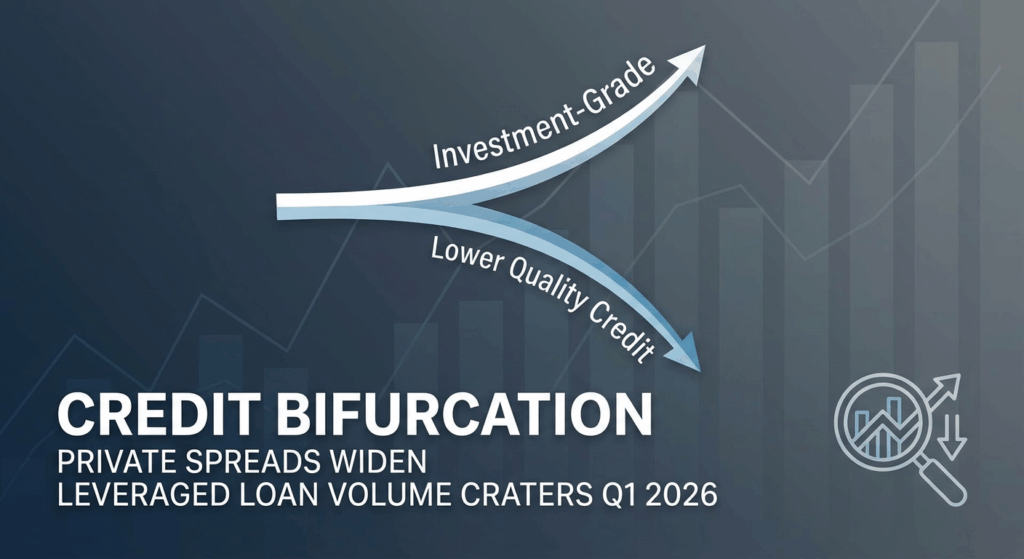
The Great Credit Bifurcation: A K-Shaped Market Takes Hold
The first quarter of 2026 has delivered a decisive macro shock to credit markets. A confluence of geopolitical instability, an oil-driven inflation resurgence, and aggressive new U.S. trade policy has snapped the borrower-friendly credit cycle that characterized much of 2024–2025. The result is a starkly bifurcated landscape: investment-grade and upper-middle-market borrowers retain access to competitive financing, while a growing cohort of lower-quality, cyclical, and sector-vulnerable credits is effectively locked out of the market, or paying materially higher risk premiums to get in.
According to data reported by financialcontent.com, leveraged loan primary activity fell to $235 billion in Q1 2026, down 34% from $355 billion in Q1 2025: the slowest start to a year for credit markets since the 2020 pandemic. Refinancings collapsed 42% and repricings fell 39%, as the Federal Reserve’s pause on its rate-cutting cycle, triggered by the so-called “March Oil Shock” with Brent crude briefly surging above $120/barrel, killed appetite for opportunistic debt activity.
Simultaneously, private credit spreads have widened 50–100 basis points from their late-2025 lows, according to ainvest.com, ending the prolonged era of spread compression that squeezed returns across direct lending portfolios. This is not a systemic unwind: private credit’s $1.8 trillion global market remains structurally sound, with an institutional investor base, first-lien dominance (~90% of loan assets), and loan-to-value ratios near 40%. But it is a meaningful repricing event that demands careful credit selection and active underwriting discipline.
Quantitative Market Snapshot: Key Credit Metrics, Q1 2026
The table below consolidates the most current publicly available credit market data points as of April 2026. Institutional investors and operators should treat these as directional benchmarks; deal-level terms will vary materially by sector, sponsor quality, and leverage profile.
| Metric | Current Value (Q1 2026) | Prior Period | Change | Source |
|---|---|---|---|---|
| U.S. Leveraged Loan Volume (Q1) | $235 billion | $355 billion (Q1 2025) | ▼ 34% | financialcontent.com |
| Private Credit Spread Widening | +50–100 bps from late-2025 lows | Near decade-low spreads (late 2025) | ▲ Widening | ainvest.com |
| Leveraged Loan Distress Ratio | 7.23% (loans trading below 80 cents) | ~4–5% (mid-2025 est.) | ▲ Highest in 3 years | financialcontent.com |
| Middle Market Credit Spreads (Q4 2025) | Unchanged QoQ; OIDs tightened to ~98.75–99.25 | OIDs ~98.50–99.00 (Q3 2025) | → Flat spreads; tighter OIDs | valuationresearch.com |
| Private Credit Non-Accrual Rate | 0.9% (Q3 2025) | Below 1.0% (historical avg. ~1% loss rate) | → Marginally higher, not alarming | heronfinance.com |
| Average LTV on Private Credit Loans | ~40% | Consistent over prior 2 years | → Stable | heronfinance.com |
| Skilled Manager All-In Yield Target | S+550 bps and above | S+475–525 bps (2025 average) | ▲ Expanding | ainvest.com |
On KPI thresholds: lenders are increasingly conditioning credit on tighter debt/EBITDA and fixed charge coverage ratio (FCCR) standards. Per valuationresearch.com, pricing grids tied to lower leverage step-downs (e.g., S+475 → S+450 at reduced leverage) are now common in middle market deals, signaling that lenders are actively rewarding deleveraging and penalizing leverage-heavy capital structures. Borrowers with FCCRs below 1.2x and debt/EBITDA above 6.0x are finding themselves firmly in the upper band, or excluded entirely.
Sector Analysis: Where Lender Appetite Is Expanding, and Contracting
🔴 Sectors Facing Tighter Credit Conditions
- Enterprise Software & AI-Disrupted Tech: Per ainvest.com, enterprise software exposed to AI disruption is a primary stress concentration. Recurring revenue lenders are reassessing net revenue retention assumptions and tightening advance rates against ARR multiples. Underwriters are demanding more conservative FCCRs and shorter amortization profiles.
- Media & Entertainment: financialcontent.com identifies media as one of the two sectors most visibly locked out of the primary market in Q1 2026. Structural advertising revenue declines and streaming fragmentation continue to erode EBITDA quality, with lenders requiring significant equity cushions and covenant protection before committing capital.
- Tariff- and Cycle-Exposed Industrials: valuationresearch.com explicitly flags cyclical and tariff-exposed credits as requiring higher risk premiums. Sectors with import-dependent cost structures (consumer goods manufacturing, certain auto suppliers) face underwriting scrutiny on margin durability and debt service capacity under stress scenarios.
🟢 Sectors Retaining Strong Lender Appetite
- Healthcare & Healthcare Services: Non-cyclical revenue, inelastic demand, and government-backed reimbursement streams continue to attract private credit capital at competitive spreads. Lenders view healthcare as a defensive allocation in an uncertain macro environment.
- Infrastructure-Adjacent & Energy Transition: Long-duration, contracted cash flow assets retain strong bid from insurance-affiliated lenders and direct lenders seeking yield with duration. The oil shock has paradoxically boosted interest in domestic energy infrastructure financing.
- High-Quality Sponsor-Backed Middle Market: valuationresearch.com notes that lender demand continues to outstrip new issuance for quality assets, with a growing share of deals pricing in the low-to-mid spread band. PE firms holding legacy investments with 7–8 year hold periods are motivated sellers, creating a pipeline of well-structured take-private and recapitalization opportunities.
Implications for Institutional Investors and Business Operators
For Institutional Investors
The spread widening of 50–100 bps creates a more favorable entry point for new private credit commitments, but only with disciplined manager selection. As ainvest.com observes, performance dispersion among fund managers is increasing, making underwriting quality and sector expertise the primary alpha drivers. Investors should prioritize managers demonstrating S+550+ all-in yields on new originations with first-lien security, sub-40% LTV, and FCCR covenants set at 1.15x–1.25x minimum. Separately, pimco.com makes a compelling structural case for public corporate bond market liquidity, noting it is stronger today than at any point since the GFC, offering institutional allocators a liquid counterweight to illiquid private credit positions. Public BDCs also offer a tactical liquidity hedge, capturing diverging risk-return profiles as redemption gates have been triggered at major private credit funds, including Blackstone’s BCRED, which faced $3.7 billion in quarterly redemptions per financialcontent.com.
For Business Operators and Borrowers
Borrowers approaching the debt markets in Q2 2026 must enter with conservative capital structures and clear documentation of EBITDA quality. Lenders are scrutinizing FCCRs below 1.2x with heightened concern, and debt/EBITDA above 5.5x–6.0x is triggering upper-band pricing or outright pass decisions. The favorable trend of OID tightening observed in Q4 2025 per valuationresearch.com has likely reversed given Q1 2026 macro conditions. Operators in tariff-exposed sectors should proactively model downside margin scenarios and present lenders with stress-tested coverage ratios to maintain access to competitive pricing. Refinancing windows are narrowing; borrowers with near-term maturities should engage lenders early.
Forward-Looking View: Liquidity and Lending Dynamics Over the Next 3–6 Months
The credit cycle has moved from late-cycle compression to early-correction territory. The key variable over the next 3–6 months is the Federal Reserve’s path: a resumption of rate cuts would release significant pent-up refinancing and M&A activity, valuationresearch.com noted pre-shock that improving Fed sentiment was already catalyzing LBO pipelines, but persistent inflation above target will keep the pause in place and deepen the bifurcation.
The distress ratio reaching 7.23%: the highest in three years per financialcontent.com, is a leading indicator worth watching closely. If it moves toward 10%+, a wave of distressed exchanges and selective defaults in software, media, and cyclical sectors becomes increasingly probable. However, the structural resilience of private credit: 90% first-lien exposure, ~40% LTV, institutional LP bases, and non-accrual rates still below 1.0% per heronfinance.com, suggests the asset class is equipped to absorb this correction without systemic impairment. For well-capitalized lenders with dry powder, the next two quarters may represent the most attractive new origination environment since 2022.
Key Market Insights
- Volume Collapse Is Real, Not Transitory: A 34% YoY drop in leveraged loan volume to $235B is not a seasonal blip; it reflects a structural risk-off shift driven by oil, inflation, and trade policy uncertainty that will persist until the Fed resumes easing.
- Spread Widening Creates Selective Entry Points: Private credit spreads 50–100 bps wider than late-2025 lows offer improved risk-adjusted returns for new commitments, but require rigorous manager and sector selection, S+550+ all-in yields on first-lien deals are the new benchmark for skilled underwriters.
- Distress Ratio at 7.23% Is the Key Watchlist Metric: The percentage of leveraged loans trading below 80 cents on the dollar is at a three-year high, institutional investors should monitor this weekly as a leading indicator of default wave timing and recovery value assumptions.
- KPI Thresholds Are Tightening: Lenders are actively conditioning credit on debt/EBITDA below 5.5x–6.0x and FCCR above 1.2x, with pricing grids rewarding deleveraging. Borrowers unable to demonstrate these metrics face the upper spread band or market exclusion.
- Manager Selection Is the Alpha Driver: Performance dispersion across private credit funds is widening materially. Investors should prioritize originators with demonstrated sector expertise, conservative LTV discipline, and transparent mark-to-market practices, redemption gate events at major platforms signal that liquidity management is now as important as yield generation.


