
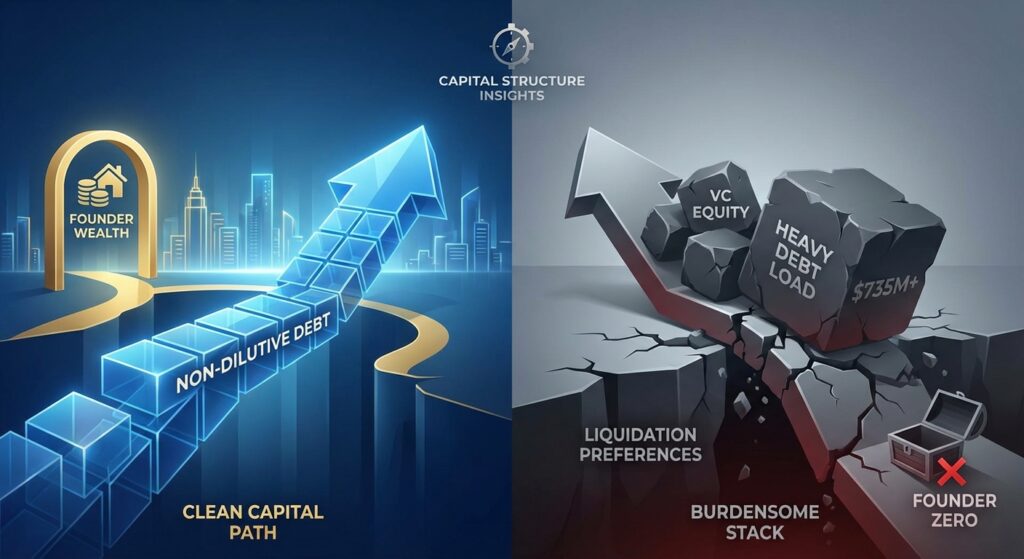
The Story: Two Paths, Two Outcomes
In September 2022, Greg and Timothy Holifield (a father-son team who had already built and sold three companies) made a quiet, deliberate capital decision. Their AI-based weapons detection startup, SafePointe, needed growth capital. They had the attention of two lenders and could have entertained equity investors. Instead, they chose a $1 million non-dilutive debt facility from TIMIA Capital.
Twelve months later, SafePointe was acquired by SoundThinking, Inc. (Nasdaq: SSTI), a leading public safety technology firm. The Holifields walked away with founder value intact, their fourth successful exit in 16 years of building together. No dilution. No preferred liquidation stack. Just clean, aligned capital that served its purpose and stepped aside.
Now contrast that with a company that raised a billion-dollar round table of support (venture giants, top-tier institutional backing, a $2.3 billion valuation) and still left its founders with nothing. Divvy Homes sold to Brookfield Properties in early 2025 for approximately $1 billion. The founders received $0. The employees received $0. Even most venture investors received $0. As SaaStr’s Jason Lemkin wrote in February 2026, “This isn’t just a failure story. This is a capital structure story.”
The contrast between these two outcomes is not a matter of product quality or market fit. It is a story about how capital was structured, and who it was structured to protect.
The Decision: What the Options Actually Looked Like
For the Holifields at SafePointe, the choice was straightforward in theory but requires discipline in practice. As a bootstrapped, hardware-enabled SaaS company, SafePointe faced a classic capital bottleneck: hardware costs embedded into license fees created heavy accounts receivable lines and suppressed working capital. Equity financing would have forced dilution at a moment when the company’s trajectory was accelerating. Instead, the $1 million TIMIA debt facility funded the operational push needed to triple monthly recurring revenue, without surrendering a single point of ownership. The eventual acquirer, SoundThinking, paid for a company the founders still controlled, according to the timiacapital.com case study.
Myagi, a retail sales enablement SaaS company and another TIMIA portfolio company, faced a similar fork in the road in early 2021. Originally planning a major equity round in March 2020, the pandemic forced a pivot. When demand for digital retail tools surged, co-founder Simon Turner recognized the company could grow into a strong exit; it just needed a capital injection without the dilution of a new equity raise. He took a $2.5 million non-dilutive facility from TIMIA. Two years later, Myagi was acquired by Rallyware. Turner summarized the principle cleanly: “Debt is a powerful tool for capital-efficient businesses when used under the right circumstances,” as documented by timiacapital.com.
At Divvy Homes, the options were defined by scale, and the decisions reflected a very different set of incentives. After raising over $400 million in venture equity and reaching a $2.3 billion valuation in 2021, Divvy took on approximately $735 million in debt financing in October of that year, a staggering leverage ratio layered on top of a preferred equity stack that already carried its own liquidation priority. The debt was not used to bridge to a clean exit or fund a targeted growth initiative. It was used to scale a capital-intensive, rate-sensitive real estate model at peak market, per reporting cited by saastr.com.
The Outcome: Who Got Paid and Why
When interest rates rose sharply in 2022, Divvy’s model (built on the assumption of low-cost debt and rising home values) fractured. Three rounds of layoffs followed. By 2023, the company had paused new home acquisitions entirely. When Brookfield acquired Divvy for ~$1 billion in January 2025, the debt had to be repaid first. Then came the transaction costs. Then the liquidation preferences owed to preferred shareholders. By the time that waterfall ran dry, CEO Adena Hefets confirmed in a shareholder letter that neither common shareholders nor founders received any proceeds.
The mathematical reality is brutal and worth naming clearly: a $1 billion exit sounds like success. But when $735 million in debt sits at the top of the capital stack, followed by hundreds of millions in preferred equity with liquidation preferences, the common equity (the layer where founders and employees live) is wiped out entirely. The exit was not too small. The structure was too heavy.
SafePointe and Myagi tell the inverse story. Small, targeted debt facilities ($1 million and $2.5 million respectively) deployed into capital-efficient businesses with recurring revenue and clear exit paths, produced full founder liquidity at acquisition. The debt was repaid from deal proceeds. The remainder flowed to the founders. No preferred stack. No liquidation overhang. Clean exits.
The Lessons: A Framework for Capital Decisions
These stories reveal principles that hold across company size, sector, and deal type:
1. Debt Amplifies: in Both Directions
Non-dilutive debt preserves ownership and can turbocharge founder outcomes in capital-efficient businesses. But in capital-intensive, rate-sensitive models, high debt loads amplify downside risk with surgical precision. The question is never simply “debt or equity”; it is whether the underlying cash flow model can service and survive the debt under stress conditions.
2. Size the Debt to the Business Model, Not the Ambition
Divvy’s $735 million debt load was sized to the ambition of a $2.3 billion company in a bull market. SafePointe’s $1 million facility was sized to a specific operational bottleneck with a measurable payoff horizon. Right-sizing debt to the business’s actual cash generation capacity, not its peak valuation, is the discipline that separates leverage that liberates from leverage that buries.
3. Understand Who Gets Paid First
Every capital structure is a priority waterfall. Debt holders sit at the top. Preferred equity, the instrument that fuels most VC deals, comes next, often with 1x or greater liquidation preferences. Common equity, where founders and employees hold their stakes, sits at the bottom. Before signing any term sheet, founders must map their own position in the waterfall under a range of exit scenarios, including ones that feel unlikely at the time.
4. Non-Dilutive Capital Earns Its Premium When the Exit Is Clean
Venture debt and revenue-based financing carry higher interest rates than traditional bank loans. Critics cite that cost as a reason to prefer equity. But the cost comparison ignores the equity given up in a dilutive round, and the liquidation preferences that accompany it. For founders in capital-efficient businesses approaching a strategic exit, paying a premium for non-dilutive capital can generate substantially higher net proceeds at the finish line.
Key Insights
- Structure determines outcomes, not valuation. Divvy Homes sold for $1 billion and founders received zero. SafePointe raised $1 million in debt and founders exited with full value intact. The exit price mattered less than where founders sat in the capital stack.
- Non-dilutive debt is a precision instrument, not a blunt solution. It works powerfully for capital-efficient, recurring-revenue businesses with defined payoff horizons, and catastrophically in capital-intensive models exposed to rate or macro risk.
- Preferred equity liquidation preferences are hidden dilution. A $200M raise at a $2B valuation looks like 10% dilution on paper. Under stress at exit, those liquidation preferences can consume the entire proceeds available to common shareholders.
- The Holifield model, serial exits using non-dilutive capital, is replicable. Four successful exits built on the discipline of preserving founder equity and deploying targeted debt capital at inflection points is not luck. It is a repeatable capital strategy.
- The right debt question is not “can we raise it?” but “what happens when things go wrong?” Every leverage decision should be stress-tested against a scenario where revenue drops 30%, rates rise 200 basis points, and the acquisition market freezes. Founders who survive that scenario survive.


