
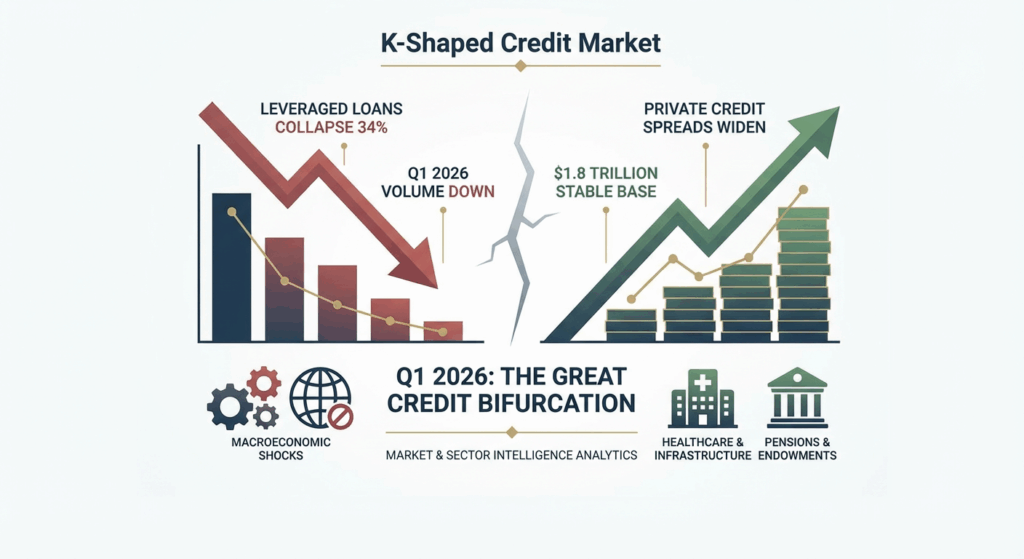
Market Headline: A K-Shaped Credit Market Takes Hold
The first quarter of 2026 has delivered a decisive structural rupture in credit markets. What was once described as a broadly competitive, lender-saturated environment has fractured sharply into two distinct realities: a well-functioning upper tier serving investment-grade and upper-middle-market borrowers, and a deteriorating lower tier where software companies, media issuers, and cyclically exposed credits face a de facto liquidity freeze.
The catalyst for this divergence was a confluence of macroeconomic shocks. Geopolitical instability in the Middle East intensified in January, trade policy volatility rattled corporate planning horizons, and an oil price surge above $120 per barrel in what markets have termed the “March Oil Shock” reignited inflationary pressures, forcing the Federal Reserve to pause its rate-cutting cycle just as many leveraged borrowers had positioned for relief. The result: credit conditions that look stable in the aggregate but are deeply stressed at the margin, according to data from MarketMinute via FinancialContent.
This is not a 2008-style systemic unraveling. Private credit’s institutional investor base (pensions, endowments, sovereign wealth funds) provides structural durability absent in the banking-deposit model of prior crises. However, the repricing of risk at the margin is real, consequential, and accelerating. Operators and investors who read only the headline stability metrics are missing the stress fractures forming beneath the surface.
Quantitative Market Snapshot
The table below synthesizes current key credit market metrics across public and private channels as of Q1 2026:
| Metric | Current Value | Prior Period | Direction | Source |
|---|---|---|---|---|
| Leveraged Loan Primary Volume (Q1 2026) | $235B | $355B (Q1 2025) | ▼ 34% YoY | MarketMinute |
| Private Credit Spreads (Widening from Late-2025 Lows) | +50–100 bps | Near historic tights (late 2025) | ▲ Widening | AInvest |
| Loan Distress Ratio (Trading Below 80 cents) | 7.23% (March 2026) | ~4–5% (Mid-2025 est.) | ▲ 3-Year High | MarketMinute |
| Middle Market Credit Spreads (Q4 2025) | Unchanged QoQ; pricing grids at S+425–S+475+ | OIDs tightening to ~98.75–99.25 | → Stable / Selective | Valuation Research Corp. |
| Leveraged Loan Refinancings (Q1 2026) | Down 42% YoY | Active in 2025 | ▼ Collapsed | MarketMinute |
| Private Credit Market Size (Global) | ~$1.8 Trillion | – | → Stable Base | AInvest |
Sources: MarketMinute/FinancialContent (Apr. 6, 2026); AInvest (Apr. 1, 2026); Valuation Research Corp. (Jan. 23, 2026). Data as of April 7, 2026.
From a KPI underwriting perspective, lenders are tightening fixed charge coverage ratio (FCCR) thresholds and debt-to-equity tolerance in direct proportion to sector risk. Quality-tiered pricing grids (step-downs contingent on leverage milestones (e.g., S+475 stepping to S+450 upon achieving lower debt multiples)) have become standard structure in new middle market originations, per Valuation Research Corp. The message is clear: lenders are not retreating wholesale, but they are repricing operational risk with granular precision.
Sector Analysis: Where Lender Appetite Is Moving, and Where It Isn’t
The credit market’s bifurcation is most visible at the sector level. Three distinct dynamics are at play simultaneously:
🔴 Cold: Enterprise Software & Media. Software companies with meaningful AI disruption exposure are facing the sharpest repricing. Valuations are being reassessed industry-wide, and lenders are demanding materially higher risk premiums or declining participation altogether, according to KKR’s Q1 2026 credit review. Media issuers, already burdened by structural secular headwinds, are largely locked out of primary issuance. For operators in these verticals, debt-to-equity ratios that were acceptable in 2024 are now deal-breakers, and lenders are requiring FCCR coverage well above the legacy 1.2x threshold, with 1.35x–1.5x becoming the new minimum for credit committee approval in stressed sectors.
🟡 Selective: Cyclically Exposed & Tariff-Sensitive Credits. Industrial, manufacturing, and trade-exposed credits are navigating a narrow corridor. Per Valuation Research Corp., these credits are being pushed to the upper band of pricing grids and face additional structuring requirements: tighter maintenance covenants, accelerated amortization schedules, and equity cure limitations. Deals are getting done, but only for issuers who can demonstrate supply chain insulation and demonstrate EBITDA stability across tariff stress scenarios.
🟢 Active: Healthcare, Infrastructure & Upper-Middle Market. Defensive sectors with visible, contracted cash flows continue to attract strong lender competition. Healthcare services, infrastructure-adjacent businesses, and upper-middle-market borrowers with clean balance sheets are still pricing inside historical averages. KKR notes that income continues to compound and defaults remain contained in aggregate, with the broader credit markets entering 2026 in better structural shape than feared, provided sector selection remains disciplined. Public BDCs have emerged as a tactical instrument for institutional investors seeking liquidity optionality while maintaining private credit yield exposure, as highlighted by AInvest.
A structural shift worth monitoring: the collapse in broadly syndicated loan refinancing activity (down 42% and repricings down 39%) is funneling a new cohort of borrowers into the private credit channel. This supply surge into direct lending creates a short-term overhang but also a selective origination opportunity for managers with disciplined underwriting standards and sector conviction.
Implications for Institutional Investors and Operators
For Borrowers: The era of frictionless refinancing is over. Operators relying on opportunistic repricing to manage interest burden should recalibrate their capital structure assumptions immediately. With refinancing volumes down 42% and the Fed’s rate-cut cycle on hold, the floating-rate relief many borrowers anticipated in 2026 has been deferred indefinitely. FCCR headroom should be stress-tested against a prolonged higher-rate environment. Businesses with tariff-exposed supply chains or AI-vulnerable revenue models will need to demonstrate concrete mitigation strategies, not projections, to access credit at competitive rates.
For Lenders and Institutional Investors: Spread widening of 50–100 bps from late-2025 lows represents a genuine repricing opportunity for disciplined allocators, but only with active manager selection. As AInvest notes, performance dispersion across private credit managers is widening materially, making fund selection the primary alpha lever. Skilled underwriters accessing S+550+ deals with structural protections are generating meaningfully better risk-adjusted returns than passive allocators accepting tighter deals on weakening terms. The Blackstone BCRED redemption episode ($3.7 billion in quarterly requests, triggering a 5% gate) serves as a critical reminder that liquidity mismatches within private credit vehicles carry real portfolio management risk.
Public Credit Liquidity Advantage: PIMCO’s April 2026 analysis of corporate bond market liquidity provides an important counterpoint: public credit markets are actually more liquid today than at any point since the GFC, with transaction costs, market depth, and breadth all improving, per PIMCO. Institutional portfolios with liquidity mandates should weigh this structural advantage when calibrating private-to-public credit allocation ratios in the current environment.
Key Market Insights
- Volume Collapse Is a Structural Signal, Not a Blip: A 34% YoY decline in leveraged loan primary issuance, to $235B from $355B, driven by simultaneous macro, geopolitical, and monetary policy headwinds signals a durable reset in risk appetite, not a temporary pause. Plan capital structure strategy accordingly.
- Distress Ratio at 7.23% Demands Triage: The highest distress ratio in three years is concentrated in software and media. Lenders and investors with exposure to these verticals should conduct immediate portfolio triage, differentiating between liquidity-driven distress and fundamental credit deterioration.
- FCCR and Leverage Thresholds Are Tightening in Real Time: Middle market lenders are enforcing stricter FCCR floors and deploying leverage step-down pricing grids. Operators should expect lender scrutiny of coverage ratios to intensify, particularly for businesses with cyclical revenue profiles or input-cost exposure.
- Manager Selection Is Now the Dominant Alpha Factor in Private Credit: As performance dispersion accelerates across a $1.8 trillion market, the gap between top-quartile and median private credit managers will widen significantly. Active oversight of GP relationships and underwriting discipline is no longer optional.
- Liquidity Mismatch Risk in Private Credit Vehicles Is Elevated: The BCRED redemption gate event is a leading indicator, not an outlier. Institutional investors should review gate provisions, NAV valuation methodologies, and liquidity waterfall structures across all semi-liquid private credit allocations before Q2 2026 quarter-end.


