
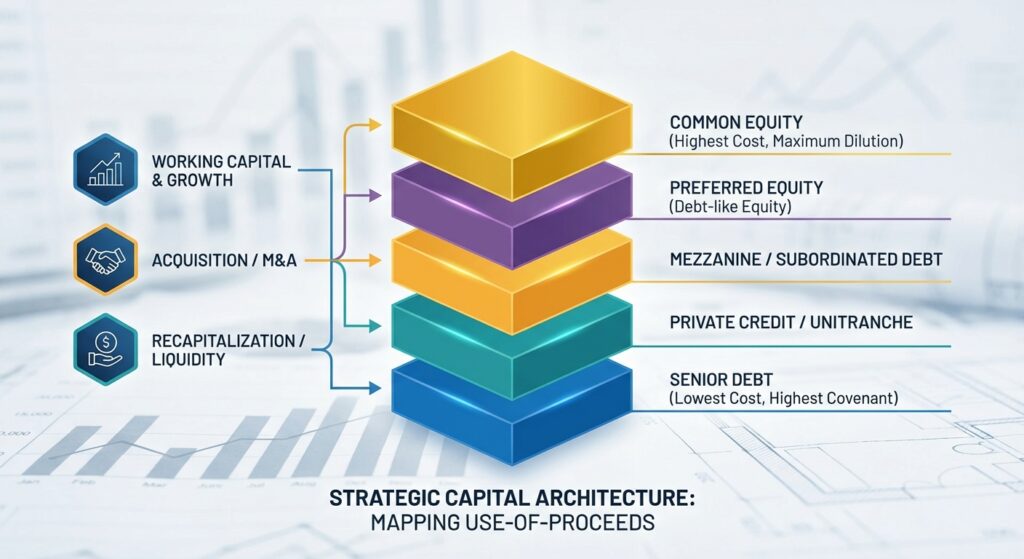
The Inflection Point Nobody Plans For
There is a moment in every company’s trajectory (usually somewhere between $3M and $10M in recurring revenue or stabilized EBITDA) when the original capital structure stops fitting. The seed round is deployed. The revolving line of credit is fully drawn. The business is growing, but the next move requires capital that doesn’t exist in the current stack: a sales team build-out, a tuck-in acquisition, a facility expansion, a management buyout, or simply the working capital runway to execute a contract backlog.
This is the growth-stage capital gap, and it is where most operators make their most consequential financing mistakes. They either reach for equity too early (diluting at the wrong valuation inflection point) or they underestimate how long a debt process takes and run out of runway before the close. The companies that navigate it well treat the capital stack as a strategic architecture, not a single transaction.
This article maps use-of-proceeds to instrument, walks through the cost-of-capital spectrum from senior bank debt to common equity, and provides a tactical playbook for quantifying the gap, preparing the process, and negotiating the structure.
Step 1: Anchor Everything to Use-of-Proceeds
The single most important structuring question is not “how much do we need?”; it is “what is the capital going to do, and how does the business repay or return it?” The answer to that question determines the correct instrument before any lender or investor is contacted.
Here is a practical mapping framework:
| Use of Proceeds | Repayment Source | Preferred Instrument | Cost of Capital Range |
|---|---|---|---|
| Working capital / AR financing | Receivables conversion cycle | Revolving credit / ABL facility | SOFR + 200–350 bps |
| Organic growth (sales, headcount, product) | Incremental recurring revenue | Revenue-based financing / venture debt | 12–18% all-in (RBF); SOFR + 500–700 bps + warrants (venture debt) |
| Acquisition / tuck-in M&A | Combined EBITDA / synergies | Unitranche or senior + mezz split | Unitranche: SOFR + 550–750 bps; Mezz tranche: 12–16% cash/PIK |
| Recapitalization / owner liquidity | Ongoing cash flow / future sale | Preferred equity or subordinated debt | 14–20% preferred dividend or IRR target |
| Succession / management buyout | Business cash flows over 5–7 years | Senior + seller note + equity rollover | Blended cost: 10–16% depending on leverage |
The discipline here is critical: matching a long-duration use-of-proceeds (e.g., a platform acquisition) to a short-duration instrument (e.g., a 12-month bridge line) creates structural mismatch risk. As the alvren.com framework notes, capital stack design should sequence instruments by matching the cost and duration of the capital to the risk profile of the deployment, not by what closes fastest.
Step 2: Map the Cost-of-Capital Spectrum
Once use-of-proceeds is anchored, the operator or CFO should map the full spectrum of available instruments, ordered from lowest to highest cost. This is not just a pricing exercise: each layer of the stack carries governance, covenant, and control implications that compound over time.
Layer 1, Senior Bank Debt (Lowest Cost, Highest Collateral Requirement): Commercial bank revolvers and term loans remain the cheapest source of growth capital for businesses with hard assets, receivables, or predictable contracted revenue. Current pricing for a well-secured senior facility runs in the SOFR + 200–350 bps range, with maintenance covenants on leverage and coverage. The constraint: banks require seasoned cash flows, audited financials, and clean collateral. They are structurally limited in the leverage they will accept, typically 2.5–3.5× senior debt to EBITDA for non-sponsor credits.
Layer 2, Asset-Based Lending (ABL): For businesses with strong receivables, inventory, or equipment, an ABL facility can unlock capital that cash-flow lending undervalues. The borrowing base formula, typically 85% of eligible AR plus 50–65% of eligible inventory, drives availability, not EBITDA. This makes ABL particularly powerful for distribution, manufacturing, and services businesses where traditional leverage ratios understate real asset coverage.
Layer 3, Private Credit / Unitranche: When leverage requirements exceed what banks will provide, typically 4.0–6.0× total debt to EBITDA for sponsor-backed deals, private credit lenders step in with unitranche or first-lien term loans. As of mid-2026, large-cap unitranche pricing has tightened to the SOFR + 450–550 bps range for high-quality credits, while middle-market deals continue to price at SOFR + 550–750 bps. The trade-off: fewer lenders, more restrictive documentation, and incurrence-based covenants that travel with the deal.
Layer 4, Mezzanine / Subordinated Debt: Mezzanine sits below senior secured debt and above equity in the repayment waterfall. It typically carries a blended cash/PIK coupon of 12–16%, often with an equity kicker (warrants or co-investment rights) that provides the lender with upside participation. Mezzanine is most appropriate when: (a) the senior market is fully stretched, (b) the equity gap is too large for a clean equity raise, or (c) the operator wants to defer cash interest via PIK to preserve liquidity during a growth phase.
Layer 5, Preferred Equity: Preferred equity occupies the top of the debt-like capital spectrum. It carries no contractual repayment obligation (unlike debt), but it does carry a dividend, typically 8–14% cumulative, and often includes participation features, conversion rights, or liquidation preference stacks that affect downstream equity economics. Preferred equity is the instrument of choice for recapitalizations, partial liquidity events, and situations where the company cannot service additional debt but wants to avoid full common equity dilution at a cyclical low.
Layer 6, Common Equity (Highest Cost, Maximum Dilution): Venture capital and private equity buyouts represent full equity capital, the most expensive on a dilution-adjusted basis. As the lendity.com analysis illustrates, a 25% equity stake sold at a $8M valuation that later exits at $50M costs the founder $12.5M in realized value, against a venture debt alternative that might cost $3–4M in total interest. Equity is the right tool for high-uncertainty, high-upside bets, not for financing predictable working capital or contracted revenue growth.
Step 3: Quantify the Gap and Build the Financing Brief
Before approaching any capital source, operators must complete what Bond Capital refers to as the Financing Brief: a four-component document that anchors every conversation with lenders or investors:
- The Gap Analysis: What is the specific capital need, expressed in dollars, duration, and deployment timeline? Separate the permanent capital need (the acquisition price, the capex investment) from the working capital overlay (the integration float, the AR build during ramp). Lenders and investors price differently against each.
- The Repayment Waterfall: Model at least three scenarios (base, downside, and stress) showing how the debt or preferred return is serviced under each. This is not for the investor’s benefit; it is to ensure the operator has stress-tested the structure before committing to covenants they cannot meet in a trough year.
- The Leverage Capacity Analysis: Calculate maximum sustainable leverage using trailing twelve-month and forward EBITDA (or ARR for SaaS businesses). The moonshotnx.com institutional framework reinforces this: the capital stack must be designed to survive conversion events, covenant resets, and governance transitions, not just the base case close.
- The Structure Preference Map: Rank instrument options by cost, dilution impact, covenant restrictiveness, and time-to-close. This prevents process drift: the common outcome where an operator starts pursuing bank debt, gets rejected, pivots to mezz, accepts equity-like terms, and ends up with a worse outcome than if they had started with a blended structure from day one.
Step 4: Run the Process, Then Negotiate the Structure
Process sequence matters as much as instrument selection. The cardinal rule: negotiate equity last, not first. Establishing debt capacity, even preliminary term sheets from senior lenders, creates a reference point that disciplines equity pricing conversations. When operators lead with equity, they anchor the valuation conversation before understanding how much of the raise can be debt-financed at a fraction of the dilution cost.
The recommended sequence for a growth-stage raise:
- Soft-circle senior lenders first. Get indicative terms on the secured layer before any equity conversation begins. This establishes the leverage base and tells you exactly how large the equity gap actually is.
- Approach mezzanine or subordinated lenders in parallel with a defined ask. The mezz layer is sized by the gap between senior availability and total capital need, not by what the mezz lender offers to underwrite.
- Bring preferred or common equity to fill the residual gap only. By the time equity investors see the deal, the senior and mezz terms are set, the leverage capacity is documented, and the equity investor is pricing against a defined residual need, not an open-ended round.
Key negotiation points at each layer:
- Senior debt: Push for incurrence-based covenants over maintenance covenants where possible. Maintenance covenants require continuous compliance and create restructuring risk in cyclical businesses. Incurrence covenants only test compliance when the borrower takes an action (e.g., pays a dividend, makes an acquisition). For growth businesses with uneven EBITDA, this distinction is material.
- Mezzanine: Negotiate the PIK/cash split of the coupon based on your projected liquidity. A 12% all-cash coupon on a $10M mezz tranche is $1.2M per year in hard cash. Converting 6% to PIK preserves $600K in annual liquidity at the cost of compounding interest, a worthwhile trade in Years 1–2 of a growth plan if the capital is deployed into revenue-generating assets.
- Preferred equity: Scrutinize the liquidation preference stack and participation mechanics. Non-participating preferred with a 1× liquidation preference is the founder-friendly standard, as noted by the alvren.com structuring framework. Participating preferred, where the investor takes their preference and converts to common, can be extremely dilutive at moderate exit multiples. Model the waterfall at 2×, 3×, and 5× enterprise value before signing.
- Warrants and equity kickers: Venture debt and mezzanine providers frequently require warrant coverage of 5–20% of the loan amount as an equity kicker. Negotiate the strike price (ideally set at or above the last round valuation, not at a discount), the coverage percentage, and whether warrants are net-exercisable to minimize dilution mechanics at exercise.
Key Takeaways
- Use-of-proceeds drives instrument selection. Before approaching any capital source, map what the money does, how it is repaid, and over what time horizon. A mismatch between instrument duration and capital deployment is the most common structural error at the growth stage.
- The cost-of-capital spectrum runs from bank debt to common equity. Each layer carries a different cost, governance burden, and covenant profile. The goal is to fill the capital need at the lowest blended cost, which almost always means maximizing senior debt before touching equity.
- Mezzanine and PIK structures preserve liquidity during growth phases but compound if the business underperforms. Model the PIK accrual at your downside case before accepting a PIK toggle as a covenant accommodation.
- Process sequence disciplines pricing. Establishing senior debt capacity before equity conversations anchors the equity investor’s sizing and prevents over-dilution on a round that could have been partially debt-financed.
- Covenant design is not boilerplate. The choice between maintenance and incurrence covenants, the definition of EBITDA add-backs, and the grower/builder baskets in a credit agreement are negotiating points with real economic consequences, particularly for businesses with uneven cash flow profiles or acquisition strategies.


