
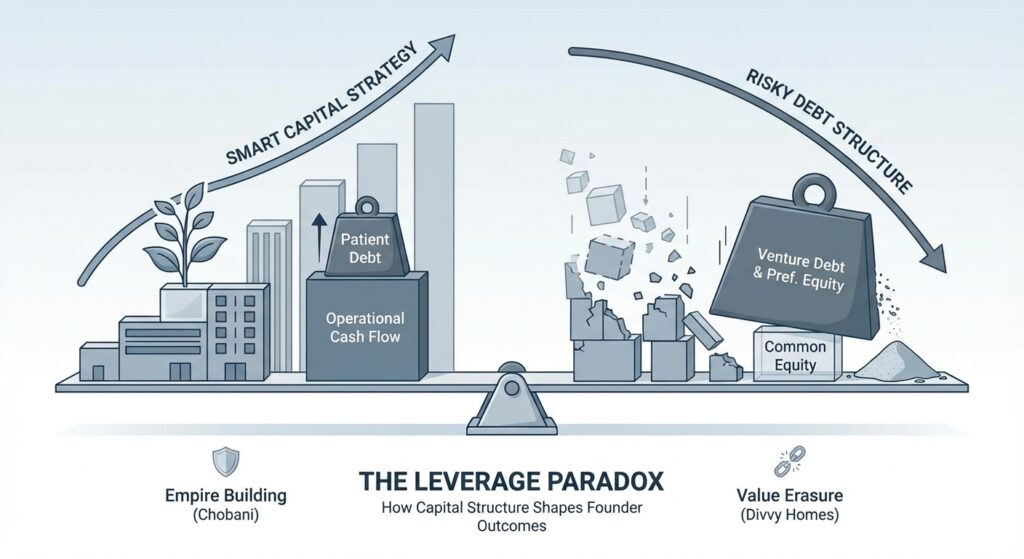
The Story: Two Founders, Two Debt Decisions, Two Completely Different Outcomes
In 2005, a Kurdish immigrant named Hamdi Ulukaya stood inside a shuttered Kraft yogurt plant in upstate New York and saw something most people would have walked away from: opportunity buried in rust and obsolescence. He had no pitch deck, no venture capitalist waiting on the other end of a call, and no cap table to speak of. What he had was a Small Business Administration loan: government-backed debt, and an unshakeable conviction about Greek yogurt.
Fifteen years later, Chobani would be valued at $20 billion, commanding over $3 billion in annual revenue, and Ulukaya would still control the company he built. He never sold his soul to get there.
Now contrast that with Divvy Homes. Founded in 2016, Divvy built a genuinely elegant rent-to-own model that helped over 2,000 families move toward homeownership. By 2021, it had raised more than $400 million in venture equity from blue-chip investors including Andreessen Horowitz and Tiger Global, reaching a peak valuation of $2.3 billion. Then, in October 2021, Divvy layered on approximately $735 million in debt financing: on top of all that preferred equity with its own liquidation preferences.
In January 2025, Brookfield Properties acquired Divvy for roughly $1 billion. After repaying outstanding debt and satisfying liquidation preferences for preferred shareholders, CEO Adena Hefets confirmed in a letter to shareholders that neither common shareholders nor founders would receive a single dollar of proceeds. A billion-dollar exit. Zero for the builders. [saastr.com]
Two companies. Both used debt. One founder built an empire and kept it. The other watched $1 billion evaporate before it ever reached his hands. The difference was not the instrument; it was the architecture.
The Decision: How Each Founder Structured Their Capital
Ulukaya’s genius was not just in the product; it was in the sequencing of capital. He started with an SBA loan: patient, low-cost, non-dilutive. He built Chobani to $750 million in revenue by 2012 without a single dollar of venture capital. The company was genuinely profitable and cash-generative before he ever considered outside money.
When scale demands finally required institutional capital in 2014, Ulukaya turned to TPG Capital for $560 million in debt: structured with warrant coverage rumored at approximately 20% of the company. Critically, he maintained majority control and operational decision-making authority. The warrants gave TPG meaningful upside without stripping Ulukaya of the steering wheel. [creatorsblueprint.co]
The Chobani structure worked because:
- Debt was layered onto a profitable, cash-flowing business, not a pre-revenue concept
- The underlying asset (a consumer brand with dominant market share) was defensible against rate changes
- Ulukaya avoided the VC trap of stacking liquidation preferences above common equity
- Control stayed with the operator, not the capital provider
Divvy’s structure was the mirror image of every mistake available. First came hundreds of millions in venture equity, each round likely carrying 1x to 2x liquidation preferences that sat above common stock in any exit waterfall. Then came $735 million in senior debt, which by definition sits above everything. When Brookfield paid $1 billion, the math was inescapable: debt got paid first, preferred shareholders with seniority got paid second, and the common equity (held by founders and employees) got nothing.
The debt itself was not inherently wrong. The fatal flaw was deploying nearly $735 million in fixed-obligation financing into an asset class (residential real estate) that depended entirely on low interest rates. When the Federal Reserve began its aggressive hiking cycle in 2022, Divvy’s model broke structurally. Three rounds of layoffs followed. New home acquisitions paused entirely by 2023.
The Outcome: What the Numbers Actually Say
The counterfactual for Chobani is instructive. Had Ulukaya raised $100 million in venture capital in 2007 at what would have been a modest valuation (say, $200 million post-money) he would likely have owned 40 to 50% of the company after dilution. By the time Chobani hit its $20 billion valuation in 2021, that early VC would have been diluted further through subsequent rounds, but Ulukaya’s stake would still have been meaningfully reduced. Instead, by maintaining debt-based financing and avoiding early dilution, he retained a controlling stake in a $20 billion asset.
For Divvy, the counterfactual is even starker. Had the company raised less debt (or structured it as convertible equity with no hard repayment trigger) the $1 billion Brookfield paid would have flowed through to equity holders. Even a modest common equity recovery of 10 to 15 cents on the dollar would have meant $100 to $150 million for founders and employees who spent years building the company.
The lesson is not that debt destroys value. It is that debt deployed into rate-sensitive, capital-intensive asset models without equity-cushion architecture destroys founders.
The Lessons: A Framework for Founders Facing the Same Choice
The stories of Chobani and Divvy Homes bracket the full spectrum of what non-dilutive capital can do, and what it can undo. Founders and operators facing a capital decision today should interrogate three core questions before signing any term sheet:
1. Is the underlying business cash-flow positive or on a clear, short path to it?
Debt works when a business generates reliable cash to service it. Ulukaya’s yogurt company was operationally profitable before he borrowed at scale. Divvy was structurally dependent on external financing and a static rate environment. Debt does not fix a model; it amplifies whatever is already there.
2. What sits above you in the capital stack?
Every layer of preferred equity you accept is a tax on your eventual exit. When debt is added on top of that, founders get mathematically squeezed out of their own success. Understand your liquidation waterfall before you add the next instrument, not after.
3. Does your debt have a hard repayment trigger tied to macro conditions outside your control?
Divvy’s debt was vulnerable to interest rate movements it could not control and could not hedge at scale. Chobani’s debt was tied to operational performance in a category it dominated. The best debt structures are ones where the repayment mechanism is driven by your business engine, not by the Federal Reserve.
Smaller operators are validating this framework in real time. Founders like Simon Turner of retail SaaS company Myagi used a $2.5 million non-dilutive debt facility from TIMIA Capital to grow revenue and market position, ultimately exiting by acquisition to Rallyware without giving away equity prematurely. [timiacapital.com] The same pattern held for SafePointe, a hardware-enabled AI security company, whose father-son founders used a $1 million debt facility to triple monthly recurring revenue before being acquired by Nasdaq-listed SoundThinking, their fourth successful exit using non-dilutive capital as the primary growth instrument. [timiacapital.com]
The pattern across all three winning examples (Chobani, Myagi, SafePointe) is identical: debt used as a precision tool by profitable operators, not as a substitute for a business model that doesn’t yet work.
Key Insights
- Non-dilutive capital preserves ownership, but only when the business can service the obligation. Ulukaya built a $20B empire by keeping debt proportional to cash flow and avoiding VC dilution from day one.
- Stacking debt on top of liquidation-preference-heavy venture equity is a founder trap. Divvy’s founders earned $0 from a $1 billion exit because the capital structure consumed the entire proceeds before common equity was reached.
- Macro sensitivity is a debt risk that equity does not carry. Divvy’s $735 million debt load was viable at 2021 interest rates and catastrophic at 2023 rates. Founders must stress-test debt against the macro scenarios they cannot control.
- The best debt structures align repayment with business performance, not market conditions. Revenue-based facilities, warrant-covered growth loans, and SBA-backed debt all tie obligations to operational outcomes, giving founders room to maneuver.
- Serial entrepreneurs consistently choose non-dilutive capital to maximize exit value. The Holifields at SafePointe used debt as a growth accelerant across four consecutive exits, not because equity was unavailable, but because they understood which instrument protected founder economics at the moment of acquisition.


