
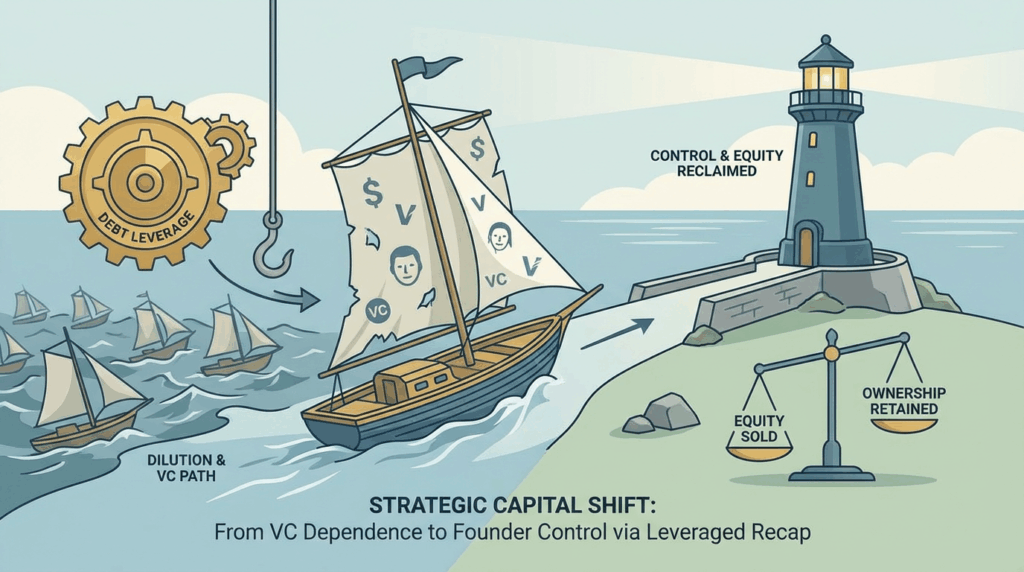
The Story: A Founder Who Decided to Buy Back His Own Company
In early 2020, Francis Pedraza was quietly running out of road. His company, Invisible Technologies, had spent four-plus years trying to convince Silicon Valley that a hybrid AI-and-human services business was worth backing. Most VCs had passed. Services businesses were unglamorous, hard to scale, and low on the valuation multiples that VC fund math demands. Invisible had lost four cofounders, gone back to angel investors for bridge capital, and scraped along on a skeleton runway.
Then DoorDash called. The pandemic had detonated demand for food delivery, and DoorDash needed someone to handle the painstaking, semi-automated work of importing thousands of restaurant menus at speed. Invisible stepped in. Two years later, OpenAI came knocking, then Amazon, then Microsoft, then a string of AI unicorns needing human-in-the-loop data labeling and workflow automation. Revenue exploded from $3 million in 2020 to $134 million by 2024, with $15 million in EBITDA.
By any measure, Pedraza had built something real. But he’d built it with venture money, roughly $23 million raised from Day One, Greycroft, and Backed, and those investors held meaningful equity stakes in a company that was now, quietly, a cash-generating machine. The question became: what happens next?
In the AI boom of 2024–2025, the answer most founders would have chosen was obvious: raise a monster round, chase the $14 billion valuation that Scale AI had commanded, and let the VC flywheel spin. Pedraza chose the opposite. He decided to buy his investors out: using debt.
The Decision: Leverage Over Dilution
The capital decision Pedraza faced is one that every successful founder eventually confronts, though few frame it this way: Do I keep selling equity to fund the next chapter, or do I use the company’s own cash flows to reclaim the equity I’ve already given away?
The venture equity path would have been straightforward. Invisible’s revenue trajectory and AI tailwinds made it an attractive late-stage raise candidate. A Series B or C at a premium multiple would have given Pedraza fresh capital, and further diluted his ownership at a moment when the company was finally printing real profits.
Instead, Pedraza structured what is effectively a leveraged recapitalization: borrowing against the company’s balance sheet and cash flows to buy out existing VC shareholders. The result is that Invisible Technologies is actively reducing its outside equity base rather than expanding it: a move almost unheard of in venture-backed circles, where the implicit contract is always grow-and-raise, grow-and-raise.
The logic is clean once you see it. With $134 million in revenue and $15 million in EBITDA, Invisible had the debt service capacity to support a meaningful credit facility. The cost of that debt, even at prevailing private credit rates in the 10–13% range, is almost certainly lower than the effective cost of selling equity at a discount to intrinsic value or surrendering future upside to new investors. As Pedraza put it directly: “We could not be more different”, a pointed contrast to Scale AI’s billion-dollar raise at a $14 billion valuation and the equity dilution that came with it. His logic: why sell a share of a profitable, growing company when you can borrow against its earnings instead? As reported by forbes.com.au, Pedraza is deliberately plotting a path of share buybacks and debt, not new VC rounds.
The Outcome: What Equity Preservation Actually Looks Like
The counterfactual here is instructive. Consider what a traditional venture path would have meant for Pedraza. If Invisible had raised a $100 million Series C at a $700 million valuation, a conservative scenario given AI market comparables, new investors would have taken roughly 14% of the company. Existing investors would have been diluted further. Pedraza’s own stake, already reduced through prior rounds, would have shrunk again.
By instead using debt to repurchase VC shares, every percentage point of equity bought back flows directly to the founder and remaining aligned stakeholders. On a $500 million enterprise value (a reasonable estimate for a profitable, high-growth AI services company with $134 million in revenue) even a 5% swing in ownership is worth $25 million in exit proceeds. A 10% swing is worth $50 million. The math compounds significantly at exit.
The contrast with Divvy Homes makes the point even more sharply. Divvy raised over $400 million in venture equity and then layered on approximately $735 million in debt to fund home acquisitions. When rising interest rates in 2022 destroyed the unit economics of their rent-to-own model, the debt didn’t forgive them; it devoured them. Brookfield acquired Divvy for roughly $1 billion in early 2025, but after repaying debt and satisfying preferred equity liquidation preferences, founders and common shareholders received nothing. A billion-dollar outcome. Zero for the builders.
The difference is not that Pedraza used debt and Divvy used debt. The difference is what the debt was used for and whether the underlying business could actually service it. Invisible’s debt is collateralized by profitable, recurring revenue from blue-chip AI clients. Divvy’s debt was collateralized by homes in a rising-rate environment with a model whose entire margin depended on cheap money.
The Lessons: A Framework for the Recapitalization Decision
Invisible Technologies’ story isn’t a template for everyone, but it crystallizes a set of principles that any founder, family business owner, or operator should internalize before their next capital conversation.
1. Debt to reclaim equity is not the same as debt to fund losses. The Divvy Homes cautionary tale is about using leverage to prop up a capital-intensive model that was rate-sensitive and margin-thin. Invisible’s leverage is used to buy back equity in a profitable, cash-generating business. These are fundamentally different risk profiles wearing the same financial label.
2. EBITDA coverage is the floor, not the ceiling, of leverage decisions. A company with $15 million in EBITDA can comfortably service $30–45 million in debt at a 2–3x coverage ratio, without endangering operations. If your debt load exceeds what your operating cash flow can cover in a realistic stress scenario, you’re not using leverage strategically. You’re gambling.
3. The cost of equity is invisible but real. Founders consistently underestimate the true cost of issuing equity because it doesn’t appear on the income statement. Debt service does, which makes founders more disciplined about it. A VC’s equity stake that converts at a 3–4x effective cost of capital is vastly more expensive than a 12% private credit facility in most exit scenarios.
4. Know what you’re optimizing for. Scale AI optimized for valuation and market dominance. Invisible Technologies is optimizing for founder control and long-term ownership economics. Neither is wrong, but they are incompatible, and most founders never force themselves to choose explicitly.
The SafePointe case offers one more data point: a bootstrapped, father-son hardware-software company that took a $1 million non-dilutive debt facility from TIMIA Capital in 2022, tripled its monthly recurring revenue, and sold to Nasdaq-listed SoundThinking less than a year later, delivering meaningful founder proceeds precisely because equity had not been given away. Small company, same principle.
Key Insights
- A leveraged recapitalization to buy out VC investors is a legitimate and underused tool for profitable, cash-flowing companies, Invisible Technologies’ story shows it can work at meaningful scale in a hot market.
- The true cost of equity only becomes visible at exit. Liquidation preferences, anti-dilution provisions, and VC ownership stakes routinely consume the bulk of proceeds before founders and employees see a dollar, Divvy Homes’ $1 billion sale with zero founder proceeds is a stark example.
- Debt is not inherently dangerous, misapplied debt is. The variable that matters is whether operating cash flow can service the debt in a realistic downside scenario, not whether the company uses debt at all.
- EBITDA-backed leverage to repurchase equity converts future dilution into a fixed, manageable cost. At a 2–3x debt-to-EBITDA ratio, a profitable business can buy back meaningful equity without threatening operations, and the ownership recaptured compounds at exit.
- The decision to stop raising VC is itself a strategic capital decision: one that more founders with profitable, recurring-revenue businesses should be making explicitly rather than defaulting to the raise-and-dilute cycle out of inertia or social pressure.


