
The Underwriting Question Every Private Credit Lender Must Answer
Imagine you are evaluating a $10 million EBITDA specialty manufacturing company seeking a $45 million senior secured term loan, 4.5x leverage at close. The sponsor presents three years of adjusted EBITDA showing steady growth, a customer concentration below 30%, and a fixed charge coverage ratio (FCCR) of 1.8x. On paper, the credit looks serviceable. But what happens if revenue contracts 15% in year two, a plausible scenario in a rate-sensitive industrial cycle? Does the capital structure survive? Does the borrower breach its maintenance covenant? Does your lender position remain money-good?
These are not hypothetical anxieties. The private credit market, now a $1.67 trillion asset class projected to reach $2.9 trillion by 2030: is simultaneously facing a surge in structural weakness: covenant-lite structures, opaque leverage, and a dramatic rise in retroactive Payment-In-Kind (PIK) conversions. According to ainvest.com, the share of “bad PIKs” (retroactive conversions of cash interest to PIK, a signal of borrower underperformance) surged from 36.7% in Q4 2021 to 57.2% by Q3 2025. This is not a market where base-case underwriting is sufficient. Stress testing cash flows is not optional; it is the discipline that separates recoverable credits from permanent capital impairment.
The Analytical Framework: Building From Cash Flow Up
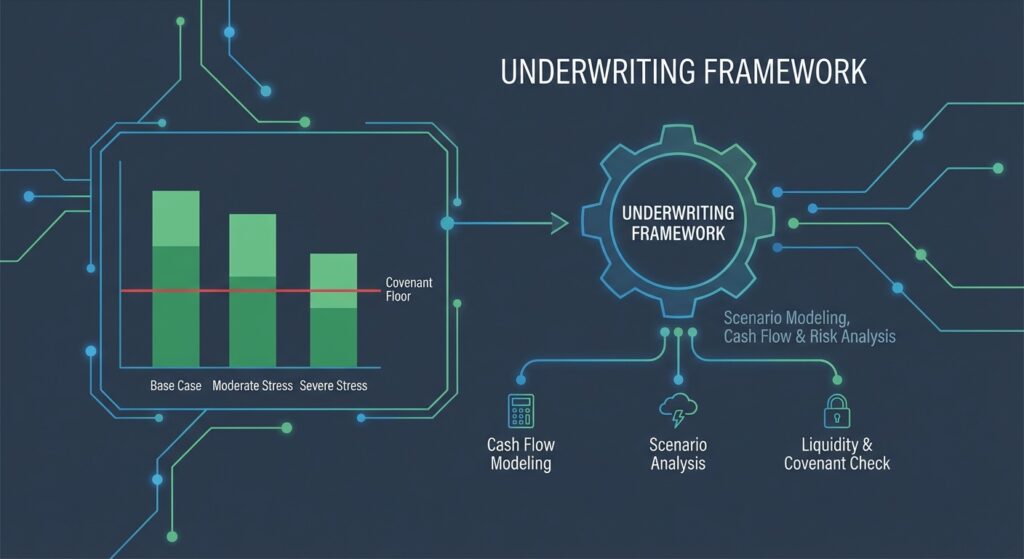
Stress testing is not simply applying a haircut to EBITDA and checking whether a ratio holds. A rigorous framework operates in three layers: (1) base case construction, (2) scenario modeling, and (3) covenant headroom and liquidity survivability analysis. Each layer must be grounded in company-specific data, industry cycle history, and structural positioning within the capital stack.
The Basel Committee’s updated 2025 Principles for the Management of Credit Risk reinforces that sound credit-granting processes require lenders to assess repayment capacity under both normal and stressed conditions, not just at origination, but continuously throughout the loan lifecycle. For private credit lenders, this means cash flow stress testing must be built into both the initial underwriting model and ongoing portfolio monitoring.
Key Metrics to Anchor the Analysis
- Total Leverage (Debt/EBITDA): Current market norms for middle market senior secured loans range from 4.0x to 5.0x EBITDA, down from 6.0x+ during the low-rate era, per ibinterviewquestions.com. Anything above 5.0x in a cyclical sector warrants a stress overlay before approval.
- Interest Coverage Ratio (EBITDA / Interest Expense): A minimum of 2.0x on a cash pay basis is the institutional floor; below 1.5x triggers watch-list consideration.
- Fixed Charge Coverage Ratio (FCCR): Measures EBITDA less capex and taxes against all fixed obligations including debt service. Lenders typically covenant a minimum of 1.10x to 1.25x.
- Debt Service Coverage Ratio (DSCR): Critical for amortizing structures. A DSCR below 1.0x means the business cannot service principal from operating cash flow, a hard underwriting threshold.
- Free Cash Flow Conversion: EBITDA-to-FCF conversion below 50% (common in capex-intensive or working capital-heavy businesses) meaningfully constrains real debt capacity versus headline leverage multiples.
Walking Through the Stress Test: A $10M EBITDA Manufacturing Example
Return to our manufacturing borrower: $10M EBITDA, $45M senior secured term loan (4.5x), $4.5M annual cash interest (10% rate), $1.5M mandatory amortization, $1.2M maintenance capex. Base case FCCR = ($10M EBITDA − $1.2M capex) ÷ ($4.5M interest + $1.5M amortization) = 1.47x. The maintenance covenant is set at 1.10x with 10% headroom.
Scenario A, Moderate Stress: 15% Revenue Decline
Assuming 60% variable cost structure, a 15% revenue decline translates to roughly a 25% EBITDA reduction (due to operating leverage). Stressed EBITDA = $7.5M. Stressed FCCR = ($7.5M − $1.2M) ÷ $6.0M = 1.05x. This is below the 1.10x covenant floor, a technical default event in year two. Leverage balloons to 6.0x on trailing EBITDA.
Scenario B, Severe Stress: 25% Revenue Decline
Stressed EBITDA = $6.25M. FCCR = ($6.25M − $1.2M) ÷ $6.0M = 0.84x. The borrower cannot service debt from operations. Liquidity runway depends entirely on revolver availability and cash on hand. At this point, PIK conversion risk materializes, consistent with the market-wide deterioration documented in private credit portfolios entering 2026.
What the Stress Test Reveals
The base case FCCR of 1.47x appears comfortable, but even a moderate cyclical downturn cracks the covenant floor. This is precisely the analytical gap that separates disciplined underwriting from headline-metric lending. The stress test also highlights that covenant headroom of only 10% is insufficient for a cyclical industrial business, institutional lenders in senior secured positions typically require 20–25% headroom in the base case for operationally sensitive sectors.
What Institutional Lenders Require: Standards and Red Flags
The private credit market’s best performers, including the senior secured strategies tracked by Cliffwater’s Direct Lending Index, have historically posted loss rates of approximately 0.4% net annually, compared to 1.1% for broadly syndicated leveraged loans, according to ainvest.com. That outperformance is not accidental; it reflects stricter underwriting discipline, tighter covenants, and more active monitoring. Here is what experienced lenders embed in their process:
Red Flags That Demand Deeper Stress Testing
- Sponsor-adjusted EBITDA addbacks exceeding 20% of reported EBITDA: indicates aggressive normalization that may not materialize under stress.
- Revenue concentration above 25% in a single customer: a single contract loss can trigger immediate covenant breach in a stressed environment.
- Covenant-lite or incurrence-only structures: remove the lender’s early warning system and accelerate the path from underperformance to default without intervention rights.
- Retroactive PIK elections: as noted by Lincoln International and cited by ainvest.com, retroactive PIK conversions are a leading indicator of borrower liquidity stress, not a benign structuring tool.
- FCF conversion below 40% in a high-capex business, headline EBITDA overstates real debt service capacity.
📊 Data Box: Private Credit Risk Benchmarks (2025–2026)
- Bad PIK share of private credit portfolios: 57.2% as of Q3 2025 (up from 36.7% in Q4 2021)
- Private credit net loss rate: ~0.4% annually for senior secured strategies (vs. 1.1% for leveraged loans)
- Current LBO senior leverage ceiling: 4.0x–5.0x EBITDA in most middle market transactions
- Private credit AUM: $1.67 trillion in 2025, projected at $2.9 trillion by 2030 (11.62% CAGR)
- Institutional FCCR covenant floor: 1.10x–1.25x with 20–25% headroom in base case
Underwriting Checklist: Stress Testing Cash Flows
Use this diligence framework before any credit approval for middle market senior secured or unitranche positions:
- Build a clean, unlevered FCF model: Start from audited financials, strip sponsor addbacks, and reconcile EBITDA to operating cash flow over a minimum three-year period.
- Identify the three largest EBITDA risk drivers: Volume sensitivity, pricing power, and input cost exposure. Quantify the EBITDA impact of a 10%, 20%, and 30% adverse move in each.
- Run at least two stress scenarios: A moderate case (15–20% EBITDA decline) and a severe case (30–40% decline). Both must test covenant compliance and liquidity runway.
- Calculate covenant headroom in each scenario: Map the distance between stressed FCCR/leverage and the covenant trigger. Flag any scenario where headroom falls below 15%.
- Assess revolver availability and cash runway: If base cash plus revolver availability covers less than 12 months of debt service in the severe scenario, require structural protections (cash sweep, springing covenant, equity cure rights).
- Document all assumptions explicitly: Every stress scenario must include a written assumption log. Undocumented assumptions are audit and litigation risks.
- Require management responses to the downside: What cost actions can management take in a 20% revenue decline? Quantify timing and magnitude of operational levers.
Key Takeaways for Credit Underwriters
- ✅ Base-case EBITDA is a starting point, not an underwriting conclusion: always stress the number before sizing a debt structure.
- ✅ Covenant headroom of 10% is structurally insufficient for cyclical industries; institutional best practice demands 20–25% buffer in the base case.
- ✅ Rising PIK conversions are a portfolio-wide early warning signal: retroactive PIK elections at 57.2% of private credit portfolios signal that cash flow stress is already present across the asset class entering 2026.
- ✅ FCF conversion discipline matters as much as EBITDA: a borrower with $10M EBITDA and 40% FCF conversion has less than half the real debt capacity of a business with 80% conversion at the same leverage multiple.
- ✅ Stress testing is a continuous obligation, not a closing-day exercise: the Basel Committee’s updated 2025 credit risk principles explicitly require ongoing assessment of repayment capacity under adverse conditions throughout the loan lifecycle.


