
The Growth-Stage Capital Challenge: You Have Proof, But Not Scale
A business generating $8M in annual recurring revenue with 75% gross margins and a 110% net revenue retention rate has already won the hardest battle in business: product-market fit. But it now faces a different, structurally harder problem. To double revenue, it needs $6M: for three enterprise sales hires, a channel partnership budget, and six months of extended payment terms to land larger logos. A Series A at a punishing dilution multiple feels excessive for a capital need this defined. A bank line of credit requires collateral the business doesn’t carry. This is the growth-stage gap, and it is where capital stack architecture either creates or destroys long-term enterprise value.
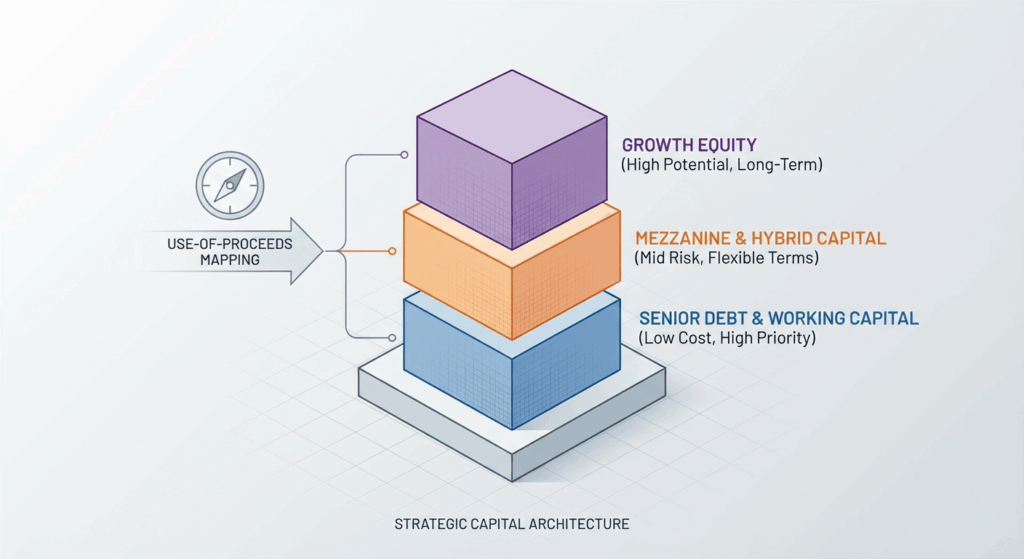
Understanding the gap starts with a simple principle: the right instrument is determined by the use-of-proceeds first, the business’s cash flow profile second, and the cost of capital third, in that order. Founders and operators who reverse this sequence almost always either overpay for capital or accept structural constraints that impair future raises. As the team at capitalxo.com frames it, a capital stack determines three things simultaneously: the aggregate cost of capital, how much operational control you retain, and how much flexibility you preserve to adjust financing as conditions change.
The Capital Stack Spectrum: Mapping Cost to Risk Position
Every layer in the capital stack carries a different risk profile, a different claim priority, and a different price. For a growth-stage operator, the spectrum looks like this, from cheapest to most expensive:
- Senior Bank Debt / Revolving Credit Facilities: Cheapest cost of capital (typically SOFR + 200–350 bps for creditworthy borrowers), but requires hard collateral, EBITDA covenants, and demonstrated free cash flow. Suitable for working capital cycling, inventory finance, or AR-backed facilities. Maintenance covenants, tested quarterly, are standard and unforgiving at this tier.
- Asset-Based Lending (ABL): Availability tied directly to eligible receivables and inventory. Particularly powerful for product businesses with lumpy cash conversion cycles. Advance rates on eligible AR typically run 80–85%; inventory 50–65%. The borrowing base certificate becomes the operating rhythm of the facility.
- Private Credit / Unitranche: The dominant mid-market instrument of the current cycle. A single lender (or club) provides what used to require a senior/mezz split: one blended rate, one set of docs, one agent. For a $50M unitranche on a $100M enterprise value software business, current market pricing lands in the SOFR + 550–650 bps range, with 1% origination fees and a six-year term. The borrower gets certainty, speed, and covenant flexibility (often incurrence-only above a specific leverage threshold). The lender gets a first-lien, all-in yield in the 10–12% range. This is the instrument of choice when a business needs acquisition capital or a full recap without the execution complexity of a bifurcated structure.
- Mezzanine / Subordinated Debt: Sits behind senior claims, prices accordingly: typically in the 13–18% all-in range, often structured as a combination of current cash pay interest and PIK (payment-in-kind) toggle, plus warrant coverage of 1–3% of fully diluted equity. PIK preserves cash at the cost of compounding the obligation. Warrants give the mezzanine provider equity upside without taking a direct equity position. This layer is optimal when the senior facility is fully committed and the business needs incremental capital for a defined-duration initiative (an acquisition bridge, a facility buildout, or a product line launch) where cash generation will service or retire the mezz within 36–60 months.
- Preferred Equity: No mandatory cash pay; liquidation preference sits above common but below all debt. Used in growth situations where cash flow does not yet support debt service but the business does not want to reprice common equity. Cumulative preferred dividends (8–12% typical) accrue and are settled at exit or conversion. Preferred is the right instrument when the proceeds fund market expansion with a 4–7 year horizon and no near-term monetization event.
- Common Equity / Venture: Most expensive in dilution terms, least restrictive in covenant terms. As angelinvestorsnetwork.com notes, a founder raising $5M at a $15M pre-money valuation surrenders 25% of the company: capital that, at a $50M exit, costs $12.5M in forgone proceeds versus debt costing a fraction of that in total interest. Common equity is appropriate for early discovery capital and for late-stage public markets, but is often the most expensive choice for a well-defined, medium-duration growth initiative.
Use-of-Proceeds Mapping: The Framework That Drives Structure
Before a single term sheet is negotiated, the use-of-proceeds dictates the instrument. The mapping is mechanical:
- Working Capital: Revolving credit facility, ABL, or revenue-based financing. The duration of the need matches the duration of the instrument, short-term cycling does not belong in a five-year term loan.
- Organic Growth Investment (hiring, S&M spend, product): Venture debt, growth credit, or revenue-based financing, instruments that repay from the incremental revenue generated by the spend itself. As alvren.com advises, founders should match capital to risk: use equity for discovery, debt for repeatable cash flows, and hybrids for bridges.
- Acquisitions: Unitranche or senior/mezz split, sized to the combined entity’s pro forma leverage capacity. Lenders underwrite to 4.0–5.5x total debt / EBITDA for quality middle-market businesses in the current environment. SOFR-based floating rate structures dominate; fixed-rate mezz provides a partial hedge.
- Recapitalization / Dividend: Requires a mature cash flow profile. Maintenance covenants become negotiating leverage, borrowers with consistent EBITDA growth can push for covenant-lite or incurrence-only packages. First-lien leverage in the 3.5–4.5x range is financeable; total leverage up to 5.5x with a mezz layer.
- Ownership Transition / Succession: Management buyout structures, seller notes, and earnout provisions layered beneath institutional debt. The seller note sits subordinate to senior and mezz debt, effectively acting as quasi-equity in the cap stack. Pricing on seller notes is negotiated (often 5–8% current pay) and terms are flexible, making them a powerful tool for bridging valuation gaps.
The Gap Capital Playbook: Quantify, Prepare, Run, Negotiate
Step 1: Quantify the Gap with Precision
The gap is not the amount you want; it is the difference between your current financing capacity and your fully funded capital requirement. Build the model from the bottom up: what specific initiative requires how much capital, over what deployment timeline, with what projected return on that capital? Lenders underwrite to EBITDA coverage and leverage multiples; equity investors underwrite to IRR. Know both before you approach either. A clear use-of-proceeds memo, tied to a 24-month cash model with downside scenarios, is the first deliverable.
Step 2: Prepare the Data Room
Clean financials (three years of actuals, current year budget, 24-month projection), a capitalization table with all existing obligations, a debt schedule showing current covenants and headroom, and a concise investment thesis for the raise. Any existing liens, covenant waivers, or side letters must be disclosed upfront, hidden obligations are the most common deal-killer in mid-process diligence.
Step 3: Run a Parallel Process
Approach bank lenders, private credit funds, and mezzanine providers simultaneously, not sequentially. The competitive dynamic between a bank proposing a covenant-heavy revolving credit facility and a private credit fund offering a flexible unitranche is your most effective negotiating leverage. As alvren.com recommends: soft-circle your most flexible capital source first to anchor the process, then let competitive tension compress pricing and loosen structure on the more restrictive bids.
Step 4: Negotiate the Structure, Not Just the Rate
Sophisticated borrowers negotiate four things beyond the headline rate:
- Covenant package: Push from maintenance (quarterly tested, hard limits) to incurrence (only tested when you take an action). This single change materially improves operational flexibility.
- PIK optionality: In mezzanine structures, negotiate a PIK toggle, the right to elect PIK in cash-constrained periods without triggering default. This preserves liquidity without violating terms.
- Prepayment penalty step-down: Standard call protection runs 2-1-0 (2% in year one, 1% in year two, none thereafter). Push for 1-0.5-0 on competitive processes.
- Accordion / incremental facility: Negotiate the right to upsize the facility by a defined amount (often $10–20M or 0.5x EBITDA) without full syndication, critical if an acquisition opportunity emerges mid-hold.
Key Takeaways
- Use-of-proceeds drives instrument selection: working capital belongs in a revolver, acquisitions belong in a term loan or unitranche, and discovery-stage growth belongs in equity or hybrid capital.
- The unitranche has structurally replaced the senior/mezz split for most middle-market transactions under $150M: one set of docs, blended pricing, and faster execution with incurrence-based covenant packages now standard.
- PIK toggle and accordion provisions are negotiating currency: borrowers who understand their value extract meaningfully better structural terms than those who focus exclusively on rate.
- A parallel process across banks, private credit, and mezz providers is the single most effective lever for compressing pricing and improving covenant flexibility simultaneously.
- The capital stack is architecture: each layer must be sized, priced, and sequenced relative to the others, or the aggregate cost of capital and operational constraints will compound into a structural disadvantage over the hold period.


