
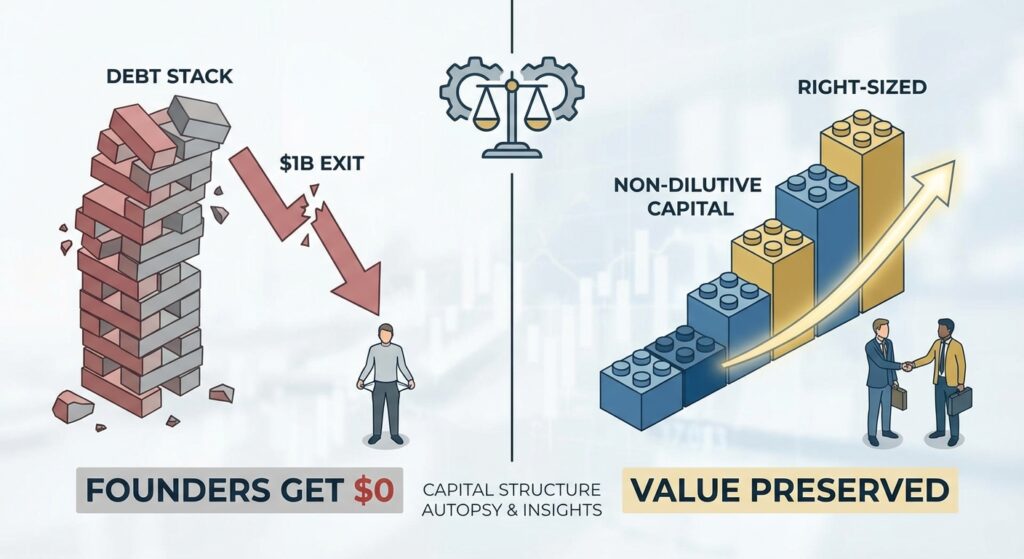
The Story: A Billion-Dollar Exit, Zero Dollars for the Builders
In January 2025, Brookfield Properties acquired Divvy Homes for approximately $1 billion. On paper, that sounds like a triumph, a unicorn-era startup landing a nine-figure exit with a name-brand buyer. In practice, it was one of the most instructive capital structure autopsies of the decade. The founders received nothing. The employees received nothing. Even most of the venture investors (firms like a16z and Tiger Global) walked away empty-handed.
Divvy Homes was a rent-to-own platform founded in 2016. The model was elegant in its social purpose: Divvy would purchase a home on behalf of a prospective buyer, rent it back to them, and reserve a portion of each monthly payment toward a future down payment. After three years, the renter could buy the home outright. The company raised more than $400 million in venture equity over its lifetime, reaching a peak valuation of $2.3 billion following a $200 million Series D led by Tiger Global in 2021.
Then came the fateful debt raise. In October 2021, at the peak of the low-rate environment, Divvy took on approximately $735 million in debt financing to fund its home-buying operations. The logic was sound in context: cheap debt to acquire hard assets generating rental income. But when interest rates surged in 2022, the model snapped. Three rounds of layoffs followed. By 2023, Divvy had paused new home acquisitions entirely. The rest was silence, and a $1 billion sale where, as CEO Adena Hefets described in a letter to shareholders, after repaying outstanding debt, covering transaction costs, and satisfying liquidation preferences for preferred shareholders, common shareholders and founders received zero proceeds.
As saastr.com framed it bluntly: “This isn’t just a failure story. This is a capital structure story.”
The Decision: Stacking Debt on Top of Liquidation Preferences
The capital architecture at Divvy illustrates a compounding problem that founders in capital-intensive businesses must understand before they sign a single term sheet. At the moment of the 2021 debt raise, Divvy already carried hundreds of millions in preferred equity, each round carrying its own liquidation preference, meaning preferred shareholders get paid first in any exit before common equity sees a dollar.
Then the $735 million in debt was layered on top. In a simplified waterfall, this is what that structure demanded upon exit:
- Debt repayment: $735M+ in outstanding obligations, with accrued interest
- Transaction costs: Legal, advisory, and closing fees
- Preferred equity liquidation preferences: $400M+ in preferred shares with their own priority claims
- Common equity (founders, employees, common shareholders): Whatever remains, in this case, nothing
The $1 billion sale price was not large enough to clear the debt and preferred stack simultaneously. This is the hidden danger that many founders never model: debt and liquidation preferences are additive liabilities, and they do not compress when the exit multiple compresses. The equity cushion (built by years of founder labor, employee effort, and investor conviction) was the first casualty of a rising rate environment that Divvy’s debt structure was never designed to survive.
The choice to use $735 million in debt financing was not irrational at the moment it was made. Cheap debt funding hard assets is a legitimate playbook. The catastrophic error was in sizing, taking on debt that represented nearly 1.8x the eventual exit value, with no rate-risk hedging, in a business whose unit economics were directly tied to the cost of capital.
The Outcome: What Non-Dilutive Capital Done Right Actually Looks Like
The Divvy story becomes even sharper when placed alongside a counter-example of disciplined non-dilutive financing. SafePointe, a Florida-based AI-driven weapons detection company founded by father-and-son duo Greg and Timothy Holifield, engaged TIMIA Capital in September 2022 for a $1 million USD venture debt facility: a fraction of what Divvy raised, and sized precisely to the milestone it needed to reach. Within 12 months, SafePointe tripled its monthly recurring revenue and was acquired by Nasdaq-listed SoundThinking, Inc. (SSTI), a public safety technology firm. Founders walked away with value intact. As reported by timiacapital.com, this was the Holifields’ fourth successful exit, each built on a deliberate strategy of non-dilutive capital to maximize founder value rather than inflate paper valuations.
The contrast is instructive:
- Divvy Homes: $735M in debt + $400M+ in preferred equity → $1B exit → $0 for founders
- SafePointe: $1M in venture debt, right-sized to milestone → 3x MRR growth → strategic acquisition → founder value preserved
The lesson is not that debt is dangerous. The lesson is that debt sized beyond the business’s ability to service it through a full rate cycle, and stacked beneath equity structures that compound the liquidation waterfall, is the true risk. SafePointe used debt as a precision instrument. Divvy used it as a flood.
The Lessons: A Framework for Founders Facing the Debt-vs-Equity Decision
These two stories compress into a framework that any operator, family business owner, or founder can apply before their next capital decision:
1. Model the full waterfall before you sign
Every dollar of debt and every dollar of preferred equity sits ahead of common shareholders in a liquidation. Before raising, run the math: at what exit price does common equity receive nothing? If that number is anywhere near a plausible outcome, the structure is dangerous.
2. Size debt to the milestone, not the ambition
SafePointe raised $1 million to reach a specific, measurable milestone, tripling MRR, and exited within 12 months. Divvy raised $735 million to fund unlimited scale in a rate-sensitive business. Right-sized debt is a tool. Oversized debt is a time bomb.
3. Match debt maturity and rate structure to business cycle risk
Divvy’s debt was taken on in a zero-rate environment to fund assets whose economics depended on low rates. When rates rose, the mismatch became existential. Founders using non-dilutive capital must stress-test their structures against rate and revenue scenarios, not just base-case projections.
4. Non-dilutive capital preserves equity, but only when it doesn’t replace it
The appeal of debt is that it doesn’t dilute ownership. That advantage is real and meaningful. But debt taken in excess of what the business can safely service doesn’t preserve equity; it destroys it, transferring value from founders and employees to creditors and preferred shareholders the moment the exit math fails to clear the stack.
5. Understand what “non-dilutive” actually means in a downside scenario
Venture debt, revenue-based financing, and private credit are powerful tools precisely because they don’t give away ownership, in a base case. In a downside scenario where the exit price is compressed, debt becomes the most dilutive instrument of all: it doesn’t take equity, it eliminates it entirely.
Key Insights
- 📌 A billion-dollar exit can pay founders zero: Divvy Homes sold for $1B in early 2025, but a $735M debt load combined with preferred equity liquidation preferences consumed every dollar before common shareholders could participate.
- 📌 The waterfall is the weapon: Debt and preferred equity liquidation preferences are additive, not averaged. Founders must model the full exit waterfall before any raise, not after.
- 📌 Right-sized debt creates exits: SafePointe used a $1M venture debt facility, tripled MRR in 12 months, and executed a clean strategic acquisition, preserving founder value across their fourth successful exit.
- 📌 Rate risk is capital structure risk: Debt taken in a low-rate environment to fund rate-sensitive assets requires explicit hedging or conservative sizing, Divvy’s model had neither.
- 📌 Non-dilutive is only non-dilutive when the business can service it: The equity-preservation promise of debt only holds when the debt is sized within the business’s sustainable debt capacity, exceed it, and debt becomes more destructive to founder equity than any VC term sheet.


