
The Underwriting Question Every Credit Committee Must Answer
Before any term sheet is signed, a disciplined private credit underwriter must ask a single, uncomfortable question: What happens to this borrower when conditions deteriorate, and can our debt structure survive it?
This is not a theoretical exercise. In 2025 and into 2026, private credit markets have come under increasing scrutiny from regulators and institutional investors alike. The Bank of England is now conducting system-wide stress tests of private credit funds to evaluate how economic shocks cascade through leverage, valuation practices, and funding relationships, and major U.S. alternative asset managers have voluntarily agreed to participate. As noted by privateequitylitigation.com, neither crisis nor complacency is warranted, but vigilance and discipline are non-negotiable. The rising use of payment-in-kind (PIK) interest as a proportion of private credit portfolios is one visible signal of weakening loan quality that stress testing is specifically designed to surface before capital is deployed.
Cash flow stress testing is the underwriter’s primary tool for translating macro uncertainty into deal-level risk decisions. This guide walks through a practical, step-by-step methodology.
The Analytical Framework: Three Scenario Architecture
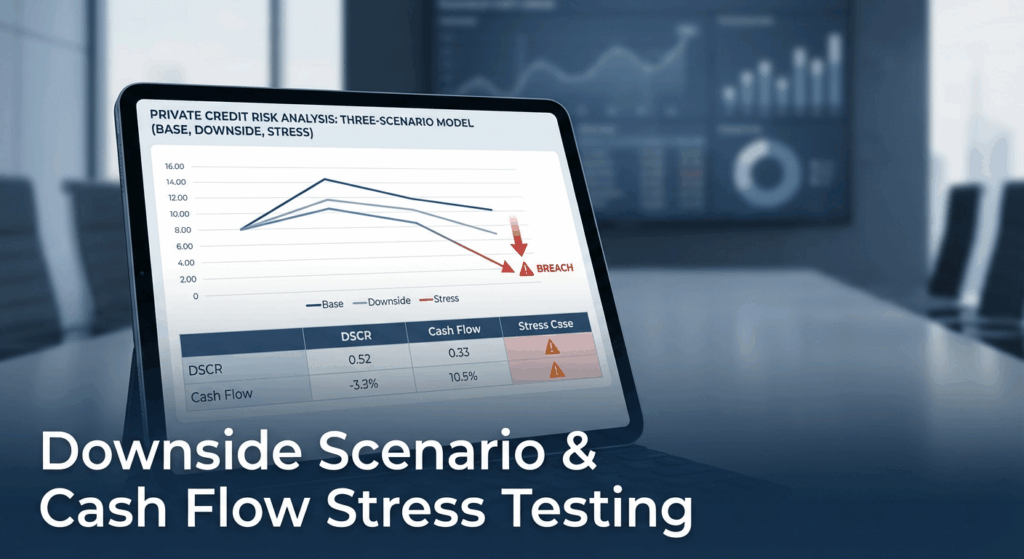
Institutional lenders construct stress tests around a three-scenario architecture: a Base Case, a Downside Case, and a Severe Downside (or “Stress”) Case. Each scenario applies a distinct set of operating assumptions to the borrower’s projected income statement and cash flow waterfall, allowing the underwriter to evaluate covenant headroom, debt service capacity, and liquidity runway across a range of outcomes.
The Basel Committee on Banking Supervision’s updated Principles for the Management of Credit Risk (April 2025) reinforces this approach, identifying stress testing as a core component of sound credit-granting processes and credit administration, specifically requiring that lenders evaluate borrower performance under adverse economic conditions before credit is extended. See: bis.org.
Core Metrics Across All Three Scenarios
- Total Leverage Ratio: Total Debt ÷ EBITDA, measures financial risk relative to earnings power
- Interest Coverage Ratio (ICR): EBITDA ÷ Cash Interest Expense, tests ability to service interest from operations
- Debt Service Coverage Ratio (DSCR): (EBITDA – Capex – Taxes – Working Capital Changes) ÷ Total Debt Service, the most conservative coverage test
- Fixed Charge Coverage Ratio (FCCR): (EBITDA – Capex) ÷ (Interest + Required Principal), commonly used as a maintenance covenant trigger
- Liquidity Runway: Unrestricted Cash + Revolver Availability ÷ Monthly Cash Burn (Stress Case), estimates months of operational runway without refinancing
Example Company: A $10M EBITDA specialty manufacturing business, acquired in an LBO at 4.5x leverage ($45M total debt), with $3.5M in annual cash interest expense and $1.2M in mandatory amortization. Base case DSCR = ($10M – $1.5M capex – $1.0M taxes) ÷ $4.7M debt service = 1.60x: adequate, but with limited margin for error.
Walking Through the Stress Test: Calculations and Trigger Points
As outlined in the debt capacity framework described by ibinterviewquestions.com, total leverage in most private credit deals now ranges from 4.0x to 5.0x EBITDA: down from levels exceeding 6.0x in prior cycles. This compression reflects both lender discipline and higher base rates. Stress testing must account for this tighter structural margin.
Scenario Application to the $10M EBITDA Manufacturing Borrower
| Scenario | EBITDA Haircut | Stressed EBITDA | Stressed DSCR | Leverage (Stressed) |
|---|---|---|---|---|
| Base Case | – | $10.0M | 1.60x | 4.5x |
| Downside Case | –15% | $8.5M | 1.17x | 5.3x |
| Stress Case | –25% | $7.5M | 0.85x ⚠️ | 6.0x ⚠️ |
The stress case DSCR of 0.85x signals that the borrower cannot fully service its debt from operations, a covenant breach scenario. If the maintenance FCCR covenant is set at 1.10x, the downside case already triggers a breach at 1.17x, leaving almost no cushion. This is a structural underwriting deficiency that must be addressed at origination, either through lower leverage, a covenant reset mechanism, or an equity cure right.
What Institutional Lenders Look For, and Where Underwriters Go Wrong
The most common underwriting mistake is anchoring too heavily on management’s base case projections without independently verifying the assumptions. The Basel Committee’s 2025 credit risk principles explicitly require lenders to establish independent credit review functions and to avoid over-reliance on borrower-supplied financial models, a discipline that is especially critical in private credit, where information asymmetry is structurally higher than in syndicated markets. (bis.org)
Key Red Flags in Cash Flow Stress Testing
- Rising PIK Toggle Usage: A borrower electing PIK interest is deferring cash obligations, a leading indicator of cash flow stress that erodes true coverage ratios in subsequent periods. Regulators and institutional investors have flagged PIK growth in private credit portfolios as a systemic concern. (privateequitylitigation.com)
- Overadjusted EBITDA: Excessive add-backs (synergies, one-time costs, management fees) inflate base case EBITDA and compress apparent leverage. Stress tests must be run on normalized, audited EBITDA, not management’s adjusted figure.
- Narrow Covenant Headroom: Maintenance covenants set with less than 15–20% headroom to the base case projection leave almost no buffer before a technical default. Lenders should model covenant headroom explicitly in each scenario.
- Cyclical Revenue Concentration: Borrowers with more than 25–30% revenue from a single customer or single end-market face amplified downside variance, stress haircuts should be increased accordingly.
- Ignoring Working Capital Volatility: EBITDA-to-cash conversion can deteriorate sharply under stress as receivables slow and inventory builds. A borrower with 1.4x EBITDA coverage may have a DSCR below 1.0x once working capital movements are modeled.
- Total leverage in most private credit LBO deals: 4.0x – 5.0x EBITDA as of early 2026, down from 6.0x+ in 2021 peak. (ibinterviewquestions.com)
- Private credit AUM has grown to a multi-trillion-dollar asset class, increasing systemic exposure and regulatory attention. (privateequitylitigation.com)
- Bank of England is now conducting system-wide stress tests covering private equity and private credit for the first time, with major U.S. managers voluntarily participating. (privateequitylitigation.com)
- Basel Committee’s updated credit risk management principles (April 2025) reaffirm stress testing as a core credit-granting requirement for banking institutions globally. (bis.org)
Underwriting Checklist: Cash Flow Stress Testing Due Diligence
Use this checklist at the underwriting stage before credit committee submission:
- ✅ Normalize EBITDA independently: reconcile management adjustments line by line; remove recurring “one-time” costs and unverifiable synergies
- ✅ Build three scenarios (Base / Downside / Stress) with documented assumption rationale: revenue haircuts, margin compression, capex normalization
- ✅ Calculate DSCR and FCCR in all three scenarios: confirm DSCR > 1.10x in Downside; document breach point in Stress
- ✅ Map covenant headroom: quantify percentage cushion between projected financial ratios and covenant trigger levels in each scenario
- ✅ Model working capital swings: stress test cash conversion cycle; apply industry-specific receivables extension assumptions in downside
- ✅ Assess PIK optionality impact: if PIK toggle is included, model compounding debt balance and leverage trajectory under each scenario
- ✅ Test liquidity runway: calculate months of runway using revolver availability and unrestricted cash in the Stress Case
- ✅ Document customer and revenue concentration: apply incremental stress haircut for any borrower with >25% single-customer exposure
- ✅ Run sensitivity analysis on interest rates: model impact of a 100–200bps rate increase on floating-rate debt service obligations
- ✅ Obtain independent third-party QoE or audit support: do not underwrite from management accounts alone; require at minimum trailing twelve-month audited financials
Key Takeaways
- 🔑 Stress testing is the foundation of credit discipline: A borrower that looks healthy at 4.5x leverage in a base case can breach covenants at a 15% EBITDA decline. Model it before you lend it.
- 🔑 DSCR is more conservative (and more honest) than EBITDA coverage alone: Capex, taxes, and working capital must be deducted before claiming debt service capacity.
- 🔑 PIK interest is a lagging stress signal, not a structural solution: Rising PIK utilization across a portfolio warrants immediate portfolio-level review and tighter underwriting standards at origination.
- 🔑 Covenant headroom should be stress-tested, not assumed: Setting maintenance covenants at 10% headroom to base case projections provides virtually no protection in a downside scenario.
- 🔑 Regulatory and institutional pressure on private credit stress testing is accelerating: Lenders who build robust internal stress testing frameworks now will be better positioned as disclosure and supervisory requirements tighten across both the UK and U.S. markets.


