
The Single Most Important Variable in Private Credit
Before evaluating yield, covenant strength, or manager reputation, every private credit investor and business owner needs to understand one foundational concept: where a loan sits in the capital stack. Position within the capital structure determines repayment priority, loss exposure, and ultimately, the return an investor receives, or the cost a borrower pays. Get this wrong, and no amount of due diligence on other variables will save a deal.
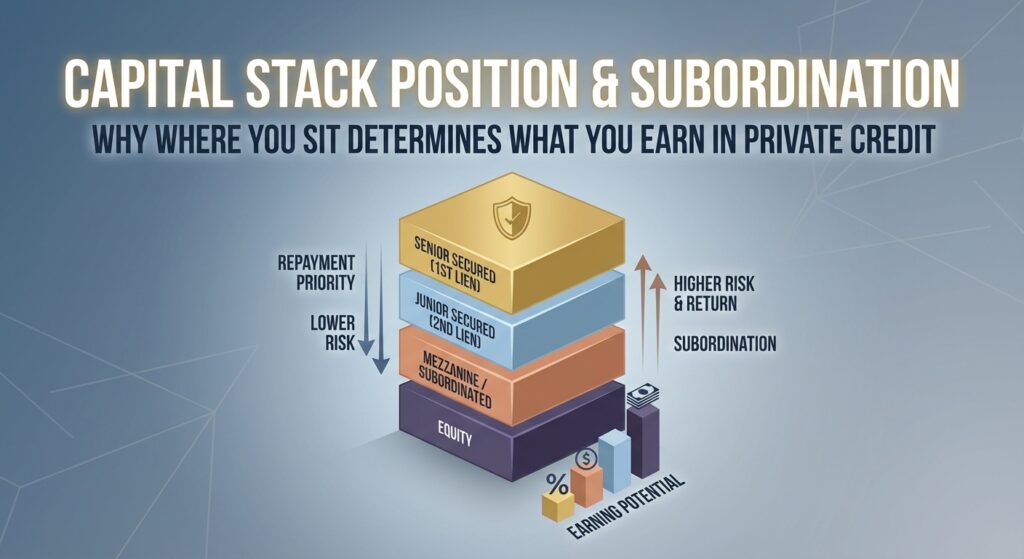
The capital stack is simply a ranked hierarchy of claims on a company’s assets and cash flows. In a default scenario, claims at the top are paid first; claims at the bottom are paid last, or not at all. That sequencing of risk is what private credit is built around, and understanding it is the starting point for every intelligent capital decision.
How the Capital Stack Is Structured
A typical leveraged buyout or middle-market financing arranges capital in four broad layers, from lowest risk to highest:
- Senior Secured Debt (First Lien): The top of the stack. Lenders here hold a first-priority claim on all pledged collateral: typically the company’s assets, receivables, and intellectual property. In a liquidation, they are paid before anyone else. Because of this protection, first-lien lenders accept lower yields, often in the range of SOFR plus 500–600 basis points in today’s middle market.
- Junior Secured / Second Lien Debt: Sits directly below senior debt. Second-lien lenders are only paid after first-lien obligations are fully satisfied. The higher loss exposure commands a meaningfully higher spread, typically 100–300 basis points more than first-lien pricing.
- Mezzanine / Subordinated Debt: Unsecured or structurally subordinated to all secured debt. Mezzanine lenders often receive a combination of cash interest and payment-in-kind (PIK) interest, with total return expectations in the low-to-mid teens. Some mezzanine instruments also carry equity kickers: warrants or conversion rights, to compensate for the elevated loss risk.
- Equity: The bottom of the stack. Equity holders receive whatever remains after all debt obligations are met. They bear the first dollar of loss in a downside scenario but capture the upside if the company outperforms. Private equity sponsors typically contribute equity equal to 30–50% of total enterprise value in a buyout transaction.
A Concrete Example: The $100M Buyout
Consider a private equity sponsor acquiring a manufacturing business for $100 million. The capital structure might look like this:
- Senior Secured Loan (First Lien): $50M: priced at SOFR + 550 bps (~10.0% all-in as of Q1 2026)
- Second Lien Term Loan: $15M: priced at SOFR + 850 bps (~13.0% all-in)
- Mezzanine Note: $10M: 14.0% cash pay plus warrants
- Sponsor Equity: $25M: no contractual return; residual claim only
Now suppose the business deteriorates and is sold in a distressed scenario for just $60 million. The first-lien lender receives their full $50M back. The second-lien lender recovers $10M of their $15M, a 33% loss. The mezzanine lender is entirely wiped out. The sponsor loses their entire $25M equity investment.
This is subordination in action: the same economic event produces dramatically different outcomes depending solely on stack position. The first-lien investor was protected by a 40% equity and junior debt cushion, meaning the enterprise value had to fall by more than 40% before they suffered a single dollar of loss.
Current Market Relevance
Understanding stack position has never been more practically important. As of Q1 2026, the private credit market has grown to approximately $1.7 trillion in global AUM at end-2024, with forecasts projecting growth beyond $2.6 trillion by 2029, according to Preqin data cited by Coll er Capital (June 2025). That scale means more capital is competing for deals, and that competition has implications for where risk is being taken.
Senior secured, first-lien direct lending has emerged as the dominant strategy precisely because of its stack protection. According to Gridline (January 2024), nearly half of all capital raised by private debt funds in recent vintage years has flowed into senior debt strategies, a structural shift driven by post-2008 bank regulations such as Basel III that pushed banks away from leveraged lending and opened space for private lenders at the top of the stack.
That senior positioning has delivered measurable credit protection. Capital Founders OS (March 2026) cites Cambridge Associates data showing private credit default rates running at approximately 1.45% versus 3.37% for broadly syndicated loans: a gap that reflects, in large part, the tighter structural protections and senior positions that direct lenders typically occupy.
At the same time, the market is not without stress. Atlas Peak Research (March 2026) notes that the sharpest liquidity pressure in early 2026 has appeared where illiquid middle-market loans were packaged inside semi-liquid retail structures, not in the classic closed-end institutional funds that hold the most senior, most protected positions. Stack position matters, but so does the structure of the vehicle holding it.
Decision Framework
For Investors Evaluating Private Credit
- Map every opportunity to its stack layer first. Yield alone is not informative unless you know what seniority and collateral coverage support it. A 14% return in first lien is a very different proposition than 14% in mezzanine.
- Quantify the loss cushion. Ask: how far does enterprise value need to fall before this loan takes a loss? For a first-lien lender at 50% loan-to-value, the business must lose half its value before principal is impaired.
- Match structure to objectives. Investors seeking capital preservation and income consider senior secured strategies. Investors seeking total return and comfortable with higher loss volatility may evaluate junior or mezzanine positions, understanding the trade-off is explicit, not incidental.
For Business Owners Seeking Capital
- Stack position determines your cost. Offering a first lien on strong collateral is the most direct path to lower-cost debt. The more junior the debt you are asking lenders to hold, the higher the coupon, the more likely PIK features appear, and the more dilutive equity kickers become.
- Understand the trade-off between flexibility and cost. Mezzanine debt avoids the covenant intensity of senior bank facilities, but it is expensive. Evaluate whether the operational flexibility is worth the additional 400–600 basis points in interest cost relative to a senior secured facility.
- Equity cushion protects all lenders above it, including you. Retaining more equity in a transaction increases the loss buffer for senior lenders and can improve borrowing terms, even if it means less leverage overall.
Key Takeaways
- Stack position is the primary determinant of risk and return. Before analyzing yield, covenants, or manager quality, establish where any private credit instrument sits in the repayment hierarchy.
- Senior secured first-lien debt offers structural downside protection because all junior capital must be exhausted before first-lien principal is impaired, a protection that has kept institutional direct lending default losses historically low.
- Each layer down the stack demands higher compensation. Moving from first lien to second lien to mezzanine typically adds 100–400+ basis points per step, reflecting the incremental loss exposure at each layer.
- For operators, knowing your lender’s stack position shapes the negotiation. Lenders higher in the stack accept lower yields but demand tighter controls; junior lenders charge more but may offer more flexibility.
- Market growth amplifies the importance of stack discipline. With private credit AUM approaching $2 trillion globally, the range of product structures is wider than ever, making independent analysis of stack position and collateral coverage essential for any capital decision.


