
Why Where You Sit in the Stack Is Everything
In private credit, the single most important question is not what interest rate you earn; it is where you sit in the repayment hierarchy. That hierarchy, called the capital stack, determines who gets paid first when a business generates cash flow, who gets wiped out first when it does not, and how much cushion stands between a lender and a loss. For investors evaluating direct lending funds and for business owners structuring a financing round, understanding capital stack position is the foundational skill everything else builds on.
As the private credit market has grown, reaching approximately $1.34 trillion in U.S. assets under management and nearly $2 trillion globally as of mid-2024, per Atlas Peak Research (March 2026), the range of instruments sitting inside that stack has multiplied. Senior secured loans, unitranche facilities, mezzanine debt, and equity co-investments each occupy a distinct rung. Knowing which rung you are on, and what sits below you as a protective cushion, is the difference between disciplined capital allocation and an underprice of risk.
The Capital Stack: Definition and Mechanism
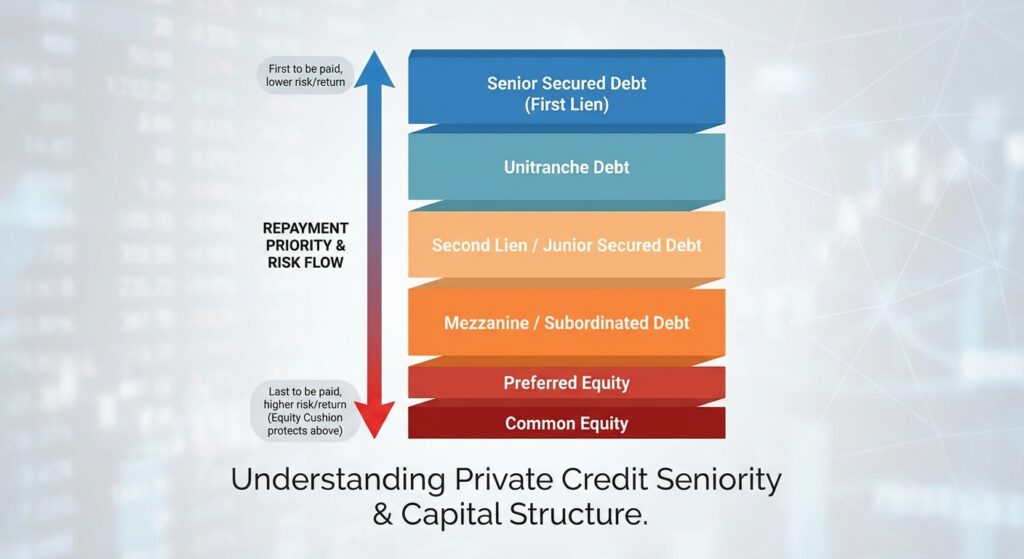
The capital stack is the ordered list of all financial claims on a business, ranked by their legal priority in repayment. Think of it as a waterfall: cash flows and asset sale proceeds fill each bucket from the top down, and any bucket that overflows passes value to the next level. Crucially, losses work in reverse; they erode value from the bottom up.
The standard layers, from most senior to most junior, are:
- Senior Secured Debt (First Lien): First priority claim on collateral. Lowest yield, highest recovery in default. Typically carries a first lien on all business assets.
- Unitranche Debt: A blended single-tranche facility that combines first- and second-lien economics into one instrument, governed by an Agreement Among Lenders (AAL). Increasingly dominant in middle-market deals.
- Second Lien / Junior Secured Debt: Subordinated to first-lien holders but still secured. Higher yield reflects lower recovery priority.
- Mezzanine / Subordinated Debt: Often unsecured or lightly secured. Compensates lenders with higher coupons and sometimes equity warrants.
- Preferred Equity: Ahead of common equity in liquidation, behind all debt. Hybrid risk-return profile.
- Common Equity: Last in line. Bears the first loss but captures all upside above the debt obligations.
As Gridline’s Alternative Investment Knowledge Base (January 2024) notes, senior debt holds priority over more junior debt within the capital structure and typically carries a lower interest rate than subordinated debt, a direct expression of the risk-return tradeoff embedded in the stack.
How It Works: A Concrete Example with Numbers
Consider a mid-market manufacturing company being acquired in a private equity buyout. The total enterprise value is $100 million. The capital structure is financed as follows:
- Senior Secured Loan (First Lien): $50 million, 50% of enterprise value
- Mezzanine Debt: $20 million, 20% of enterprise value
- Equity (PE Sponsor): $30 million, 30% of enterprise value
Now suppose the business underperforms and is sold in a distressed scenario for only $60 million. Here is how the waterfall flows:
- The senior secured lender receives the first $50 million, fully recovered.
- The mezzanine lender receives the remaining $10 million, recovering only 50 cents on the dollar.
- The equity sponsor receives nothing, a complete loss on $30 million.
This is the protective power of equity cushion: the $30 million of sponsor equity absorbed the first $40 million of value decline before the senior lender suffered a single dollar of loss. The senior lender’s loan-to-value (LTV) at origination was 50%, meaning enterprise value would need to fall by more than half before principal was impaired. The mezzanine lender, by contrast, had only 30% equity cushion below them, a thinner buffer that justified their higher coupon.
This example also illustrates why attachment point: the percentage of enterprise value at which your claim begins, is a key underwriting metric. The senior lender attaches at 0% and detaches at 50%. The mezzanine lender attaches at 50% and detaches at 70%. Every percentage point of attachment matters when stress scenarios are modeled.
Current Market Relevance
The capital stack is not a static academic concept, its dynamics shift with market conditions, and current conditions make stack position more consequential than it has been in years.
According to Capital Founders OS (March 2026), with SOFR at approximately 4.3%, senior direct lending is currently generating yields of 10–12%+ without requiring lenders to reach down the risk curve into junior positions. That compression of risk premium, strong yield available at the top of the stack, has reinforced institutional preference for senior secured paper.
The same source cites Cambridge Associates data showing private credit default rates running at 1.45%, compared with 3.37% for broadly syndicated loans, a performance differential that reflects both the covenant protections and the seniority characteristics typical of direct lending portfolios.
Meanwhile, stress in the market is revealing where stack mismatches create problems. As Atlas Peak Research (March 2026) documents, the sharpest liquidity stress in early 2026 appeared in semi-liquid vehicles holding illiquid middle-market loans, a structural mismatch concern, but one that underscores how critical it is for investors to understand both the position within the credit stack and the vehicle structure wrapping that position.
On the borrower side, as Clockwork (November 2025) explains, private credit’s appeal to operators is precisely its flexibility relative to bank lending: negotiated terms, faster execution, and willingness to lend to companies with more complex credit profiles. That flexibility, however, comes with covenants and structural protections that reinforce the lender’s stack position.
| Metric | Level | Source |
|---|---|---|
| U.S. Private Credit AUM | ~$1.34 trillion | Atlas Peak Research, Mar 2026 |
| Global Private Credit AUM | ~$2 trillion (Fed framing); ~$2.5T (BIS AUM) | Atlas Peak Research, Mar 2026 |
| Senior Direct Lending Yield | 10–12%+ (SOFR + spread) | Capital Founders OS, Mar 2026 |
| Private Credit Default Rate | 1.45% (vs. 3.37% for BSLs) | Capital Founders OS / Cambridge Associates, Mar 2026 |
| Family Office Private Credit Allocation | 4% of portfolio (up from 2% in 2023) | Capital Founders OS / UBS Family Office Report 2025 |
Decision Framework: Investors and Operators
For investors evaluating private credit funds and direct lending strategies:
- Identify attachment and detachment points. Before assessing yield, determine at what percentage of enterprise value the fund’s loans attach. Senior secured strategies typically target sub-50% LTV; mezzanine strategies often sit in the 50–70% range.
- Quantify the equity cushion. Ask how much sponsor equity sits below the debt. A deal with 30–40% equity below the first lien gives the senior lender a meaningful buffer before principal is impaired.
- Match stack position to liquidity structure. Senior secured loans held in closed-end funds with 5–8 year lockups represent a coherent match of asset and vehicle duration. Investors in semi-liquid vehicles holding junior or illiquid debt face compounding risks, as early 2026 redemption events illustrated.
- Evaluate covenant packages by tranche. Senior loans typically carry maintenance covenants (tested quarterly). Junior instruments may carry incurrence covenants only, weaker early-warning signals for investors.
For operators and CFOs seeking private capital:
- Understand what seniority costs you. Senior secured debt is cheaper because lenders bear less risk. If your business can support predictable cash flows and meaningful collateral, senior secured is generally the most cost-efficient financing option.
- Stack junior debt carefully. Mezzanine or second-lien debt increases your total cost of capital and reduces the equity buffer protecting your senior lenders, potentially tightening future refinancing options.
- Equity below debt is a feature, not just dilution. Sponsor equity or management equity sitting below debt layers protects lenders and signals alignment. Operators approaching private lenders with thin equity contributions face tighter terms and higher spreads.
Key Takeaways
- Position is primary. In private credit, where you sit in the capital stack determines your risk exposure, recovery probability, and appropriate yield expectation, before any other analysis begins.
- Equity cushion is the lender’s first line of defense. The greater the equity below a debt claim, the larger the enterprise value decline required before that debt is impaired.
- Attachment and detachment points are underwriting anchors. These metrics translate stack position into a concrete, scenario-testable number every investor and operator should know for every deal.
- Senior secured is currently delivering compelling risk-adjusted yields. With 10–12%+ available at the top of the stack and default rates running near 1.45%, the senior layer is attracting the largest share of institutional capital for good reason.
- Vehicle structure and stack position must be evaluated together. Owning a senior secured loan inside a mismatched semi-liquid vehicle introduces structural risk that credit quality alone cannot mitigate, a lesson reinforced by Q1 2026 market events.


