
The Story: A Father, His Son, and a $1M Bet on Themselves
Greg Holifield spent 22 years on active duty. He missed his son Timothy’s high school years: baseball games, graduations, the ordinary moments that quietly define a childhood. When he finally came home, he made a different kind of commitment: he would build businesses with his son, not just for him.
By 2022, that commitment had already produced three successful exits. The fourth was SafePointe, a next-generation, AI-powered weapons detection system headquartered in Florida. The technology was real. The customers were coming. But SafePointe had a hardware problem.
As a hardware-enabled SaaS company, SafePointe embedded its hardware costs into its licensing fees. That model looked elegant on paper and punishing on a balance sheet. Every new customer required upfront capital to finance physical equipment before recurring revenue could flow. Accounts receivable lines ballooned. Working capital evaporated. Growth stalled not because the market wasn’t there, but because the Holifields couldn’t fund the next deployment fast enough.
They had a choice most founders face and few frame correctly: raise equity and dilute their stake in a fourth consecutive exit, or find another way. They chose another way. In September 2022, SafePointe secured a $1 million USD venture debt facility from TIMIA Capital: non-dilutive, structured around their recurring revenue, and fast enough to matter.
Less than twelve months later, SafePointe was acquired by SoundThinking, Inc. (Nasdaq: SSTI), a leading public safety technology firm. The Holifields walked away with their equity intact. Exit number four. Clean.
The Decision: What the Equity Path Would Have Cost
To understand why the Holifields’ choice was significant, you have to understand what the alternative looked like. An equity round at SafePointe’s stage (pre-exit, hardware-dependent, modest MRR) would have carried a price. That price is permanent: dilution compounds across every future financing event and, most critically, at the exit itself.
The TIMIA facility offered something categorically different. According to TIMIA Capital’s published case study, the structure was built on SafePointe’s revenue visibility: the recurring SaaS component provided the repayment anchor, while the debt capital freed up working capital to fund hardware deployments and break the growth bottleneck. No board seats surrendered. No liquidation preferences stacked above the founders’ heads. No cap table dilution carried into the acquisition negotiation.
The Holifields reportedly evaluated two other debt providers before choosing TIMIA: citing fund size, backing, deal terms, and the lender’s understanding of hardware-enabled SaaS as differentiating factors. This matters. The structure of non-dilutive capital is not monolithic. Choosing the wrong lender (wrong covenant package, wrong repayment timeline, wrong understanding of the business model) can turn a tool into a trap.
SafePointe’s decision worked because the debt was sized proportionally, tied to recoverable revenue streams, and deployed into a specific bottleneck, not used to fund speculative expansion or paper over fundamental unit economics. The $1M facility helped SafePointe triple its monthly recurring revenue by the time the acquisition closed. That revenue trajectory directly shaped the acquisition valuation.
Roughly a year earlier and five thousand miles away in concept, Myagi’s co-founder Simon Turner had made an almost identical call. His retail sales enablement platform had been set to raise an equity round in March 2020, then COVID arrived. The equity window closed. But demand for digital retail solutions surged. Myagi was growing faster than its capital could keep pace with. Turner turned to TIMIA for a $2.5 million non-dilutive facility, used it to strengthen Myagi’s referral-based sales model and software infrastructure, and positioned the company for an acquisition by Rallyware, completing the exit roughly two years later.
“Debt is a powerful tool for capital-efficient businesses when used under the right circumstances,” Turner said publicly after the exit.
The Outcome: What Happens When the Same Logic Fails at Scale
Now hold those two stories next to a third.
Divvy Homes was a rent-to-own startup that raised more than $400 million in venture equity, including a $200 million Series D led by Tiger Global at a $2.3 billion valuation in 2021. The model was genuinely innovative: buy homes, rent them back to aspiring owners, hold equity toward a future purchase. Noble mission. Real impact. Extreme capital intensity.
In October 2021, Divvy layered approximately $735 million in debt financing on top of hundreds of millions in preferred equity, each tranche carrying its own liquidation preferences. Then interest rates surged in 2022. The model broke. Layoffs followed. Home acquisitions paused. In January 2025, Brookfield Properties acquired Divvy for roughly $1 billion.
One billion dollars in assets. Zero dollars for founders, employees, or common shareholders. As CEO Adena Hefets wrote in a letter to shareholders: after repaying outstanding debt, covering transaction costs, and satisfying liquidation preferences for preferred shareholders, nothing remained for those who built the company.
A billion-dollar exit. A total wipeout. Not because the business had no value, but because the capital structure consumed every dollar of it before a founder could touch any of it. As SaaStr’s Jason Lemkin wrote in February 2026, “This isn’t just a failure story. This is a capital structure story.”
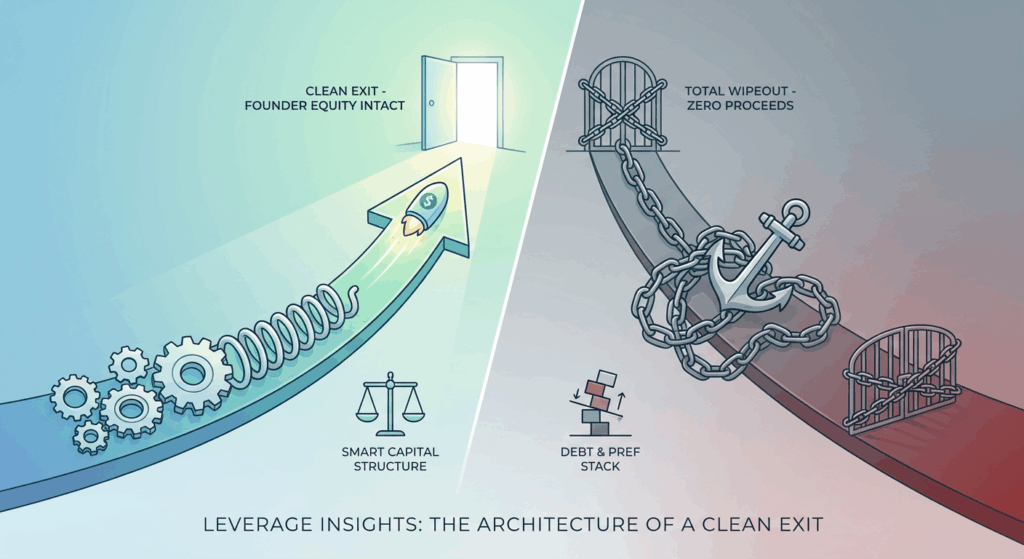
The contrast is almost surgical. SafePointe: $1M in proportional debt, revenue-anchored, model-appropriate. Exit in under a year. Founders whole. Divvy Homes: $735M in debt, stacked on preferred equity, deployed into an interest-rate-sensitive asset at the peak of a rate cycle. $1B exit. Founders with nothing. Same instrument. Radically different outcomes.
The Lessons: A Framework for Capital Decisions That Actually Protect Founders
What separates these stories isn’t luck, it’s architecture. And the architecture follows identifiable principles.
1. Match the instrument to the risk profile of the revenue. SafePointe and Myagi had predictable, recurring SaaS revenue. That revenue could service debt. Divvy Homes had illiquid real estate assets in a rate-sensitive environment. Debt amplified the rate risk directly into the capital structure. The instrument has to match the cash flow profile, not the ambition of the model.
2. Size debt to a specific, recoverable bottleneck. Both TIMIA-funded companies deployed capital into defined constraints (hardware financing and sales infrastructure) not into speculative growth. Divvy deployed debt into an asset class that became correlated with its greatest systemic risk. The question isn’t “how much can we borrow?”, it’s “what specific constraint does this remove, and how fast does that constraint generate recoverable cash?”
3. Stacking liquidation preferences is a compounding tax on your exit. Every round of preferred equity and every debt tranche creates a claim senior to common equity. A $1B exit sounds transformative until you realize that $935M of it belongs to lenders and preferred holders before a single dollar reaches the people who built the company. Founders must model the exit waterfall at every stage, not just the headline valuation.
4. Non-dilutive capital is an exit accelerator when it removes a bottleneck, not a substitute for viable unit economics. Inkle, a financial operations platform for VC-backed startups, used non-dilutive financing from Efficient Capital Labs to retain 90% founding team equity, avoid two rounds of dilution, and scale to 500+ companies served, without surrendering board control. The financing worked because Inkle had identifiable seasonal revenue cycles that the capital could exploit. The revenue was real. The constraint was capital timing, not business viability.
5. Choose your lender the way you choose a partner. Greg Holifield evaluated three providers before choosing TIMIA. He assessed fund backing, deal terms, and, critically, whether the lender understood the hardware-SaaS model. A lender who misunderstands your business model will write covenants that punish exactly the behavior your business requires. The term sheet is only as good as the lender’s comprehension of your cash cycle.
Key Insights
- Venture debt is an exit accelerator, not just a bridge. SafePointe tripled MRR and exited by acquisition within 12 months of a $1M debt facility, with full founder equity intact. The debt didn’t delay the exit; it created the conditions for it.
- The exit waterfall is the only number that matters at liquidity. Divvy Homes sold for $1 billion and founders received $0. Stacked debt and liquidation preferences consumed the entire distribution. Model the waterfall before you stack the capital, not after.
- Debt sized to a specific bottleneck compounds growth; debt used to paper over economics compounds risk. The difference between SafePointe’s $1M and Divvy’s $735M isn’t just magnitude, it’s precision and purpose.
- Equity dilution is permanent; well-structured debt is not. Myagi avoided equity dilution at the exact moment its company was positioned for acquisition. That preserved ownership translated directly into founder proceeds at exit. Dilution taken at the wrong moment is a tax you pay forever.
- Lender selection is as strategic as term negotiation. Founders who treat lender due diligence as rigorously as investor due diligence (evaluating fund structure, sector understanding, and covenant philosophy) consistently achieve better outcomes than those who optimize purely on headline rate.


