
The Underwriting Question Every Lender Must Answer
Before a credit committee approves a single term loan or revolving facility, one question should dominate the room: At what point does this borrower’s cash flow fail to service its debt? Not the base case. Not management’s optimistic projection. The downside: the scenario where revenue contracts, margins compress, and working capital deteriorates simultaneously.
Stress testing cash flows is the discipline that answers this question with precision. It is not a pessimism exercise. It is the core analytical function that determines whether a debt structure is appropriately sized, whether covenants are set at the right trigger points, and whether the lender has adequate cushion before a credit event forces a restructuring conversation. In an environment where total leverage in most leveraged buyouts now ranges between 4.0x and 5.0x EBITDA, down from levels exceeding 6.0x in prior cycles, the margin for error has narrowed, and the quality of cash flow stress testing has never mattered more. (ibinterviewquestions.com)
The Analytical Framework: Four Layers of Cash Flow Stress
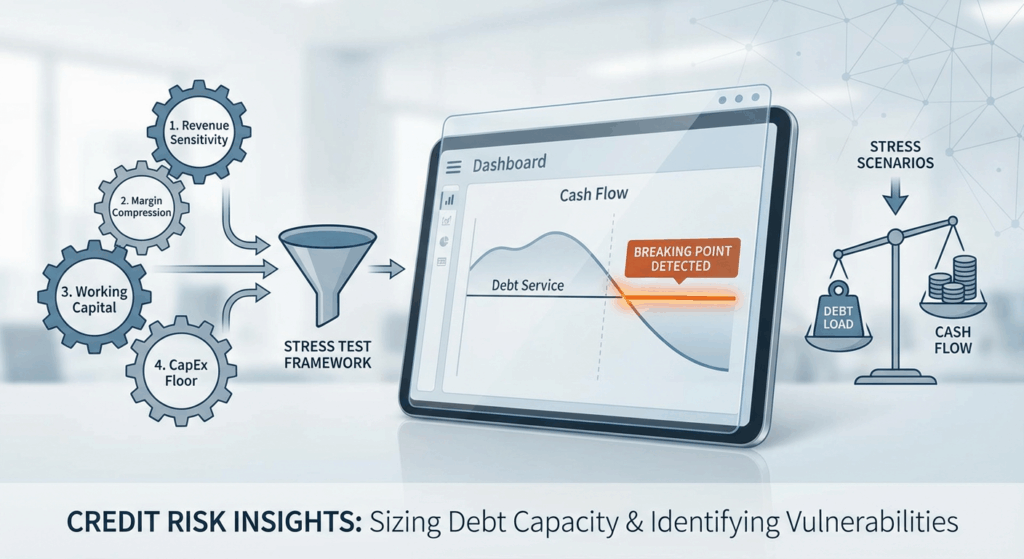
A rigorous cash flow stress test operates across four interconnected layers. Each layer adds a dimension of risk to the base case and reveals a different vulnerability in the debt structure.
Layer 1: Revenue Sensitivity
Begin by stressing the top line. Model three scenarios: a base case (management projection, lightly haircut), a moderate downside (revenue decline of 10–15%), and a severe downside (revenue decline of 20–30%). The magnitude of the stress should be calibrated to the borrower’s industry cyclicality, customer concentration, and contract structure. A business with 80% recurring, contracted revenue warrants a narrower stress band than a manufacturer exposed to spot pricing and commodity input costs.
Layer 2: Margin Compression
Revenue stress alone understates the damage. When volumes fall, fixed costs remain, and EBITDA margins compress non-linearly. A company with a 30% gross margin and high fixed-cost operating leverage may see EBITDA margins contract by 500–800 basis points on a 15% revenue decline. Model margin contraction explicitly, do not assume margins hold.
Layer 3: Working Capital Drag
Stressed revenues often come with working capital headwinds: customers extend payables, inventory builds as sales slow, and receivables age. A complete stress test converts EBITDA to unlevered free cash flow by modeling changes in net working capital under each scenario. This step separates accounting earnings from actual cash available to service debt.
Layer 4: Capital Expenditure Floor
Lenders frequently underwrite to management’s stated CapEx budget. In a downside, borrowers defer discretionary CapEx, but maintenance CapEx is non-negotiable. Establish a maintenance CapEx floor (typically 1–3% of revenue for light manufacturing, 4–6% for capital-intensive industrials) and hold it constant across all scenarios.
Walking the Calculation: A $10M EBITDA Manufacturing Company
Consider a middle-market manufacturer with $50M in revenue, $10M in EBITDA (20% margin), and a proposed debt structure of $40M senior secured at a floating rate of SOFR + 550bps (approximately 10.8% all-in as of Q1 2026). Annual interest expense: approximately $4.3M. Annual required amortization: $2.0M. Total annual debt service: $6.3M.
Base Case Metrics:
- Leverage: 4.0x Debt/EBITDA
- Interest Coverage Ratio (ICR): 2.33x ($10M EBITDA ÷ $4.3M interest)
- Debt Service Coverage Ratio (DSCR): 1.59x ($10M EBITDA ÷ $6.3M debt service)
- Free Cash Flow to Debt Service: Approximately $3.7M after debt service
Moderate Downside (–15% Revenue, –300bps Margin Compression):
- Revenue: $42.5M | EBITDA: $7.4M (17% margin)
- ICR: 1.72x, approaching lender covenant trigger (typically set at 1.5x–1.75x)
- DSCR: 1.17x, thin but serviceable
- Free Cash Flow after debt service: approximately $1.1M, minimal liquidity buffer
Severe Downside (–25% Revenue, –500bps Margin Compression):
- Revenue: $37.5M | EBITDA: $5.6M (15% margin)
- ICR: 1.30x, covenant breach if set at 1.50x
- DSCR: 0.89x, cash flow deficit; borrower cannot fully service debt from operations
- This is the breaking point. The lender now faces an accelerated restructuring timeline.
The analysis reveals that this structure has adequate resilience in moderate stress but breaks under a severe scenario. A disciplined underwriter would either reduce the debt quantum to $35M (3.5x leverage), require a cash flow sweep mechanism, or price the incremental risk through tighter covenant triggers.
What Institutional Lenders Require, and Where Underwriters Go Wrong
The Basel Committee on Banking Supervision’s updated Principles for the Management of Credit Risk (April 2025) reaffirms that sound credit-granting processes must include forward-looking scenario analysis, not merely point-in-time financial assessment. The framework emphasizes that credit risk measurement must account for evolving economic conditions and that stress testing is a core supervisory expectation, not a supplementary exercise. (bis.org)
From a credit analysis modeling perspective, the CFA Institute’s curriculum on credit risk models underscores that the key inputs, probability of default (PD), loss given default (LGD), and expected exposure: must all be stress-tested as a system, not as isolated variables. A downside scenario that stresses only revenue while holding recovery assumptions constant produces a false sense of resilience. (cfainstitute.org)
The most common underwriting errors in cash flow stress testing include:
- Anchoring to management projections without independent verification of revenue growth assumptions or margin targets
- Treating EBITDA as a cash proxy without converting to free cash flow through working capital and CapEx adjustments
- Applying uniform stress factors across industries without adjusting for sector-specific cyclicality, fixed-cost structures, or input cost volatility
- Setting covenant triggers at the base case rather than at the point where lender intervention is still commercially meaningful, typically 15–25% of headroom above the break-even DSCR
- Ignoring interest rate sensitivity on floating-rate facilities, particularly in an environment where base rates have remained elevated through 2025–2026
- Total leverage in LBO structures: 4.0x–5.0x EBITDA in current market conditions, constrained from the 6.0x+ levels of the low-rate era (ibinterviewquestions.com)
- Interest coverage ratios below 1.5x are widely treated as distressed-level triggers in institutional lending agreements
- DSCR below 1.0x indicates the borrower cannot service debt from operating cash flows, a direct indicator of imminent default risk
- The Basel Committee’s 2025 Credit Risk Principles reaffirm forward-looking scenario analysis as a supervisory cornerstone, not optional practice (bis.org)
Cash Flow Stress Testing: Underwriting Checklist
Use this checklist at the pre-credit committee stage for every new credit origination:
- Normalize EBITDA: Strip out non-recurring items, owner compensation adjustments, and pro forma add-backs before building any scenario. Stress an adjusted, defensible EBITDA baseline.
- Establish revenue stress bands: Calibrate downside scenarios (–10%, –20%, –30%) to the borrower’s industry cyclicality, contract duration, and customer concentration risk.
- Model margin compression explicitly: Do not assume margins hold under volume stress. Identify fixed vs. variable cost components and calculate EBITDA sensitivity per point of revenue decline.
- Convert EBITDA to unlevered free cash flow: Deduct maintenance CapEx floor and model working capital changes under each stress scenario. Confirm the actual cash available for debt service.
- Calculate DSCR and ICR under all three scenarios: Flag any scenario where DSCR falls below 1.10x or ICR falls below 1.50x as a structural concern requiring covenant or sizing adjustment.
- Stress interest expense on floating-rate facilities: Model a +100bps and +200bps rate shock on top of the revenue/margin downside to assess combined sensitivity.
- Set covenant triggers with meaningful headroom: Maintenance covenants should trigger lender intervention while the borrower still has liquidity to cure or negotiate, not after the breaking point has already been reached.
- Document your breaking point analysis: Every credit memo should explicitly state the revenue decline or margin compression at which the borrower can no longer service its debt. This is the single most important output of the stress test.
Key Takeaways for Credit Underwriters
- 📌 EBITDA is not cash. A disciplined stress test converts EBITDA to free cash flow through working capital and CapEx adjustments before calculating debt service capacity.
- 📌 Stress revenue and margins together. Margin compression is non-linear under volume pressure, model them as a linked system, not independent variables.
- 📌 Know your breaking point before you lend. Every credit memo should state the exact revenue or EBITDA level at which the borrower’s DSCR falls below 1.0x. If you cannot identify it, the stress test is incomplete.
- 📌 Covenant triggers must precede the break. Set ICR and leverage covenant triggers at a level where lender intervention is still commercially viable, not as a post-mortem mechanism.
- 📌 Interest rate stress is structural, not hypothetical. On floating-rate facilities in the current rate environment, a +150bps rate shock is a plausible scenario that must be modeled alongside operational stress.


