
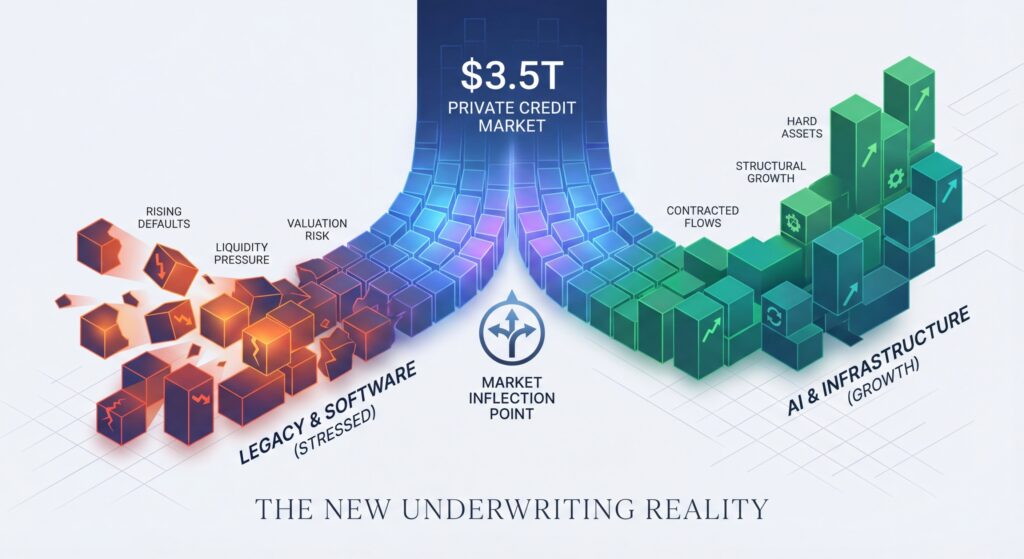
Market Headline: A Liquidity and Valuation Reckoning, Not a Solvency Crisis
Private credit enters Q1 2026 at a genuine inflection point. The asset class, which grew from $500 billion in AUM in 2015 to $3.5 trillion by end-2024, deploying a record $592.8 billion in 2024 alone: is now confronting the structural vulnerabilities that rapid scale and declining underwriting discipline inevitably produce. According to longyield.substack.com, that 2024 deployment figure was 78% above 2023 levels, a pace that compressed spreads and diluted covenant protections across the market.
The macro story is not one of generalized insolvency. As kkr.com observes, credit markets entered 2026 in better shape than many anticipated, spreads remain near historical tights on a relative basis, and defaults have normalized rather than spiked. However, the micro story is sharply more complex: default rates are rising, valuation credibility is under pressure, and the structural mismatch between semi-liquid fund vehicles and illiquid underlying loans has moved from theoretical to operational risk. Per atlaspeakresearch.com, the sharpest stress is concentrated specifically where illiquid middle-market loans have been packaged inside semi-liquid structures distributed through retail wealth channels, not in the institutional closed-end drawdown funds that still dominate direct lending by volume.
The clearest market signal: Blue Owl closed a $1.6 billion fund redemption window in February 2026, a canary event that encapsulates the liquidity mismatch risk now testing the wealth-channel segment of private credit. Simultaneously, JPMorgan has begun marking down private credit collateral, particularly software-sector loans, to preemptively tighten leverage and reduce credit availability ahead of AI-driven disintermediation risks, as reported by ainvest.com.
Quantitative Market Snapshot
The table below consolidates key market metrics as of Q1 2026. Institutional operators and investors should treat these as baseline benchmarks when structuring transactions or assessing portfolio positioning.
| Metric | Current Value (Q1 2026) | Prior Period | Direction | Source |
|---|---|---|---|---|
| Private Credit AUM (Global) | $3.5T (end-2024); BIS estimates $2.5T+ on AUM basis | $500B (2015); ~$2.9T (end-2023 est.) | ↑ +17% YoY (2024) | longyield.substack.com |
| 2024 Annual Deployment | $592.8B | ~$333B (2023) | ↑ +78% YoY | longyield.substack.com |
| Proskauer Default Index | 2.46% (Q4 2025) | 1.84% (Q3 2025) | ↑ +62 bps QoQ | longyield.substack.com |
| Broader Default Rate (Private Credit) | 5.2% (through July 2025) | Historically sub-2% (2021–2023) | ↑ Elevated | longyield.substack.com |
| Borrowers with Negative Free Cash Flow | ~40% of private credit borrowers | Not disclosed at same scale in prior years | ↑ Structural concern | longyield.substack.com |
| PIK Toggle Income (BDC portfolios) | 8%+ of total BDC income | Historically low single digits | ↑ Rising credit stress proxy | longyield.substack.com |
| Software Loans Maturing Within 4 Years | 46% of software private credit loans | N/A (structural data point) | ⚠ Refinancing cliff risk | longyield.substack.com |
| Target Investor Yield (Private Credit) | 9–13% (gross) | 10–14% (2022–2023 peak rate environment) | ↓ Modest compression as rates eased | longyield.substack.com |
Credit spreads in public markets (investment grade and high yield) remain near historical tights, creating an unusual divergence from the deteriorating fundamentals visible at the borrower level in private credit. This spread-fundamentals gap is the central tension KKR flags when asking: “If the headlines feel increasingly uncertain, why do credit markets still appear relatively calm?” The answer lies in greater dispersion between stronger and weaker borrowers, masked by aggregate index-level stability. As cepres.com notes in its 2026 outlook (built on data from 17,200+ funds and 157,000+ deals) performance dispersion is widening materially, making manager selection and sector-level underwriting more consequential than headline market conditions suggest.
Sector Analysis: Software Under Siege, Infrastructure Gains Ground
Software / Technology (Tightening Rapidly): Software is the single most stressed sector in private credit today. The confluence of AI-driven disruption to traditional software business models, elevated leverage at origination, and a looming refinancing cliff, with 46% of software private credit loans maturing within four years: is forcing lenders into a rapid underwriting reassessment. JPMorgan’s decision to mark down software loan collateral values is a direct institutional response to AI disintermediation risk, per ainvest.com. atlaspeakresearch.com identifies software as the primary pressure point in private credit stress, noting that reported NAVs in software-heavy portfolios face the sharpest valuation-credibility challenges. Lenders are now applying tighter FCCR thresholds and reduced leverage multiples to new software originations.
Generative AI Infrastructure and Power (Expanding Appetite): In sharp contrast, infrastructure lending tied to AI compute buildout and power generation is seeing materially increased lender appetite. atlaspeakresearch.com dedicates specific analysis to generative AI infrastructure and power sector implications, identifying these as structural growth verticals where private credit lenders are actively competing on terms. Hard-asset collateral, long-term contracted cash flows, and energy transition tailwinds are driving tighter spreads and higher advance rates in this segment.
Sponsor-Backed Middle Market (Selective but Active): The traditional middle market (sponsor-backed LBOs and platform acquisitions in non-technology sectors) remains open but increasingly selective. Lenders are re-emphasizing debt-to-EBITDA discipline (market consensus around 5.0–5.5x for core middle market versus 6.0x+ at recent peak), FCF conversion quality, and covenant package strength. PIK toggle usage at 8%+ of BDC income is a direct indicator that legacy borrowers are under cash flow pressure, and lenders are tracking FCCR trends more vigilantly at the portfolio level.
Retail-Channel Semi-Liquid Vehicles (Structural Stress): The vehicle-level stress in perpetual BDCs and interval funds, which carry 10–40% liquid sleeves against predominantly illiquid loan books, represents a structural shift in how private credit risk is distributed. Blue Owl’s $1.6 billion gate event in February 2026 is a structural warning that the wealth-channel distribution model for private credit requires either more conservative liquidity sleeve sizing or more transparent redemption terms.
Implications: What This Means for Borrowers, Lenders, and Investors
For Borrowers and Operators
Operators in software and technology-adjacent sectors should anticipate a materially tighter refinancing environment over the next 12–24 months. With 46% of software private credit loans facing maturity within four years and collateral values being actively written down by major bank counterparties, refinancing risk is front-loaded. Operators should prioritize demonstrating clear FCF conversion, not just EBITDA, in lender presentations, as lenders are now scrutinizing PIK-heavy capital structures as proxies for cash flow stress. Debt-to-EBITDA multiples are compressing for software names, and any refinancing or new capital raise should be modeled at conservative leverage assumptions (4.5–5.0x) rather than the 6.0x+ seen at recent cycle peaks.
For Institutional Investors and Lenders
The performance dispersion theme identified by cepres.com is the most actionable signal for institutional allocators: top-quartile manager selection in private credit now matters more than beta exposure to the asset class. Allocators should be auditing their private credit managers’ software sector concentration, PIK income percentage, and redemption gate history. For lenders actively deploying capital, the most defensible origination today is in sectors with hard-asset collateral, contracted revenue, and FCF-positive borrowers: energy infrastructure, healthcare services, and government-contracted technology services among them.
Forward-Looking View: Next 3–6 Months
The private credit market’s trajectory through mid-2026 will be largely determined by two variables: the pace of sponsor-driven refinancing activity and the trajectory of underlying borrower free cash flows. longyield.substack.com identifies sponsor refinancing capacity as the critical swing factor for 2026–2029 returns. If rates remain elevated and private equity exit activity stays subdued, the refinancing cliff in software and leveraged buyout portfolios will sharpen. Simultaneously, the regulatory and institutional scrutiny of mark-to-model valuations, already evident in JPMorgan’s collateral markdowns, is likely to intensify, creating further pressure on NAV-dependent structures.
Key Market Insights
- Default Rates Are Rising, Not Normalizing Downward: The Proskauer Default Index climbed 62 basis points in a single quarter (Q3 to Q4 2025), reaching 2.46%, with broader metrics already at 5.2%. Aggregate spread tightness in public markets is masking real credit deterioration at the borrower level in private portfolios.
- Software Is the Sector-Level Fault Line: JPMorgan’s active markdown of software loan collateral, combined with a 46% near-term maturity concentration in private credit software books, makes this the single highest-priority sector to monitor for lenders and operators alike in 2026.
- Liquidity Mismatch Risk Has Moved From Theory to Reality: Blue Owl’s $1.6 billion redemption gate in February 2026 is a market-structure event, not an isolated incident. Allocators in semi-liquid private credit vehicles should stress-test liquidity sleeve adequacy against synchronized redemption scenarios.
- Manager Dispersion Is the Alpha Signal: With private credit AUM at $3.5 trillion and 40% of borrowers cash-flow negative, the asset class is no longer a beta trade. CEPRES data across 157,000+ deals confirms that performance dispersion between managers is widening, top-quartile selection is the primary return driver, not market exposure.
- AI Infrastructure and Power Are Structural Growth Verticals: While software faces credit headwinds, generative AI infrastructure and power generation represent the clearest structural lender opportunity: hard-asset collateral, contracted revenue, and macro tailwinds are driving active private credit competition for quality assets in these sectors.


