
Where You Sit Determines What You Get
Every business that takes on outside capital (whether a mid-market manufacturer, a software company backed by private equity, or a commercial real estate developer) has a capital stack. This structure defines who gets paid first when things go well, and critically, who absorbs losses first when they don’t. For institutional investors evaluating private credit, and for business owners negotiating their next financing round, understanding capital stack position and subordination is the single most important concept in structured finance.
The capital stack is not just an accounting arrangement. It is a legally enforceable priority waterfall that governs cash flow, collateral claims, voting rights, and recovery outcomes. Getting it right (or misreading it) can mean the difference between a 12% yield and a total loss.
How the Capital Stack Works
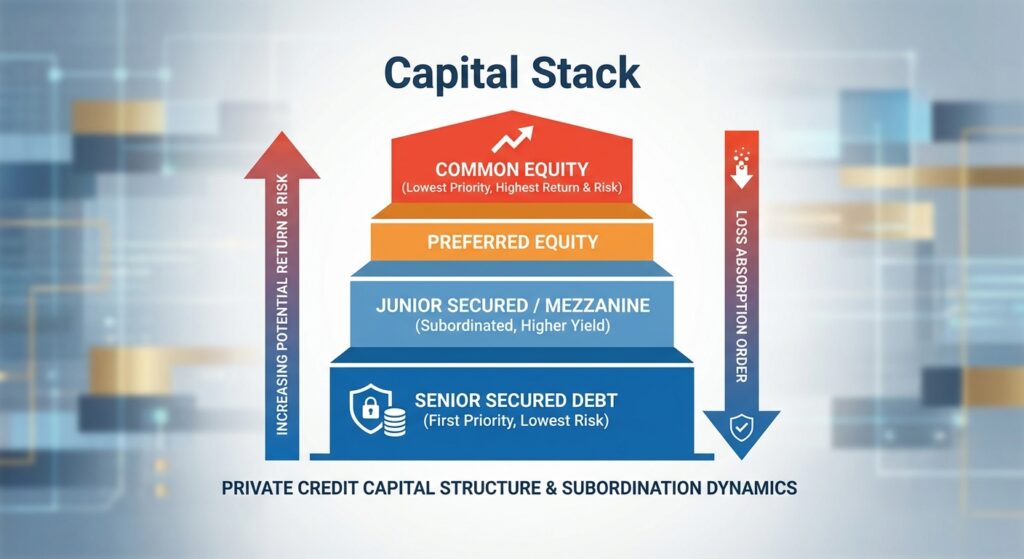
Think of the capital stack as a multi-story building. Each floor represents a different class of capital. The ground floor, senior secured debt: is the safest. It is first in line for repayment, backed by a first-priority lien on the company’s assets, and typically carries the lowest return. As you move up the building, each successive layer accepts greater risk in exchange for a higher potential return.
A typical private credit capital stack, from most senior to most junior, looks like this:
- Senior Secured Debt (First Lien): First priority claim on collateral. Lowest risk, lowest yield. Often provided by banks, insurance companies, or direct lenders. Per Umbrex’s Private Credit Industry Primer, this layer typically carries floating-rate coupons (e.g., SOFR + spread), upfront origination fees, and tighter covenant packages than syndicated loans.
- Second Lien / Junior Secured Debt: Subordinated to first lien but still secured by collateral. Higher yield, less recovery certainty in a default.
- Mezzanine / Unsecured Debt: No collateral claim. Often structured with cash and payment-in-kind (PIK) coupons, and may include equity warrants or co-investment rights. Higher return profile to compensate for subordination.
- Preferred Equity: Sits above common equity in the liquidation waterfall but below all debt. Combines income (dividends) with limited upside participation.
- Common Equity: Residual ownership. Last to be paid, first to absorb losses, but captures all upside if the business grows in value.
Subordination is the legal mechanism that enforces this hierarchy. When a borrower defaults, subordinated creditors cannot recover a single dollar until senior creditors are made whole. This principle (enforced through intercreditor agreements and bankruptcy law) is what makes seniority genuinely protective, not just theoretical.
A Concrete Example: The $50M Middle-Market Deal
Consider a private equity sponsor acquiring a manufacturing business for $50 million. The deal is financed as follows:
- $25M Senior Secured First Lien Loan: provided by a direct lender at SOFR + 500 bps (approximately 9.3% all-in as of early 2026). This represents a 50% Loan-to-Value (LTV) ratio.
- $10M Mezzanine Debt: provided by a private credit fund at a blended 13% coupon (cash + PIK). This layer is subordinated to the first lien.
- $15M Equity: contributed by the private equity sponsor. This is the first-loss layer, representing a 30% equity cushion beneath all debt.
Now stress-test the structure. If the business underperforms and is sold at a distressed valuation of $30 million: a 40% decline from purchase price, the waterfall works like this:
- The $25M senior lender is repaid in full. ✓
- The $10M mezzanine lender receives the remaining $5M, a 50% loss on their position. ✗
- The equity sponsor loses their entire $15M contribution. ✗
This example illustrates the core trade-off. The senior lender accepted a lower yield (~9%) but was protected by $25M of subordinated capital sitting below them, a buffer equal to 50% of the total enterprise value. The mezzanine lender earned a higher yield (13%) but accepted meaningful downside exposure. The equity sponsor took the highest risk and requires the strongest business outcome to generate a return.
Current Market Relevance
Understanding capital stack dynamics matters more today than at almost any point in the last decade, for two converging reasons: the explosive growth of private credit and a tightening bank lending environment that is reshuffling who occupies each layer of the stack.
According to Preqin data cited by Coll er Capital (June 2025), global private credit assets under management reached approximately $1.7 trillion at the end of 2024, up from just $300 billion in 2010, and forecasts project AUM surpassing $2.6 trillion by 2029. That growth is not incidental. It reflects a structural shift: as banks have pulled back from middle-market lending under regulatory and balance sheet pressures, private credit managers (Blackstone, Apollo, Ares, KKR, and dozens of others) have moved into the senior secured layer previously dominated by commercial banks.
This shift has meaningful implications for how capital stacks are being constructed today:
- Unitranche structures: which blend the senior and junior tranches into a single loan with a blended rate, have become increasingly common in sponsor-backed middle-market deals, as noted in Umbrex’s Private Credit Industry Primer (November 2025). They simplify execution but require careful intercreditor documentation.
- Private credit funds are increasingly using back-leverage structures (subscription credit facilities, CLO warehouses, and note-on-note financings) to amplify returns at the fund level, as outlined by Mayer Brown’s Fund Finance analysis (March 2025).
- Senior secured direct lending, the ground floor of the capital stack, remains the dominant private credit strategy by AUM, reflecting institutional preference for seniority and collateral protection in an uncertain macro environment.
Decision Framework: Investors and Operators
For Investors Evaluating Private Credit Opportunities:
- Identify exactly where in the capital stack the fund invests. A “private credit” fund investing in mezzanine has a fundamentally different risk profile than one focused on senior secured first lien.
- Evaluate the equity cushion beneath the debt position, the dollar buffer of subordinated capital before your principal is impaired. A 40% equity cushion is meaningfully more protective than a 15% one.
- Examine the intercreditor agreement in multi-tranche deals. Who controls enforcement? What standstill periods apply to junior creditors?
- Understand whether the yield being offered is commensurate with the subordination risk being accepted. Higher yield without a clear structural reason for it is a warning sign, not a reward.
For Operators and Business Owners Seeking Capital:
- The more senior the lender, the cheaper the capital, but the more restrictive the covenants and collateral requirements. Operators evaluate this trade-off based on their operational flexibility needs.
- Adding mezzanine or preferred equity layers allows businesses to access more total capital without immediately diluting common equity ownership, a relevant consideration for founders and family-owned businesses.
- In the current environment, direct lenders are often able to provide a full capital stack solution (unitranche) in a single transaction, reducing the complexity of managing multiple creditor relationships simultaneously.
Key Takeaways
- Position determines protection: Senior secured lenders hold first-priority collateral claims and are repaid before any other capital provider; this seniority is legally enforceable, not just conventional.
- Subordination creates the risk ladder: Each layer down the capital stack accepts greater loss exposure in exchange for a higher target return. Understanding where a position sits is the starting point for any credit analysis.
- Equity cushion is your margin of safety: For debt investors, the amount of equity and junior capital sitting below them is the true measure of downside protection, not just the interest rate being earned.
- Private credit has displaced banks at the senior level: With global private credit AUM approaching $1.7 trillion, institutional direct lenders now routinely occupy the first-lien position that commercial banks once held in middle-market transactions.
- Operators can use stack complexity strategically: Multi-layer capital structures allow businesses to optimize the cost of capital across tranches (cheaper senior debt for core financing, more flexible junior capital for incremental growth) without unnecessary equity dilution.


