
The Underwriting Question Every Credit Committee Should Ask
Before a term sheet is signed, every credit committee must confront one foundational question: Under what conditions does this borrower stop being able to service its debt? Not in a base case. Not when management hits its projections. But when revenue slips, margins compress, and working capital tightens simultaneously.
This is the discipline of cash flow stress testing, and it sits at the core of sound credit underwriting. In a higher-rate environment where total leverage in most middle market deals now ranges from 4.0x to 5.0x EBITDA (down from levels exceeding 6.0x common in prior cycles), even modest operational deterioration can compress debt service coverage to dangerously thin margins. According to ibinterviewquestions.com, debt capacity analysis is no longer just a sizing exercise; it is a survival test for the credit structure itself.
The lenders who avoid surprise defaults are not the ones who get the most optimistic base case. They are the ones who systematically break their own underwriting before funding.
The Analytical Framework: Building a Three-Scenario Cash Flow Model
A credible stress test is not a single sensitivity toggle. It is a structured, three-scenario model that isolates the borrower’s key economic drivers and tests the debt structure against each. The three scenarios are:
- Base Case: Management projections, lightly haircut. Revenue growth reflects historical performance or conservative industry consensus. Margins held flat or slightly compressed.
- Stress Case: A plausible but adverse operating environment. Typically, revenue down 10–20%, gross margins compressed 150–300 bps, and capex held at maintenance levels (no deferral benefit).
- Downside / Covenant Breach Case: A severe but not catastrophic scenario designed to identify the exact threshold at which key covenants are tripped and liquidity is exhausted. This is the scenario that drives covenant cushion analysis.
Example: A $10M EBITDA Manufacturing Company at 4.5x Leverage
Consider a borrower with $10M in trailing twelve-month (TTM) EBITDA, $45M in senior secured debt (4.5x leverage), a 9.5% all-in interest rate, and a 7-year amortization schedule with 1% annual cash amortization plus a cash flow sweep.
- Annual interest expense: $45M × 9.5% = $4.275M
- Annual mandatory amortization: $45M × 1% = $450K
- Total annual debt service (base): $4.725M
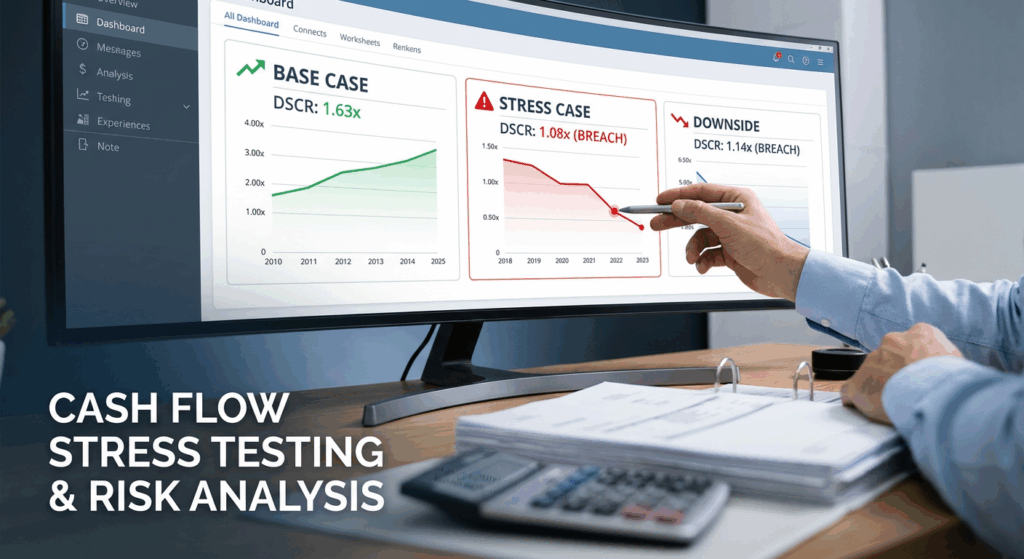
- Base DSCR: $10M EBITDA – $1.5M capex – $800K taxes = $7.7M cash available / $4.725M = 1.63x
At 1.63x, the base case looks acceptable. Most institutional lenders require a minimum maintenance DSCR covenant of 1.10x–1.25x. But what happens when we stress it?
Walking Through the Stress Calculations
Stress Case: Revenue Down 15%, Margins Compressed 200 bps
If revenue falls 15% and gross margins compress 200 basis points, EBITDA does not fall by 15%; it falls by more, because fixed cost structures mean that revenue declines flow disproportionately to the bottom line. For a manufacturing company with 60–65% fixed costs as a share of its cost structure, a 15% revenue decline can translate to a 25–30% EBITDA decline.
- Stressed EBITDA: $10M × (1 – 0.275) = $7.25M
- Cash available for debt service: $7.25M – $1.5M capex – $650K taxes = $5.1M
- Stressed DSCR: $5.1M / $4.725M = 1.08x: below the 1.10x covenant floor
A 15% revenue decline trips a covenant breach in year one. This is precisely the insight a stress test is designed to surface. The lender can now make a deliberate structural decision: set the maintenance covenant at 1.00x with a larger cushion, require a cash reserve account, or reduce the initial leverage quantum to create more headroom.
Downside Case: What Does Liquidity Exhaustion Look Like?
In the downside scenario, layer in a working capital drag (receivables extending from 45 to 65 days) and a capex spike from deferred maintenance. Cash available for debt service can turn negative within two quarters, even if the company is technically EBITDA-positive. This is why the Basel Committee on Banking Supervision (BIS, April 2025) emphasizes that sound credit-granting processes must include forward-looking cash flow projections under adverse scenarios, not just historical ratio analysis.
What Institutional Lenders Look For, and Where Credits Go Wrong
Experienced direct lenders and institutional credit platforms evaluate stress test outputs against a consistent set of benchmarks. Key thresholds that appear across credit committee frameworks include:
📊 Credit Performance Benchmarks (Institutional Reference Points)
- Minimum stressed DSCR: 1.10x–1.25x (maintenance covenant floor across most senior secured structures)
- Target leverage ceiling (current market): 4.0x–5.0x EBITDA for most middle market transactions, per ibinterviewquestions.com
- Average DSCR in stressed sectors: The skilled nursing facility sector (a capital-intensive, government-reimbursed industry) currently shows an average DSCR of just 1.18x, below the standard 1.25x underwriting threshold, per corecredit.io. Annual default rates in that sector run at 3.2%, more than double the SBA baseline of ~1.5%.
- Fixed charge coverage ratio (FCCR): Institutional lenders typically require FCCR ≥ 1.20x on a trailing and forward basis
- Operating leverage risk: Fixed cost ratios above 60% of revenue materially amplify EBITDA volatility in stress scenarios and should trigger tighter covenant structures
Common Red Flags in Stress Test Review
- Management projections with no stress scenario: A CIM that only presents upside and base is an immediate credibility flag. Experienced lenders, as noted by strutconsulting.com, are increasingly focused on judgment and governance quality, not just data volume.
- EBITDA normalization that inflates the base: Aggressive add-backs that cannot survive scrutiny make every coverage ratio look better than it is. Always rebuild EBITDA from cash receipts up.
- No working capital sensitivity: Stress tests that ignore receivables extension, inventory build, or payables compression miss the most common early warning signal of credit deterioration.
- Single-point projections: Any model that does not show a range of outcomes underestimates uncertainty and overstates analytical precision.
Cash Flow Stress Testing: Underwriting Checklist
Use this checklist as a structured diligence gate before credit committee submission:
- ✅ Reconstruct EBITDA from source documents: bank statements, tax returns, and audited financials. Do not rely on management-prepared schedules without reconciliation.
- ✅ Identify the top 3 revenue and margin drivers, then shock each independently and in combination in the stress model.
- ✅ Model three distinct scenarios (base, stress, downside) with explicit assumptions for revenue growth, margin, capex, working capital, and tax cash outflows.
- ✅ Calculate DSCR, FCCR, and leverage multiple in each scenario on a quarterly basis for at least eight quarters forward.
- ✅ Identify the exact revenue or EBITDA level that trips each covenant: document the cushion as a percentage decline from current levels.
- ✅ Test liquidity independently: model the revolver draw, cash reserve burn, and free cash flow sweep in the downside scenario.
- ✅ Document the fixed cost structure: what percentage of the cost base is truly variable within a 12-month window?
- ✅ Obtain independent market data on industry default and recovery rates as a benchmark for loss-given-default assumptions.
- ✅ Present the stress test findings to credit committee with a clear articulation of the conditions under which the credit impairs, not just the conditions under which it succeeds.
Key Takeaways for Credit Underwriters
- 🔑 Stress testing is a structural tool, not a box to check. The output should directly inform leverage sizing, covenant levels, and reserve requirements, not sit as an appendix to the credit memo.
- 🔑 DSCR in a base case tells you nothing about risk. A 1.63x base DSCR can become a 1.08x stressed DSCR with a single modest revenue decline. The stress delta is the actual risk metric.
- 🔑 Fixed cost operating leverage amplifies credit risk. Manufacturing, healthcare, and infrastructure borrowers with high fixed cost ratios require wider covenant cushions and tighter liquidity structures.
- 🔑 Working capital is the earliest warning signal. Receivables extension and inventory build often precede EBITDA deterioration by one to two quarters, monitor them monthly in portfolio credits.
- 🔑 The downside case should inform the exit, not just the entry. Understanding exactly how a credit impairs (and at what recovery rate) is as important as understanding why it is being funded.


