
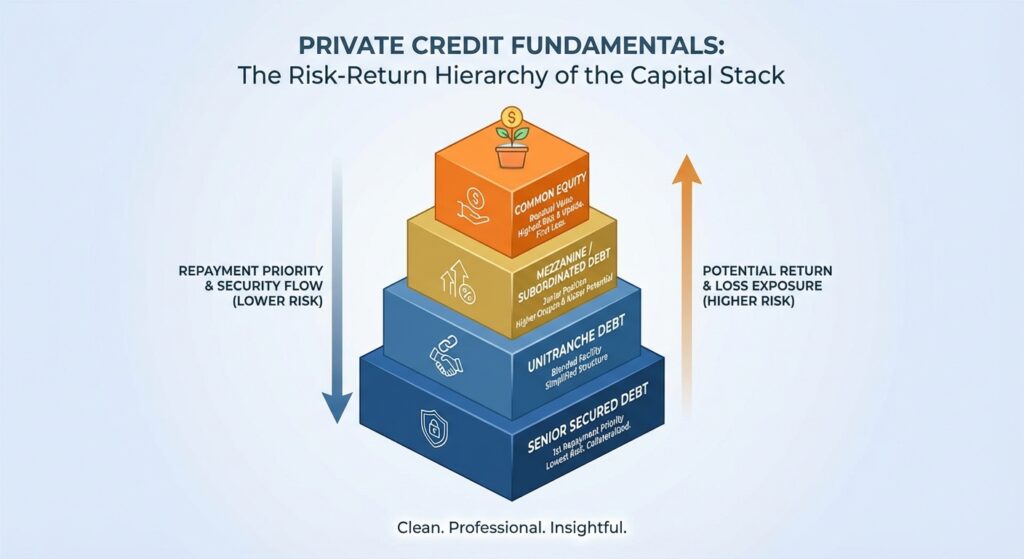
Where You Sit Determines What You Get
In private credit, one principle outranks almost every other consideration: your position in the capital stack determines both your risk exposure and your return potential. Before a single dollar is deployed into a direct lending deal, experienced investors and operators study the layering of claims: who gets paid first, who absorbs losses first, and how much of a cushion separates each layer from impairment. Understanding this hierarchy is the single most important foundational concept in private credit.
The capital stack is not a metaphor. It is a legally enforceable priority waterfall embedded in loan documents, intercreditor agreements, and security packages. Every layer has a defined place in line, and that place in line has direct consequences for yield, recovery, and risk.
The Four Layers of the Capital Stack
The capital stack is typically divided into four primary layers, ordered from lowest risk to highest risk:
- Senior Secured Debt: sits at the top of the repayment priority. Backed by a first lien on company assets, senior lenders are repaid before all other capital providers. Because of this protection, senior debt carries the lowest interest rate in the stack. According to Gridline (January 2024), nearly half of all capital raised by private debt funds in recent years has flowed into senior debt strategies, a direct reflection of investor demand for seniority and collateral protection.
- Unitranche Debt: a hybrid instrument that blends senior and junior debt economics into a single loan facility. The lender internally allocates risk between a “first-out” and “last-out” tranche via an Agreement Among Lenders (AAL). For borrowers, unitranche simplifies the documentation and negotiation process. For lenders, it delivers a blended yield that compensates for the combined risk profile.
- Subordinated / Mezzanine Debt: ranks below senior debt but above equity. Mezzanine lenders absorb losses before senior lenders do, and in exchange, they receive meaningfully higher coupons, often structured with both cash pay and PIK (payment-in-kind) components, sometimes paired with equity warrants. According to Umbrex’s Private Credit Industry Primer (November 2025), mezzanine instruments typically feature unsecured or second-lien structures with equity kickers, reflecting their subordinated risk profile.
- Common Equity: sits at the very bottom. Equity holders own the residual value of the business after all debt is repaid. They benefit most from upside but absorb losses first and are typically wiped out entirely in a restructuring before senior lenders see any impairment.
A Concrete Example: How the Stack Works in Practice
Consider a hypothetical middle-market manufacturing company valued at $50 million, being acquired with the following capital structure:
- Senior Secured Loan: $25 million at SOFR + 550 bps (≈10.3% all-in at current rates)
- Mezzanine Debt: $10 million at a 14% blended coupon (cash + PIK)
- Equity: $15 million contributed by the private equity sponsor
The total leverage is $35 million against a $50 million enterprise value, implying a loan-to-value (LTV) of 70%. For the senior lender, the equity cushion, that $15 million of sponsor equity sitting below them, means the company’s value would have to fall by 30% before the senior lender faces a single dollar of loss. The mezzanine lender’s cushion is only the $15 million equity layer, meaning a 30% value decline wipes through equity and starts eroding their position.
As Capital Market Compass (January 2025) notes, senior debt in a typical buyout capital stack represents roughly 50% of total capitalization, often sized at 2.0x–3.0x EBITDA, with interest coverage requirements of approximately 2.0x, structural guardrails that protect lenders before documentation covenants even come into play.
Current Market Relevance: Why Position Matters More Than Ever
The private credit market has grown dramatically, and the competition for senior-secured deal flow has intensified accordingly. According to Mayer Brown / Mondaq (March 2025), private credit assets under management exceeded $1.7 trillion globally by end of 2023, with projections pointing toward $3 trillion by 2028. At that scale, understanding where capital is being deployed (and at what level of the stack) is essential due diligence, not optional context.
Meanwhile, the structural shift away from bank lending has made private credit lenders the dominant providers of senior debt to middle-market companies. As Gridline (January 2024) explains, post-crisis banking regulations such as Basel III made mid-market senior lending economically unattractive for banks: creating a structural, not cyclical, opportunity for private credit funds. Senior direct lending yields of 10–12%+ at SOFR + 500–600 bps spreads reflect that opportunity, as noted by Capital Founders OS (March 2026).
For investors evaluating private credit funds, capital stack position is a primary risk signal. A fund advertising 14%+ net yields should prompt direct questions: Is that return coming from senior secured positions, or from subordinated exposure? What is the average LTV across the portfolio? How much equity cushion sits below the fund’s loans?
Decision Framework: Investors and Operators
For Investors Evaluating Private Credit Funds:
- Identify whether the fund’s stated strategy matches its actual capital stack positioning: senior, unitranche, or mezzanine exposure carry materially different risk profiles.
- Examine average LTV ratios and equity cushion thickness across the portfolio. A thin equity cushion below senior loans accelerates loss exposure in a downturn.
- Evaluate whether yield levels are consistent with the stated position in the stack. A senior-secured fund yielding 15%+ in a 10–12% market may be taking subordinated risk while marketing a senior label.
- Review intercreditor agreement terms in unitranche structures to understand how first-out and last-out economics are divided internally.
For Business Operators Seeking Capital:
- Recognize that where a lender sits in the stack directly affects the cost of your capital. Senior lenders price lower; mezzanine lenders price higher, matching the lender’s position to your affordability is a core structuring decision.
- Consider unitranche as a simplification tool when dealing with a single lender is operationally preferable to managing a two-lender senior/mezzanine split.
- Understand that lenders at every level will scrutinize how much equity sits below their loan. A thin equity layer makes senior lenders uncomfortable and drives pricing higher, or kills the deal.
Key Takeaways
- Position determines priority: In any default or restructuring, the capital stack’s legal hierarchy dictates the repayment sequence, seniority is not a preference, it is a contractual right.
- Equity cushion is a lender’s first line of defense: The thicker the equity layer below a senior loan, the more enterprise value can erode before the lender faces loss. LTV and cushion thickness are core underwriting metrics.
- Risk and yield must be consistent with stack position: Mezzanine yields compensate for subordination risk; senior yields reflect collateral protection. Mismatches between stated position and actual yield are a due diligence red flag.
- Unitranche structures blend economics, not risk: A single unitranche loan still carries internal first-out and last-out economics, the risk differentiation exists inside the loan, not just across lenders.
- Banks leaving mid-market senior lending is structural: The private credit market’s growth in senior secured direct lending reflects a permanent regulatory-driven shift, not a temporary gap, making capital stack literacy essential for anyone participating in the asset class today.


