
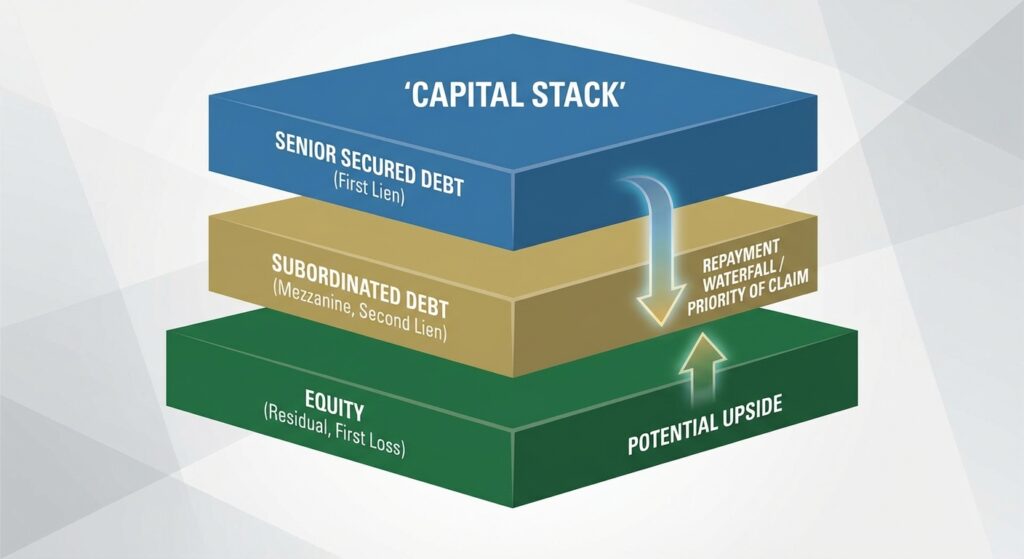
The Foundation of Finance: Understanding the Capital Stack
Just like a skyscraper requires a robust foundation before a roof can be built, corporate finance operates on a strict structural hierarchy. In private credit, this hierarchy is known as the capital stack. As the global private credit asset class continues its explosive growth, grasping where a specific loan resides within this framework (its seniority or subordination) is the single most important variable for evaluating risk, return, and downside protection.
Whether you are an allocator evaluating a private credit fund or a business operator seeking growth capital without giving up board seats, the rules of the capital stack dictate the mathematical realities of your transaction.
The Concept: Seniority vs. Subordination
The capital stack represents the absolute legal hierarchy of a company’s financial obligations. It establishes the “waterfall”: the exact sequential order in which capital providers are repaid during normal operations, and more importantly, in the event of a liquidation or bankruptcy.
At the very top sits Senior Secured Debt. These lenders possess a “first lien” on the company’s assets, meaning they hold the primary claim on cash flows, intellectual property, and physical collateral. Because their structural risk of loss is the lowest, they receive the lowest relative yield.
Moving down the structure, we find Subordinated Debt (often referred to as Mezzanine Debt). This layer sits firmly below senior lenders but above equity holders. These lenders are “subordinated” in the repayment line; they must wait for senior lenders to be completely made whole before recovering a single dollar in liquidation. To compensate for this elevated risk, junior lenders require higher returns, often blending cash interest with payment-in-kind (PIK) interest or equity warrants.
At the very bottom lies Equity. Equity holders absorb the first dollar of loss but capture all the limitless upside once all debt obligations are satisfied.
How It Works: The Waterfall in Action
To understand the mechanics of subordination, consider a hypothetical middle-market software company, “TechCorp,” which requires $100 million in total capital to fund an acquisition. The capital is structured as follows:
- Senior Secured Debt: $40 million (First lien claim). The required yield is SOFR + 5%.
- Subordinated Debt: $20 million (Second lien claim). The required yield is 12% cash interest plus 2% PIK.
- Common Equity: $40 million (Sponsor and founder capital).
In a bull-market scenario, TechCorp generates robust cash flow, services both debt tranches easily, and eventually sells for $200 million. The senior lender gets their $40 million back, the subordinated lender gets their $20 million, and the equity holders walk away with the remaining $140 million, a massive return on their initial $40 million investment.
However, the protective power of the capital stack is proven in a downside scenario. Suppose TechCorp loses its largest client, defaults, and is liquidated for a total enterprise value of just $50 million. How is the capital distributed?
The financial waterfall is absolute: The Senior Secured lender receives their full $40 million back. Despite the company losing half its value, the senior lender experiences a 100% recovery. This leaves exactly $10 million. The Subordinated lender, who is owed $20 million, takes the remaining $10 million, taking a 50% loss. The Equity holders, at the bottom of the stack, receive $0, suffering a total wipeout. This mathematical reality illustrates why the top of the capital stack offers such powerful capital preservation.
Current Market Relevance
The current macroeconomic environment has dramatically reshaped how market participants view different layers of the capital stack. As banks continue retreating from mid-market corporate lending due to stringent regulatory frameworks like Basel III, private credit funds have stepped in to fill the void, particularly at the top of the stack.
Recent data underscores this dynamic shift across the industry:
- According to Atlas Peak Research (March 2026), the global private credit market has ballooned to an estimated $2.1 trillion in assets and committed capital, based on IMF framing.
- The latest UBS Global Family Office Report revealed that family offices doubled their private credit holdings from 2% in 2023 to 4% in 2024, making it their fastest-growing allocation, per Capital Founders OS (March 2026).
- With the Secured Overnight Financing Rate (SOFR) at 4.3%, senior direct lending yields are currently paying 10-12%+. This allows lenders to pursue historical equity-like returns while retaining the defensive posture of first-lien senior status (Capital Founders OS).
- Because of these attractive risk-adjusted returns, almost half of all capital raised by private debt funds in recent vintages has been strictly allocated to senior debt, prioritizing downside protection over the marginal yield pickup of subordinated debt, according to Gridline.
Decision Framework
For Investors: Allocators evaluating private credit must weigh their appetite for risk against their yield targets. In a higher-rate environment, the 10-12% yields generated by senior secured debt effectively compensate investors without forcing them to stretch into second-lien or mezzanine risk. When evaluating funds, investors meticulously examine a portfolio’s “equity cushion” (the amount of equity sitting below the debt) and the robustness of the covenant structures that allow senior lenders to step in before value is completely destroyed.
For Operators: Business owners face a balancing act between the cost of capital and operational flexibility. Senior debt is mathematically the cheapest capital available, but it comes with the tightest financial covenants and the strictest amortization schedules. Subordinated or mezzanine debt carries a higher interest burden but is often “covenant-lite,” offering more breathing room for growth without tripping technical defaults. Crucially, while subordinated debt is more expensive than senior debt, it remains substantially cheaper than raising equity, allowing founders to fund growth metrics without permanently diluting their ownership stake.
Key Takeaways
- Position Dictates Protection: The capital stack determines the rigid legal order of repayment; senior secured lenders are always first in line for recovery.
- Yield Reflects Subordination: Moving down the capital stack increases the risk of loss, which is strictly compensated by higher interest rates and potential equity kickers.
- The Waterfall is Unforgiving: In a liquidation scenario, junior capital providers receive nothing until senior lenders are paid back in full, making the underlying equity cushion a vital shield for debt investors.
- Rates Boost Senior Yields: Strong base rates mean investors can currently achieve double-digit yields at the top of the stack, heavily reducing the incentive to take on subordinated risk.
- Debt Protects Ownership: For operating companies, utilizing the debt layers of the capital stack prevents permanent equity dilution, keeping the enterprise upside squarely in the hands of founders and existing shareholders.


