
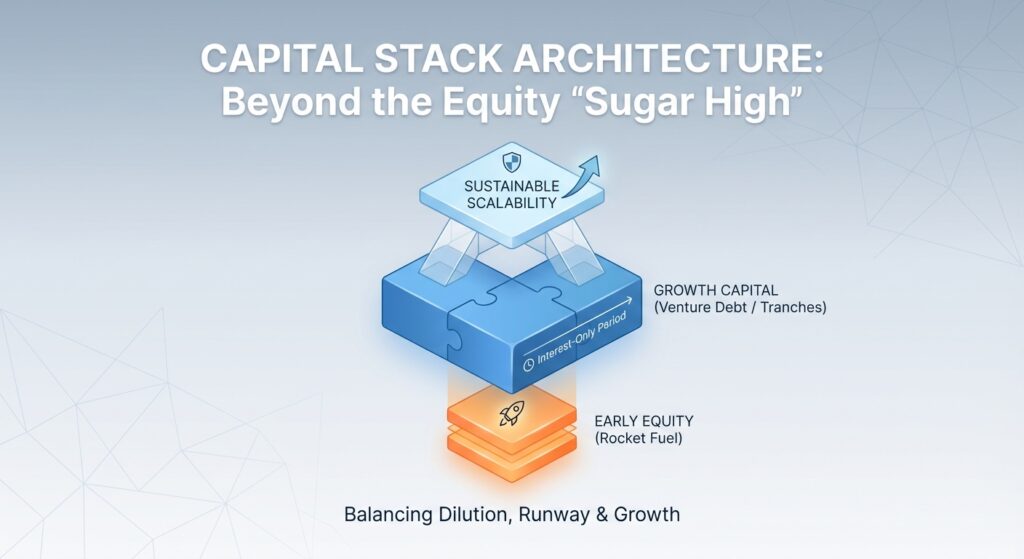
The Financing Challenge: Beyond the Equity “Sugar High”
By 2026, the capital environment has fundamentally shifted. The era of “growth at all costs” has dissolved into a discipline of unit economics and sustainable scalability. For founders and CFOs, the primary challenge is no longer just access to capital, but the architecture of that capital. As highlighted by Lendity, early equity is “rocket fuel”, essential for ignition but exorbitantly expensive for cruising altitude. Selling 25% of a company at the Seed stage for $2M can translate to selling $50M of value at a $200M exit. The mathematical reality is stark: relying solely on equity to fund working capital or predictable revenue growth is a dilution disaster.
The inflection point typically arrives around $2M–$4M in Annual Recurring Revenue (ARR). At this stage, the business has proven product-market fit and predictable unit economics. Raising a priced equity round purely to fund inventory, receivables, or customer acquisition costs (CAC) is inefficient. The strategic solution is to move down the cost-of-capital spectrum, introducing Growth Capital (Venture Debt) to the stack. This structure bridges the gap between expensive equity and restrictive traditional bank financing.
Structure Breakdown: The Growth Term Loan
A standard Growth Capital facility is designed to extend runway without triggering a valuation event or forcing a board reshuffle. Unlike a revolving line of credit which is governed by a borrowing base of immediate assets (AR/Inventory), a growth term loan is underwritten on enterprise value and recurring revenue quality.
Core Components and Mechanics
- Facility Size: Typically 20%–35% of the most recent equity round or 4x–6x Monthly Recurring Revenue (MRR).
- Draw Period: Capital is often available in tranches. Tranche A is drawn at close; Tranche B and C are available upon hitting specific revenue or EBITDA milestones.
- Amortization: The defining feature is the Interest-Only (IO) period, usually 12–18 months, followed by a 24–30 month amortization schedule. This matches the investment cycle, allowing cash to be burned on growth before repayment begins.
Hypothetical Term Sheet: Series B SaaS Company
Consider a B2B software company with $5M ARR seeking roughly $10M in capital to bridge 24 months to a Series C or profitability.
- Facility Amount: $10,000,000 Term Loan.
- Interest Rate: Prime + 4.50% (Cash Pay) + 2.0% PIK (Payment in Kind, accruing to principal).
- Maturity: 48 months.
- Interest-Only Period: 18 months.
- Warrant Coverage: 6% of the loan amount ($600k value) priced at the most recent 409a or equity round valuation. This provides the lender with upside participation (the “kicker”).
- Covenants: Minimum liquidity (e.g., 6 months burn) and a simplified performance covenant (e.g., maintain 80% of plan revenue).
How It Compares: The Cost of Capital Spectrum
Understanding where this structure fits is critical for capital stack design.
Vs. Venture Equity: Equity, while patient, is permanent. According to Moonshot Capital, early dilution compounds significantly. Venture debt is temporary; once repaid, the dilution (aside from warrants) vanishes. The internal rate of return (IRR) cost for debt might be 15–20%, whereas the cost of equity (expected return) often exceeds 30–40%.
Vs. Bank Loans: Traditional commercial bank loans are the cheapest capital (Prime + 1–2%) but come with strict maintenance covenants (e.g., Debt/EBITDA, Fixed Charge Coverage) and often require personal guarantees or profitability. Venture growth debt tolerates cash burn and lacks personal guarantees, trading this flexibility for a higher yield and warrant coverage.
Vs. Revenue-Based Financing (RBF): RBF takes a percentage of top-line revenue for repayment. While flexible, it can choke cash flow during high-growth periods. As Alvren Consulting notes, structuring RBF requires simulating pullback under slow scenarios to avoid stacking risk. Venture debt offers a predictable, fixed repayment schedule that is often easier to model into burn rate calculations.
Current Market Terms (2026)
The 2026 market reflects a flight to quality. Lenders are scrutiny-heavy on retention metrics (Net Revenue Retention > 110%) and path to profitability.
- Interest Rates: Wit h benchmarks normalizing, all-in coupons for venture debt are seeing tight spreads, hovering in the 10–13% range for strong credits.
- Warrant Coverage: Coverage has compressed slightly. Standard deals are seeing 4–8% coverage, down from 10%+ seen in tighter liquidity cycles.
- Covenant Flexibility: Insights from Alvren suggest a move toward “springing” covenants effective only when liquidity drops below a certain threshold.
- Sequencing: Founders are layering debt 3–6 months after an equity raise to maximize the “halo effect” of the fresh valuation, rather than using it as a desperate bridge when cash is low.
Data from Boundev indicates that 73% of startups fail due to cash mismanagement. Consequently, 2026 terms emphasize Drawstops: lenders retaining the right to halt future tranches if material adverse changes occur, specifically regarding unit economic deterioration.
Structuring Guidance
For Operators: View the capital stack as a 24-month horizon. Do not stack conflicting notes with different maturity timelines or conversion triggers, as this creates cap table distortion (Moonshot). Negotiate for a longer Interest-Only period over a lower interest rate; cash flow flexibility in months 12–18 is worth more than saving 50bps on the coupon.
For Investors: Focus on the leverage ratio relative to recurring revenue, not EBITDA. A healthy ratio is typically < 0.75x Debt/ARR for loss-making companies. Ensure the "Final Payment" or "End of Term Fee" (often 2–5%) is modeled into the effective APR.
Key Takeaways
- Match Term to Use: Use equity for R&D/product discovery; use debt for repeatable sales/marketing and working capital.
- Guard the Cap Table: Warrants are cheaper than priced equity rounds, treat them as such, but watch for anti-dilution triggers.
- Sequence Intelligently: Secure debt lines when the balance sheet is strongest (post-raise), not when the runway is ending.
- Negotiate Covenants: Fight for “covenant-lite” structures that rely on liquidity cushions rather than strict EBITDA or revenue floors.
- Exit Optionality: Ensure prepayment penalties scale down (e.g., 3%-2%-1%) to allow for cheap refinancing if the company outperforms or exits early.


