
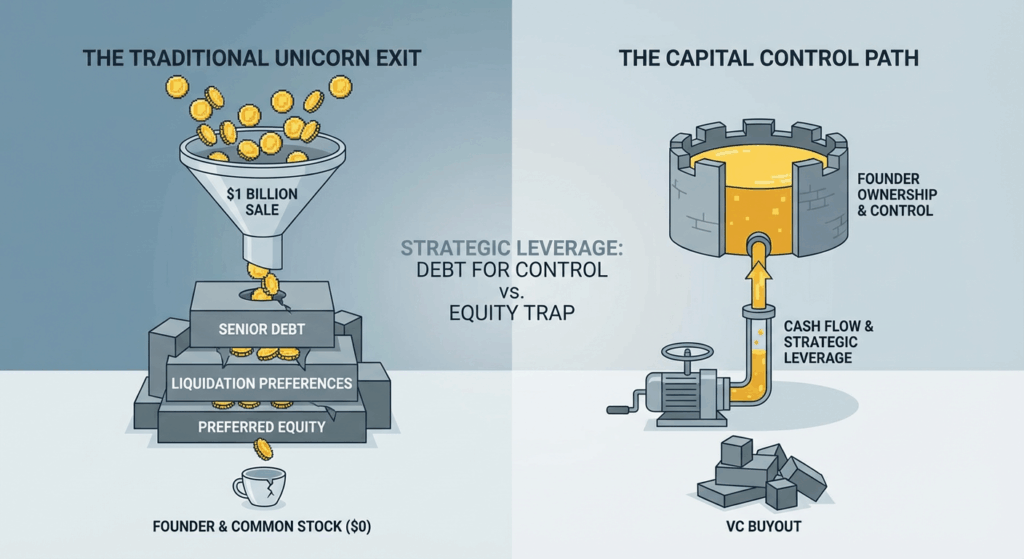
The dream of every founder is the billion-dollar exit. But as a recent sale demonstrates, the headline price holds little meaning if the capital structure beneath it is broken.
In the high-stakes world of private capital, two recent stories illustrate the extreme ends of the spectrum for founders. On one side, we have a unicorn that sold for $1 billion in early 2025, leaving its founders and employees with exactly zero. On the other, a founder who rejected the venture treadmill to buy back his company using debt, cementing control over a profitable empire.
These divergent paths, Divvy Homes and Invisible Technologies: offer a masterclass in the mechanics of seniority, liquidation preferences, and the true cost of capital.
The Cautionary Tale: Divvy Homes
In January 2025, proptech darling Divvy Homes sold to Brookfield Properties for approximately $1 billion. By any traditional metric, a billion-dollar exit is a triumph. Yet, reports confirm that the common shareholders (including the founders and early employees) walked away with nothing.
The Trap: Divvy’s capital structure was a layer cake of obligations. Founded in 2016 with a noble mission to help renters become owners, the model was capital-intensive. To fuel growth, Divvy raised over $400 million in venture equity from tier-one firms like a16z and Tiger Global, achieving a peak valuation of $2.3 billion in 2021.
But equity wasn’t enough to buy the physical homes required by their model. In October 2021, the company took on roughly $735 million in debt financing. When interest rates surged in 2022 and 2023, the cost of servicing that debt, combined with a cooling housing market, broke the unit economics.
The Math: When the sale occurred, the waterfall of payments was brutal but standard. First, the debt holders (senior secured lenders) were repaid. Second, the preferred equity investors (VCs) exercised their liquidation preferences, guaranteeing they get their money back before common stock sees a dime. After $735M in debt and hundreds of millions in preferred equity claims were satisfied, the remaining pot was empty.
As Jason Lemkin of SaaStr noted, this wasn’t a failure of the asset value, the company was worth a billion dollars. It was a failure of capital structure. The “overhang” of debt and preference stacks meant the builders owned an option that expired worthlessly.
The Counter-Narrative: Invisible Technologies
Contrast this with Francis Pedraza, founder of Invisible Technologies. In early 2020, Pedraza was struggling to raise capital. VCs dismissed his “AI-plus-humans” operations business as unscalable and messy compared to pure software. Rejected by the establishment, he was forced to operate with discipline.
The Pivot: Instead of chasing a billion-dollar valuation through capital injection, Invisible focused on cash flow. The demand for human-in-the-loop AI training data exploded with the rise of OpenAI (a key client). By 2024, the company generated $134 million in revenue and $15 million in EBITDA.
Rather than using this success to raise a massive Series B or C, Pedraza did the opposite. As reported by Forbes, he began buying out his venture investors. He is effectively leveraging the company’s own cash flow (and potentially debt financing) to recapitalize the business, reducing the liquidation preference stack rather than adding to it.
The Outcome: By using debt and cash flow to remove misalignment, Pedraza is increasing his ownership and control. He isn’t working for the debt holders or the preferred equity stack; he is using capital as a tool to consolidate legitimate manufacturing value.
The Lessons: Liquidity vs. Valuation
The juxtaposition of these two companies provides a framework for founders facing capital decisions today.
1. Liquidation Preferences Are “Silent Debt”
Founders often view equity as “safe” and debt as “risky.” The Divvy Homes case proves this false. Preferred equity with liquidation preferences acts like debt in an exit scenario; it must be paid back first. When you stack $400M of preferred equity on top of $700M of actual debt, you have created a $1.1 billion hurdle rate before you earn a dollar. Raising equity is raising a liability against your future exit proceeds.
2. Asset-Heavy Models Require distinct Capital
Divvy used corporate recourse debt to fund asset purchases. When the asset values wavered and rates rose, the corporate entity suffocated. Successful operators separate specific asset financing (non-recourse) from the operating company (“OpCo”). If the OpCo guarantees the debt of the assets, the contagions are fatal.
3. Control Has a Premium
Francis Pedraza’s path highlights that the most valuable asset a founder has is optionality. by keeping his burn low and reaching profitability, he unlocked the ability to use leverage offensively (to buy out partners) rather than defensively (to keep the lights on).
Key Insights
- The Waterfall Rules Everything: In a distressed or even moderate exit, seniority determines who gets paid. Common stock sits at the bottom.
- Valuation is Vanity, Structure is Sanity: A $2.3B valuation is dangerous if it comes with 1x or 2x liquidation preferences that bury the founder.
- Debt Can Be a Tool for Control: Used correctly against cash flow (like Invisible), debt can retire expensive equity and consolidate ownership.
- Bad capital structures kill good companies: Divvy helped 2,000 families and had real assets, but the financial engineering suffocated the operational success.
- Profitability is Freedom: You cannot engineer a buyback or leverage recapitalization without positive unit economics.


