
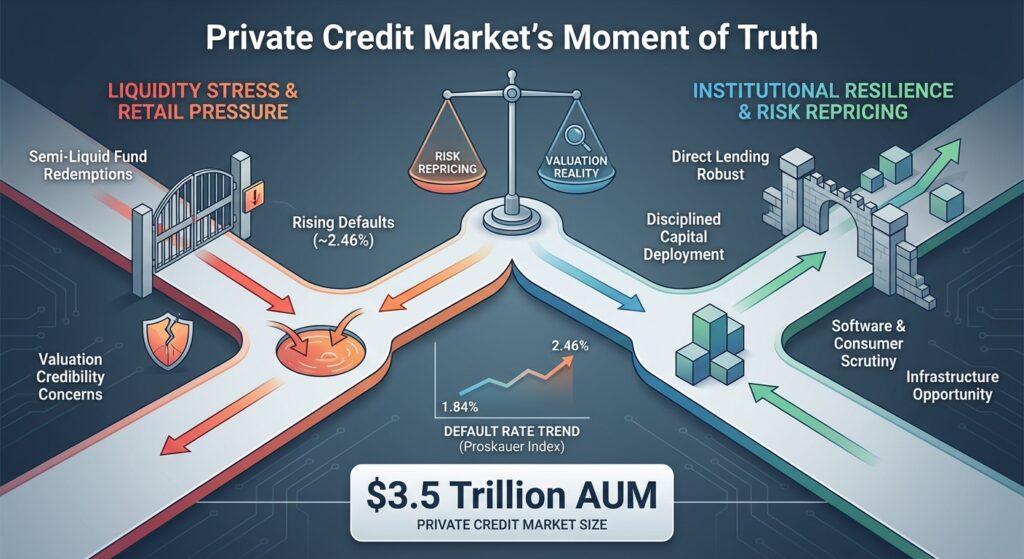
Market Headline: Private Credit Facing “Moment of Truth” Amidst Liquidity Test
As of March 2026, the $3.5 trillion private credit market is navigating its most significant stress test since the asset class went mainstream. While institutional direct lending remains structurally robust, the “semi-liquid” segment catering to individual investors is facing acute pressure. The narrative has shifted from pure growth to a focus on liquidity management and valuation credibility.
Headlines in Q1 2026 have been dominated by redemption gates at major asset managers, including Blue Owl and Blackstone, triggered partly by retail panic following high-profile bankruptcies like Tricolor and First Brands. Despite this volatility, deployment hit record levels in 2024 ($592.8 billion), and borrower demand remains high. The market is currently bifurcating: “tourism” capital is retreating, while disciplined institutional capital is repricing risk, particularly in the software and consumer sectors.
Quantitative Snapshot: March 2026
| Metric | Current Value | Trend / Comparison | Source |
|---|---|---|---|
| Default Rate (Proskauer Index) | 2.46% (Q4 ’25) | Create rising trend vs 1.84% (Q3 ’25) | LongYield |
| Target Returns | 9% – 13% | Yields remain attractive relative to public fixed income | LongYield |
| Market Size (AUM) | ~$3.5 Trillion | Up from $500B in 2015; projected to hit $5T by 2029 | LongYield |
| Software Loan Maturity | 46% < 4 Years | Significant near-term refinancing wall in key sector | LongYield |
| Borrower Cash Flow | 40% Negative FCF | Indicates heightened reliance on sponsor support/refi | LongYield |
Sector Analysis: The Software & Consumer Split
Software & Technology (Caution Watch): Historically the darling of private credit, the software sector is now termed a “pressure point” by analysts. With 46% of software loans maturing within four years and valuations under scrutiny, lenders are reassessing the enterprise value (EV) cushions that previously justified high leverage ratios. The concern is less about immediate insolvency and more about “valuation credibility” and the ability to refinance without equity injections.
Consumer & Auto (Distress Signals): The collapse of Tricolor (subprime auto) and First Brands has injected caution into consumer-facing credit. Tricolor’s liquidation following double-pledging allegations has spooked lenders, leading to tighter controls on asset-based lending collateral. This sector is currently facing the tightest credit availability as lenders scrutinize consumer resilience.
Power & AI Infrastructure (Hot): Conversely, capital is rotating toward physical infrastructure, specifically power generation and data centers supporting the Generative AI boom. These assets offer the tangible collateral and inflation-linked cash flows that software and consumer credits currently lack.
Implications for the Market
For Borrowers: The era of “covenant-lite” ubiquity is pausing. Expect lenders to demand tighter documentation and more rigorous valuation, particularly in the middle market. Borrowers in the software space may face a “repricing of underwriting discipline,” meaning lower leverage multiples and higher equity contribution requirements for new deals.
For Lenders & Investors: The liquidity mismatch in semi-liquid funds (evergreen structures) is the primary structural risk. With redemption queries spiking, managers must balance liquidity sleeves (often 10-40%) without forced selling of illiquid assets. For institutional investors (LPs), this is a buying opportunity; as retail capital retreats or gets gated, traditional closed-end funds can negotiate better terms and spreads. The “valuation lag”, where private marks trail public reality, is the critical metric to watch in Q2 2026.
Key Market Insights
- Retail vs. Institutional Divergence: Stress is concentrated in semi-liquid wealth products; traditional drawdown funds remain stable.
- Default Normalization: Defaults rising to ~2.5% is a reversion to the mean, not a systemic collapse, but forces better credit selection.
- Software Repricing: Expect valuation mark-downs in tech portfolios as the “maturity wall” forces realization events.
- Fraud Risk Focus: Post-Tricolor, operational due diligence (ODD) on collateral management is tightening significantly.
- Opportunity in Dislocation: Secondaries markets will likely see increased volume as LPs seek liquidity from gated funds.


