
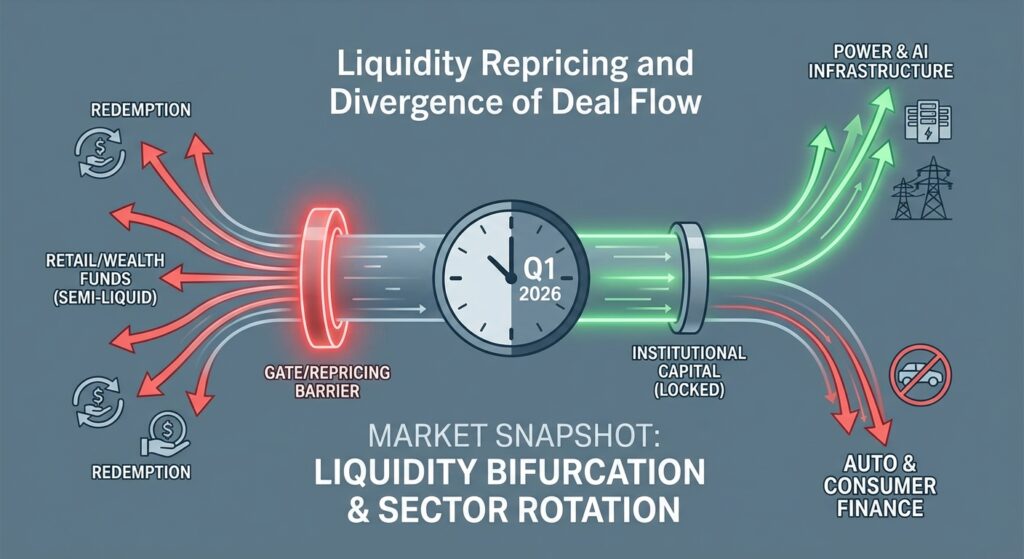
Market Headline: The Liquidity Repricing of 2026
As of March 19, 2026, the private credit market is navigating its most significant structural test since emerging as a dominant asset class. The “Golden Era” narrative has hit a tangible wall, driven not by a systemic solvency crisis, but by a liquidity mismatch in the retail and wealth channels. Following the high-profile bankruptcies of Tricolor and First Brands in late 2025, a wave of redemption requests has forced major players like Blue Owl, Blackstone, and BlackRock to implement gates or cap repurchases on semi-liquid evergreen funds.
However, institutional signals remain mixed against this retail panic. While news headlines draw comparisons to the Global Financial Crisis, underlying data suggests a “repricing” rather than a collapse. The market is witnessing a harsh bifurcation: locked institutional capital remains stable, while “semi-liquid” vehicles face severe stress due to asset-liability mismatches. For borrowers, this translates to a sudden tightening of underwriting standards and a renewed focus on valuation credibility, particularly in sectors prone to complex collateral structures.
Quantitative Snapshot: Q1 2026
The following metrics define the current credit environment, highlighting the divergence between headline sentiment and fundamental reality.
| Metric | Current Level / Trend | Comparison / Context | Source |
|---|---|---|---|
| Global Market Size | ~$2.1 Trillion (Assets + Committed) | Continued structural growth despite outflows | Atlas Peak |
| Default Rates | < 2.0% (Headline Rate) | Remains historically low despite PIK increases | With Intelligence |
| Liquidity Status | Gated / Capped (Retail Funds) | Sharp contrast to 2024-2025 liquidity abundance | Tamar Securities |
| Stress Indicators | Rising PIK Toggles | Signaling cash flow pressure in portfolios | With Intelligence |
Sector Analysis: The Flight from Consumer to Infrastructure
The sector rotation in Q1 2026 is driven largely by the fallout from specific idiosyncratic frauds and macro-trends in technology.
Cold: Consumer & Auto Finance
Lender appetite for consumer-exposed debt has evaporated following the collapse of subprime auto lender Tricolor. The bankruptcy revealed a massive instance of “double-pledging” collateral, freezing funding for similar borrowers. Tricolor and First Brands have become cautionary tales, causing credit committees to retreat from asset-heavy consumer sectors where collateral verification is difficult. This has led to a widening of spreads for any borrower in the auto supply chain or consumer finance space.
Hot: Power & AI Infrastructure
Conversely, capital is aggressively rotating toward physical infrastructure supporting the technology stack. Generative AI infrastructure and Power sectors are seeing sustained activity. As the “valuation credibility” of software recurring revenue loans comes under question, hard-asset lending in power generation (to support data centers) represents the new defensive play for large direct lenders seeking deployment at scale.
The Pressure Point: Software
Software, long the darling of private credit, is identified as a current “pressure point.” While not collapsing, the valuation multiples are being scrutinized as lenders question mark-to-model valuations in a liquidity-constrained environment.
Implications for Borrowers & Lenders
For Borrowers
The era of “covenant-lite” ubiquity in the middle market is pausing. Borrowers should expect intense forensic due diligence regarding collateral pledging, specifically to rule out the types of fraud seen in the Tricolor case. Refinancing will be challenging for issuers relying on Payment-In-Kind (PIK) toggles to preserve cash, as lenders view this as a distress signal rather than a flexibility feature.
For Lenders & Investors
The market is splitting into two realities. Institutional Lenders (Closed-end funds) are capitalizing on the volatility to negotiate better terms and wider spreads, unburdened by daily liquidity needs. Retail/Wealth Funds (BDCs, Interval Funds) are forced to hold cash to meet redemption requests, effectively sidelined from new deal issuance. This retreat by major semi-liquid players is creating a less competitive, lender-friendly environment for those with dry powder.
Forward-Looking View: The 2026 Outlook
Looking ahead to Q2 and Q3 2026, the market expects the “liquidity pricing” dynamic to persist. We do not anticipate a generalized solvency event, provided unemployment remains stable. However, the dispersion in manager performance will widen significantly. The managers who maintained underwriting discipline during the 2024-2025 boom will outperform, while those who chased volume in consumer sectors will face continued workout headaches.
Key Market Insights
- Liquidity Bifurcation: Retail funds are gated; institutional funds are deploying. Structure matters more than ever.
- Fraud Wake-Up Call: The Tricolor double-pledging scandal is forcing a complete overhaul of collateral verification items.
- Infrastructure Rotation: Capital is flowing away from consumer debt and into Power/AI infrastructure real assets.
- Valuation Scrutiny: “Mark-to-model” valuations for illiquid assets are being challenged; expect write-downs in older vintage portfolios.
- Opportunistic Vintage: 2026 funds may offer attractive vintages as lenders regain leverage on terms and pricing.


