
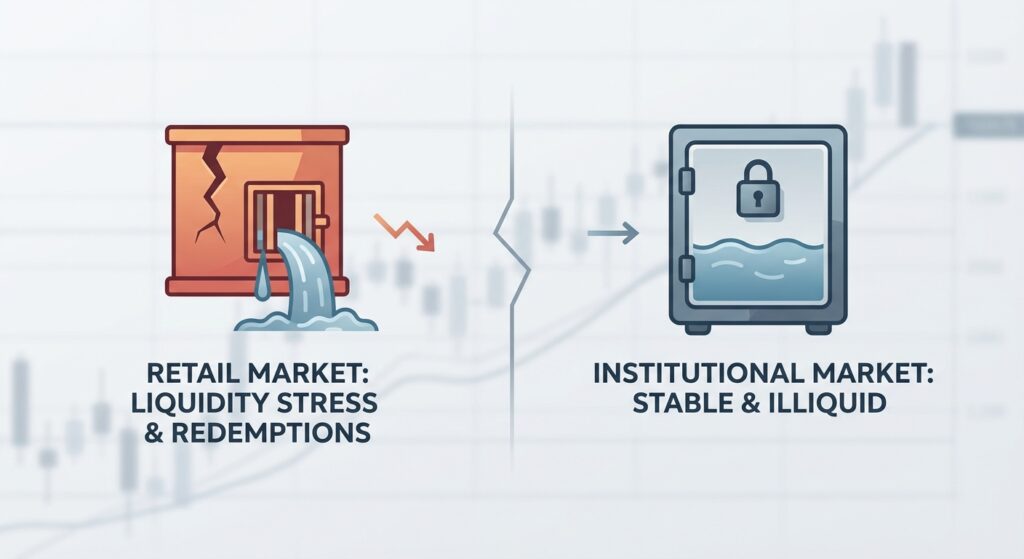
Market Headline: The First True Test of the "Democratized" Credit Model
As of March 2026, the private credit market has entered a pivotal phase characterized by a sharp bifurcation between institutional stability and retail liquidity stress. While the asset class has swollen to an estimated $3.5 trillion globally, cracks are emerging in specific structural pockets. The headlines are dominated by liquidity mismatches in semi-liquid "evergreen" funds sold through wealth channels, evidenced by recent redemption gates, while traditional closed-end institutional funds remain largely insulated but cautious regarding portfolio health.
We are witnessing a repricing of risk rather than a solvency crisis. The massive deployment of capital in 2024 ($592.8 billion) is now facing scrutiny as borrower cash flows tighten. With 40% of borrowers reportedly operating with negative free cash flow, the market is shifting from a pure deployment game to one of rigorous portfolio management and defensive positioning.
Quantitative Snapshot: March 2026
| Metric | Current Value | Comparison / Trend | Source |
|---|---|---|---|
| Proskauer Default Index | 2.46% (Q4 ’25) | Up from 1.84% in Q3 ’25 | LongYield |
| Borrower Free Cash Flow | 40% Negative | Signaling rising debt service strain | LongYield |
| 2024 Deployment Vol. | $592.8 Billion | record levels (+78% YoY) | LongYield |
| Target Returns | 9.0% – 13.0% | Yields sustaining despite headwinds | LongYield |
| Distressed Fundraising | $100 Billion+ | Raised over trailing 24 months | With Intelligence |
Sector Analysis: Software Strain and Infrastructure Resilience
The monolithic view of private credit is dissolving as sector-specific risks materialize.
- Software & Technology (The Pressure Point): Historically the darling of direct lending due to recurring revenue models, the software sector is now highlighted as a key area of stress. Valuation credibility is being questioned as high-multiple loans face maturity walls. Atlas Peak Research identifies software as a primary "pressure point" where mark-to-model valuations may not align with current exit realities.
- AI & Power Infrastructure (The Growth Engine): Conversely, capital demand remains robust in Generative AI infrastructure and the associated power generation sectors. These capital-intensive projects are absorbing significant deal flow, acting as a counter-balance to the softening in traditional LBO volume.
- Distressed & Opportunistic: A new cohort of funds is capitalizing on the volatility. With over $100 billion raised for distressed strategies recently, managers are preparing for a "refinancing cliff" where good companies with bad balance sheets will require structured capital solutions outside of standard direct lending parameters.
Implications for Market Participants
For Borrowers: The era of covenant-lite indifference is ending for the middle market. While capital is available (dry powder remains at record highs), underwriting has tightened. Lenders are demanding cleaner cash flow visibility and are less willing to underwrite pure recurring-revenue loans without a clear path to profitability. Expect higher scrutiny on "add-backs" and stricter definitions around EBITDA.
For Lenders & Investors:
The primary risk has shifted from credit risk (will they pay?) to liquidity risk (can we exit?). The recent closure of redemption windows in major semi-liquid funds serves as a wake-up call for the retailization of private markets. Investors must scrutinize the "liquid sleeve" of evergreen funds: if a fund uses its liquid assets to meet early redemptions, remaining investors are left with a more concentrated, illiquid portfolio. We expect a rotation of capital toward managers with disciplined valuation practices and away from those relying heavily on PIK (Payment-in-Kind) toggles to mask borrower stress.
Forward-Looking Perspective (Next 3-6 Months)
We anticipate the "denominator effect" to reverse locally within credit portfolios. As defaults potentially tick toward 3%, the divergence between best-in-class vintage performance and the median will widen significantly. The next two quarters will likely see:
- Secondary Market Activity: A surge in LP-led secondaries as investors seek to offload illiquid positions in gated funds.
- Consolidation: Smaller managers unable to handle workout situations may be absorbed by larger platforms with dedicated restructuring teams.
- Regulatory Attention: Heightened scrutiny on valuation methodologies, particularly regarding how funds mark assets that are currently utilizing PIK interest to remain "performing."
Key Market Insights
- Default Cycle Has Turned: Defaults have broken the 2% floor and are trending upward, led by consumer-facing and tech sectors.
- Retail vs. Institutional Split: Liquidity stress is concentrated in wealth-channel products; institutional drawdown funds remain stable but illiquid by design.
- Cash Flow is King Again: 40% of borrowers having negative FCF suggests a wave of amendments and extensions (A&E) is imminent.
- Deployment vs. Discipline: Record deployment in 2024 poses a vintage risk if those loans were underwritten at peak valuations before the current softness.
- The Opportunity Set: Dislocation creates alpha. Distressed and special situations funds are positioned to outperform pure-play direct lenders in the near term.


