
The Architecture of Risk: Understanding the Capital Stack
In the world of private credit, the most critical determinant of risk and return is not the interest rate of the moment, but the structural position of the investment. This structure is known as the capital stack.
For both investors allocating capital and business owners (operators) seeking funding, the capital stack serves as the blueprint of a deal. It defines the hierarchy of claims: who gets paid first when things go right, and more importantly, who holds the keys if things go wrong. While market sentiment shifts, as seen in the liquidity discussions of early 2026, the fundamental physics of seniority remain constant.
This article unpacks the mechanics of the capital stack, focusing on why “Senior Debt” has become the dominant instrument in private credit and how it functions as a shield against valuation volatility.
The Concept: A Layer Cake of Priorities
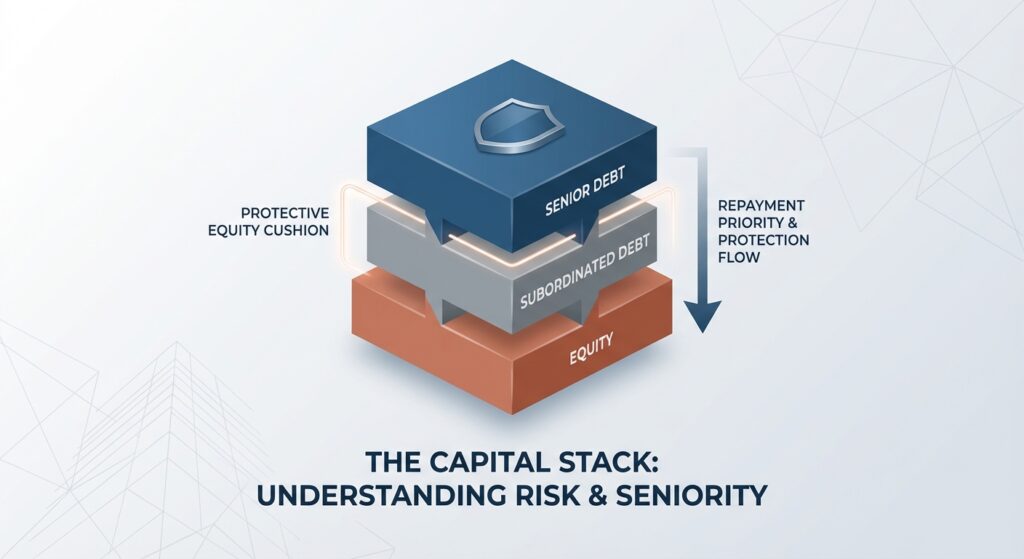
Think of the capital stack as a layer cake representing the total enterprise value (EV) of a company. Each layer represents a different source of funding with distinct rights and risks.
At the very bottom is Common Equity. This is the highest risk layer; it holds the most upside potential but is the last to be paid. Above equity lies Preferred Equity and Subordinated (Mezzanine) Debt. At the very top sits Senior Debt.
Seniority refers to the order of repayment. In a liquidity event (whether a sale, recapitalization, or bankruptcy) money flows down the stack from the top. Senior lenders are paid first. Only after their claims are fully satisfied does capital flow to the junior lenders, and finally to equity holders.
This hierarchy creates a protective buffer for senior lenders known as the Equity Cushion. The thicker the layers of equity and junior debt below the senior loan, the more the company’s value can decline before the senior lender’s principal is threatened.
How It Works: A Concrete Example
To understand the protective mechanics of the capital stack, let’s look at a hypothetical financing scenario for a stable middle-market company, “TechFlow Services.”
- EBITDA: $10 Million
- Enterprise Value (EV) Multiple: 10x
- Total Enterprise Value: $100 Million
The deal is structured with 40% debt and 60% equity (a conservative structure common in 2026).
The Capital Stack
- Senior Debt (First Lien): $40 Million (4.0x Leverage)
- Common Equity (Sponsor/Founder): $60 Million
Scenario A: Growth
If TechFlow grows its value to $150 million, the Senior Debt remains at $40 million (plus interest). The Equity value explodes from $60 million to $110 million. The equity holders capture the upside.
Scenario B: Contraction (The Downside Protection)
Suppose TechFlow faces market headwinds and its valuation multiple compresses. The company is now worth only $50 million (a 50% drop in value).
- Total Value: $50 Million
- Senior Debt Claim: $40 Million (Paid in full)
- Equity Remaining: $10 Million (83% loss)
Even in a catastrophic 50% valuation drop, the Senior Debt is fully covered. The “Equity Cushion” absorbed the blow. This implies that for the senior lender to lose a single dollar of principal, the company’s value would have to fall by more than 60%.
Current Market Relevance (March 2026)
The principles of the capital stack are particularly relevant in the current economic environment. Following the interest rate shifts of 2024-2025, the risk-return profile of senior debt has structurally changed.
According to Capital Market Insights (Jan 2025), senior debt typically comprises roughly 50% of the capital funding in deals, often generally covering 2.0x to 3.0x EBITDA, though this varies by sector.
In March 2026, the market is witnessing a “flight to quality” within the stack. Data from Capital Founders OS (Mar 2026) indicates that senior direct lending is generating yields of 10-12%+, driven by a base SOFR rate of approximately 4.3% plus credit spreads. This allows senior lenders to achieve double-digit returns without taking equity risk.
Furthermore, Atlas Peak Research (Mar 2026) notes that while stress is appearing in semi-liquid structures holding illiquid assets, traditional closed-end direct lending funds (which align duration with the underlying 5-8 year loans) remain resilient. The “cracks” in the market are largely a function of liquidity terms, not necessarily underlying credit performance for senior secured loans.
This structural shift is permanent, not cyclical. As banks retreated due to regulatory capital constraints, private credit funds stepped in to provide this senior capital, effectively becoming the new base layer of corporate finance.
Decision Framework
For Investors
When evaluating private credit opportunities, the primary metric is Loan-to-Value (LTV) attachment point. If a fund invests in Senior Debt with a 40% LTV, there is a 60% equity buffer protecting that capital. In the current 2026 environment, investors should scrutinize this cushion alongside the fund structure (evergreen vs. closed-end) to ensure their liquidity terms match the asset’s liquidity.
For Operators (Founders/CFOs)
For business owners, the capital stack represents a trade-off between cost of capital and control. Senior debt is the cheapest form of long-term capital (10-12% cost vs. 25%+ cost for equity). Utilizing senior debt allows founders to fund growth or acquisitions while minimizing dilution. However, it imposes discipline: interest must be paid quarterly, requiring stable cash flows (positive EBITDA).
Key Takeaways
- Seniority is Safety: In a default, senior lenders dictate the outcome and are paid first, utilizing the equity cushion as a shock absorber.
- The Math of Protection: A 40% LTV loan requires a >60% drop in enterprise value before principal is at risk.
- Yield Without Dilution: For 2026 investors, senior debt offers equity-like returns (10-12%) with debt-like protections.
- Structure Matters: The stability of the capital stack depends on matching asset duration with fund structure; traditional drawdown structures remain robust.
- Strategic Capital: For operators, senior debt is a tool to amplify returns on equity without selling ownership stakes.


