
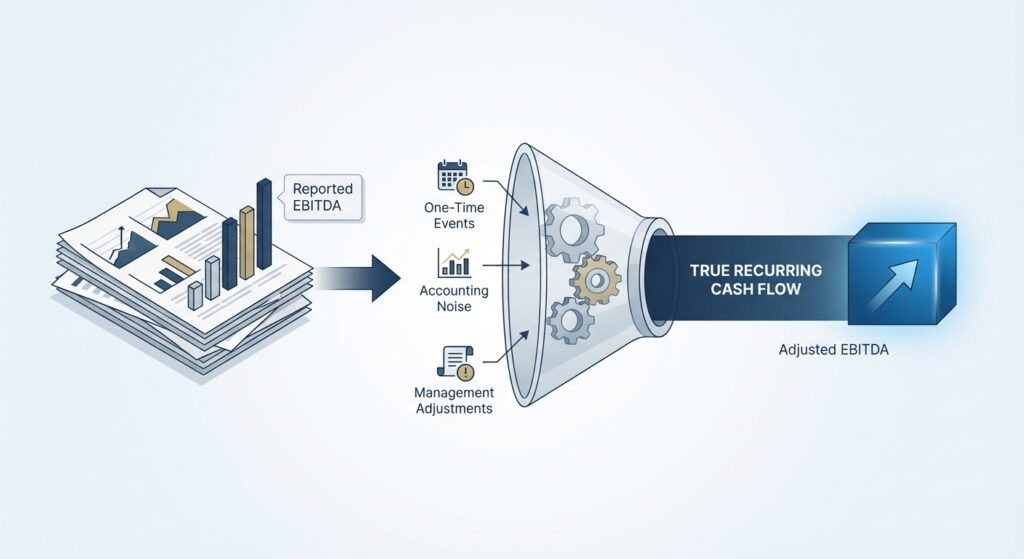
The Underwriting Challenge: Identifying True Cash Flow
In credit underwriting, reported financial statements rarely tell the whole story. While Net Income is an accounting construct, EBITDA (Earnings Before Interest, Taxes, Depreciation, and Amortization) is the standard proxy for operating cash flow. However, standard EBITDA frequently fails to capture the recurring economic reality of a borrower. The critical underwriting challenge lies not in reading the income statement, but in normalizing it: separating true, recurring cash flow from one-time events, accounting noise, and aggressive management adjustments.
For lenders, the risk is asymmetric: accepting inflated EBITDA numbers leads to understated leverage ratios (Debt/EBITDA) and overstated coverage ratios, masking the borrower’s true ability to service debt. As noted in the Principles for the Management of Credit Risk by the Basel Committee, a sound credit-granting process requires a thorough assessment of the borrower’s repayment capacity under various scenarios, not just acceptance of presented figures.
The Framework: Normalization and Quality of Earnings
The objective of EBITDA normalization is to derive “Adjusted EBITDA”, a metric that represents the run-rate earnings power of the business post-closing. This process typically mirrors a Quality of Earnings (QoE) analysis performed during due diligence.
An effective normalization framework categorizes adjustments into three buckets:
- Non-Recurring Items: True one-time events that will not repeat (e.g., litigation settlements, disaster recovery costs).
- Pro Forma Adjustments: Impacts of the transaction or recently implemented changes (e.g., eliminating owner salaries, realizing cost savings from a closed factory).
- Accounting Corrections: Reclassifying items to align with cash flow (e.g., treating capitalized software development as an expense if it recurs annually).
The Analysis: Walking Through the Adjustments
Consider a manufacturing company undergoing underwriting with a reported LoLa (Last Twelve Months) EBITDA of $10.0 million. A borrower may present a “Marketing EBITDA” of $14.0 million based on aggressive add-backs. A prudent underwriter analyzes each line item:
- Management Fees (+$2.0M): The borrower adds back fees paid to the previous private equity owner. Since these will cease post-transaction, this is a valid pro forma adjustment.
- “Restructuring Costs” (+$1.5M): The company classifies severance and consulting fees as one-time. However, analysis shows they have booked “restructuring” charges in 4 of the last 5 years. Action: Reject or significantly discount this add-back, as it appears to be a recurring operating expense.
- Inventory Write-down (+$0.5M): A discrete event caused by a warehouse flood. Action: Accept as non-recurring.
Calculation Result:
Start: $10.0M (Reported)
+ $2.0M (Valid Fees)
+ $0.5M (Valid One-time)
+ $0.0M (Rejected Restructuring)
= $12.5M Adjusted EBITDA
If the lender is providing $50M in debt:
Borrower’s View: $50M / $14M = 3.5x Leverage
Underwriter’s View: $50M / $12.5M = 4.0x Leverage
This 0.5x turn difference in leverage is material for risk rating and pricing. Similar rigor applies to coverage ratios; calculating EBITDA less Capex is essential for capital-intensive industries to determine true free cash flow available for debt service.
Industry Standards and Red Flags
Institutional lenders and rating agencies maintain strict guidelines on “add-backs.” While private credit lenders may allow more flexibility than commercial banks, the core principles of credit analysis remain constant. According to financial training data, leverage ratios such as Total Debt / EBITDA and Net Debt / EBITDA are the primary constraints in loan agreements.
Red Flags in Adjustments:
- Uncapped “Synergies”: Projected cost savings that have not yet been realized. Best practice typically caps these at 15-20% of EBITDA or requires them to be realizable within 12-18 months.
- Poor Quality of Accounts: Significant differences between EBITDA and Cash Flow from Operations (CFO) often signal aggressive revenue recognition or working capital issues.
- Crypto/Digital Exposure: As highlighted in CFA Institute refresher readings, sole reliance on high-level metrics without digging into asset quality (like wirecard insolvency examples) can be fatal.
Underwriting Checklist: Validating the Numbers
To rigorously assess EBITDA quality, underwriters should execute the following diligence steps:
- Review the Quality of Earnings (QoE) Report: Ensure a reputable third-party accounting firm has vetted the historical numbers.
- Request “Bridge” Analysis: Ask management to bridge the gap between Reported EBITDA and Adjusted EBITDA with line-item detail.
- Bank Statement Verification: Does the cash accumulation in bank accounts match the reported EBITDA generation?
- Covenant Definition Check: Review the credit agreement definition of “Consolidated EBITDA.” Does it allow uncapped add-backs for future “cost savings”? Tight definitions protect the lender.
Key Takeaways
- Reported EBITDA is a starting point, not the answer. Prudent lenders must build their own view of “Adjusted EBITDA.”
- Distinguish “one-time” from “recurring.” If an expense happens every year (e.g., annual “restructuring”), it is an operating expense.
- Leverage is sensitive to adjustments. A small rejection of add-backs can significantly increase effective leverage and risk.
- Cash is king. Always reconcile EBITDA back to operating cash flow to ensure earnings are real.
- Structure protects capital. Use strict definitions in the credit agreement to prevent borrowers from inflating EBITDA post-closing.


