
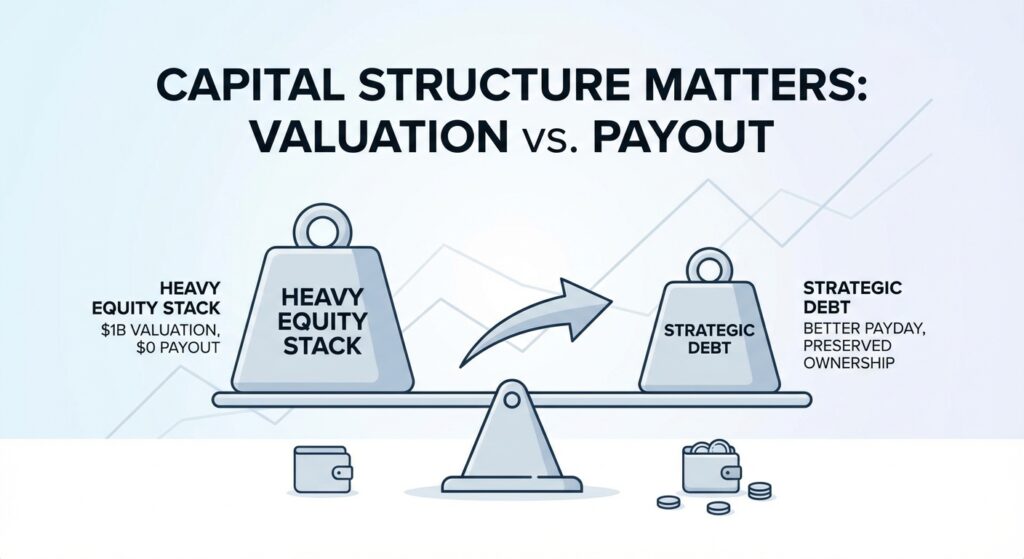
The $1 Billion Exit With a $0 Payday: Why Capital Structure Matters
In the world of high-growth technology, the headline number often hides the real story. In early 2025, real estate startup Divvy Homes sold to Brookfield Asset Management for roughly $1 billion. By most historical standards, a billion-dollar exit is a triumph, the legendary “unicorn” status realized in cash.
Yet, reports emerged shortly after the deal that the founders, employees, and even many early venture investors walked away with zero.
This scenario highlights a critical, often overlooked principle in corporate finance: Capital structure dictates the payout, not just valuation. While Divvy Homes serves as a sobering cautionary tale of a heavy “preference stack,” other founders, like Simon Turner of Myagi, illustrate how a lighter capital footprint, leveraging debt over equity, can arguably lead to better personal outcomes even at smaller exit values.
The Cautionary Tale: When The Stack Gets Too Heavy
Divvy Homes, founded with the noble mission of helping renters become homeowners, raised over $400 million in venture capital and secured substantial debt financing to purchase homes. At its peak in 2021, the company was valued at $2.3 billion.
However, the capital structure required to fuel this asset-heavy model was immense. According to analysis by SaaStr, Divvy had taken on approximately $735 million in debt financing by late 2021, sitting atop hundreds of millions in preferred venture equity.
When the market turned and interest rates rose, the company’s valuation compressed. The exit price of ~$1 billion, while optically large, had to flow through a strict “waterfall” of payments:
- First: Senior debt holders were repaid.
- Second: Preferred equity holders (late-stage VCs) collected their liquidation preferences (often 1x or more of their investment).
- Last: Common shareholders (founders and employees).
In Divvy’s case, the waterfall ran dry before it reached the bottom. The lesson is stark: Equity is not just ownership; it is the last position in line.
The Alternative Path: Strategic Debt to Preserve Equity
Contrast this with the journey of Myagi, a retail sales enablement platform. In 2021, around the same time Divvy was maximizing its valuation, Myagi’s co-founder Simon Turner faced a capital decision. The company had strong product-market fit and needed capital to accelerate growth, but Turner was wary of excessive dilution.
Instead of raising a large venture round that would have permanently sold off a chunk of the company (and added to the liquidation preference stack), Myagi opted for $2.5 million in non-dilutive debt financing from TIMIA Capital.
The Decision:
Turner utilized the debt facility to fund sales and marketing expansion without surrendering board control or ownership percentages. “Debt is a powerful tool for capital-efficient businesses when used under the right circumstances,” Turner noted in a case study regarding the deal.
The Outcome:
Two years later, in 2023, Myagi was acquired by Rallyware. Because the company hadn’t stacked heavy liquidation preferences on top of the founders, the exit math was simpler: repay the remaining debt principal, and distribute the rest to shareholders. The debt acted as a bridge to the exit, costing interest payments rather than permanent ownership points.
The Lesson: Renting Capital vs. Selling Ownership
These two stories illustrate the fundamental trade-off between debt and venture equity.
Venture Equity is “expensive” in success but “safe” in failure. It doesn’t require monthly repayments, but it demands a massive multiple on exit. It effectively raises the bar for what constitutes a successful exit price.
Private Debt is the inverse. It is “risky” if cash flows fail (because it must be serviced), but it is “cheap” in a successful exit. Once the principal and interest are paid, the lender has no claim on the remaining upside.
For founders, the Divvy Homes saga proves that raising capital is not a proxy for success; it is a liability until proven otherwise. A $1 billion exit can result in $0 returns if the capital stack is $1.1 billion high.
Key Insights for Founders
- Liquidation Preferences Matter: Late-stage VC money often comes with “guaranteed returns” that sit above common stock. Understand your “overhang.”
- Debt Caps the Cost of Capital: In an exit scenario, debt gets paid a fixed amount. Equity gets paid a percentage of the infinite upside.
- Asset-Heavy Models Need Caution: Businesses like Divvy that require massive debt to hold assets are twice as sensitive to interest rate shocks.
- Bridge to Exit: If an exit is on the horizon (12-24 months), non-dilutive debt is often mathematically superior to an equity round for bridging that gap.
- The “Waterfall” is Real: Always model your exit waterfall. Know exactly what price you need to sell for to clear the debt and preference stack.
This article is for informational purposes only and does not constitute investment advice.


