
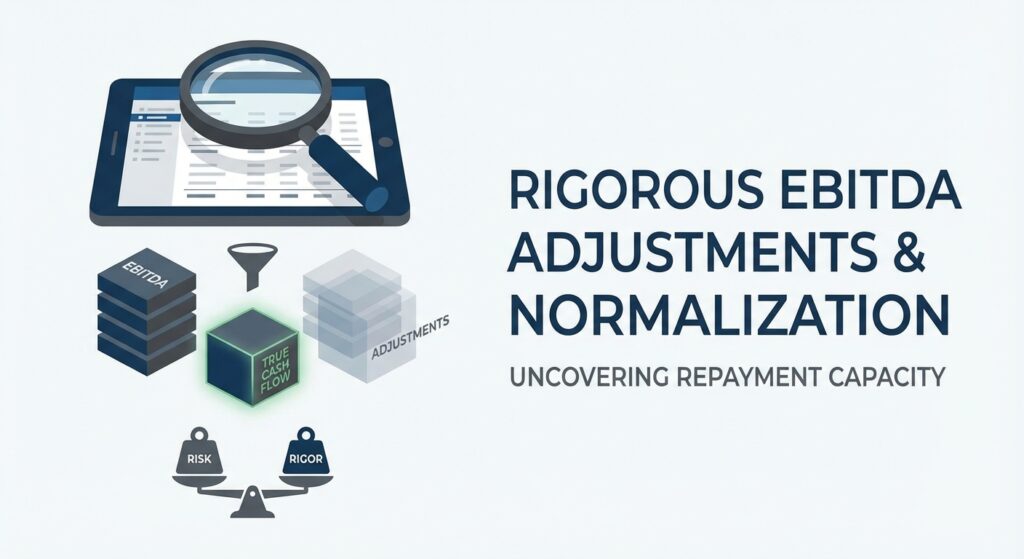
The Underwriting Challenge: Defining The Denominator
In the high-stakes environment of credit underwriting, the definition of EBITDA (Earnings Before Interest, Taxes, Depreciation, and Amortization) often generates the most friction between borrowers and lenders. As of March 2026, as credit structures become increasingly bespoke, the gap between a company’s reported earnings and its verifiable debt-service capacity remains a primary source of risk. For underwriters, “Adjusted EBITDA” is more than an accounting metric; it is the denominator that dictates leverage ratios and the numerator that determines interest coverage.
If a lender accepts aggressive add-backs without rigorous normalization, they artificially deflate the leverage ratio. A borrower presenting 3.0x leverage on Adjusted EBITDA may actually be operating at 5.0x leverage on a cash basis. This divergence is where credit losses crystallize. The objective of sound underwriting is not merely to facilitate a deal, but to construct a “Quality of Earnings” (QoE) view that reflects sustainable, recurring cash flow available for debt repayment.
The Framework: Normalization Methodology
Effective credit analysis requires a disciplined normalization framework. Lenders must bridge the gap between GAAP Net Income and Credit-Ready EBITDA. According to the Basel Committee on Banking Supervision’s 2025 report on credit risk principles, a “sound credit-granting process” requires an accurate assessment of the borrower’s repayment capacity under various scenarios, rather than reliance on optimistic projections.
The normalization process generally classifies adjustments into three tiers of risk:
- Tier 1 (Standard): Non-cash items (D&A, stock-based compensation) and definitive one-time expenses (proven legal settlements, disaster recovery).
- Tier 2 (Operational): Owner compensation normalization, rent adjustments regarding facility moves, and severances. These require verification of future savings.
- Tier 3 (Aggressive/Speculative): Pro-forma “synergies,” projected cost savings from unexecuted initiatives, and “lost revenue” adjustments.
The Analysis: Stress-Testing the Add-Backs
Consider a hypothetical manufacturing borrower, “Alpha Corp,” seeking a term loan. Their CIM presents a robust picture:
- Revenue: $100 Million
- LTM Reported EBITDA: $8 Million
- Proposed Adjustments: +$4.5 Million
- Marketing EBITDA: $12.5 Million
The Adjustments Detail:
- Management Fees ($500k): Fees paid to current owners that will cease post-close.
- Severance ($1M): One-time RIF (Reduction in Force) costs paid in Q2.
- Pro-Forma Synergies ($3M): Estimated savings from closing a warehouse next year.
The Underwriter’s Calculation:
To determine the true credit risk, the underwriter applies a rigor test. The Management Fees are accepted (Tier 1) as they are contractual savings. The Severance is accepted (Tier 1) as cash already spent and non-recurring. However, the $3M in synergies is widely speculative.
Lender’s Adjusted EBITDA Calculation:
$8.0M (Base) + $0.5M (Fees) + $1.0M (Severance) = $9.5M Credit EBITDA.
Impact on Leverage (Assuming $40M Debt Request):
- Borrower’s Leverage: $40M / $12.5M = 3.2x (Appears moderate)
- Lender’s Leverage: $40M / $9.5M = 4.2x (Significantly higher risk)
By rejecting the speculative synergies, the underwriter reveals that the company is leveraged a full turn higher than advertised. This triggers stricter covenant requirements or a reduction in the loan amount.
Industry Standards and Red Flags
Institutional lenders mitigate normalization risk through covenant definitions. The CFA Institute notes that credit analysis must account for the pitfalls of sole reliance on ratings or headline metrics. A common structural protection is the “Capped Add-Back,” where lenders limit speculative adjustments (like synergies) to 15%–20% of total EBITDA.
Furthermore, Wall Street Prep highlights that leverage ratios (Total Debt/EBITDA) are the primary maintenance covenant. If the definition of EBITDA in the credit agreement is too loose, the covenant fails to act as an early warning signal. A robust credit agreement will often include a “sundown clause” on synergies, requiring them to be realized within 12–18 months or forfeited from the calculation.
Common Red Flags:
- Poor “Cash Conversion”: If Adjusted EBITDA is $15M but Operating Cash Flow is $2M, the add-backs are likely artificial.
- Recurring “One-Time” Fees: “Restructuring costs” that appear every year for three years are effectively operating expenses.
- Excessive Owner Add-Backs: Adding back 100% of owner salary without deducting the cost to hire a professional replacement CEO.
Underwriting Checklist: Validating the EBITDA Bridge
To finalize the normalization process, underwriters should execute the following diligence steps:
- Verify Invoices: Request legal bills and settlement documents to confirm “one-time” nature of disputes.
- Bank Validation: Match reported “one-time cash expenses” to actual wire transfers in bank statements.
- Market Replacement Test: For owner-operator adjustments, validate the cost of a replacement executive using compensation surveys.
- Implementation Plans: For synergies, require a detailed implementation plan with costs to achieve the savings (CTA) deducted from cash flow.
Key Takeaways
- Leverage is Sensitive: A 20% inflation in EBITDA can disguise a full turn of leverage, shifting a deal from “pass” to “critical risk.”
- Cash is Sovereign: Always reconcile Adjusted EBITDA to Net Operating Cash Flow; significant divergence is a warning sign.
- Structure is Safety: Use “Caps” and “Sunset Provisions” in legal documentation to limit the life and size of speculative add-backs.
- Define “One-Time”: If an expense occurs in two consecutive years, treat it as an operating expense, not an add-back.
- Scenario Analysis: Stress test the portfolio by removing all Tier 3 add-backs to see if the borrower can still service debt.


