
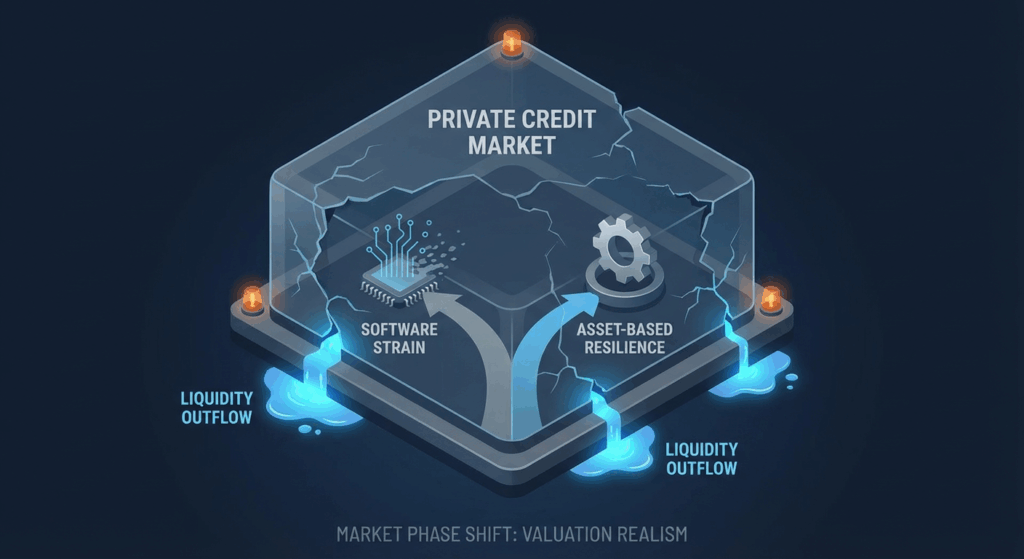
Market Headline: The Liquidity Test Arrives
As of March 15, 2026, the private credit market has entered a defining phase of repricing and liquidity stress, marking its first true structural test of the post-ZIRP era. After expanding to an estimated $3.5 trillion in assets, the sector is grappling with the convergence of retail redemption pressures and deteriorating borrower fundamentals. The focal point of this stress occurred in February 2026, when Blue Owl closed a $1.6 billion fund redemption window, signaling that the liquidity mismatch in semi-liquid “wealth” products is no longer theoretical.
While institutional drawdown funds remain stable, the cracks are widening in credit quality. The “golden age” of deferral is fading; payment-in-kind (PIK) toggles now account for over 8% of BDC income, and 40% of borrowers are operating with negative free cash flow. We are observing a shift from a generalized accumulation phase to a “valuation realism” phase, where lenders must triage portfolios, particularly within the software vintage that dominates many middle-market books.
Quantitative Snapshot: Q1 2026
The following metrics highlight the rapid shift in credit conditions over the last two quarters.
| Metric | Current Value | Comparison / Prior Period | Source |
|---|---|---|---|
| Proskauer Default Index | 2.46% (Q4 2025) | Up from 1.84% in Q3 2025 | LongYield |
| Total Market AUM | ~$3.5 Trillion | 17% YoY Growth | LongYield |
| Borrower Free Cash Flow | 40% Negative | Deteriorating coverage ratios | LongYield |
| Distressed Capital Raised | >$100 Billion | Last 24 months (2024-2025) | With Intelligence |
| Market Deployment | $592.8 Billion (2024) | +78% vs 2023 levels | LongYield |
Sector Analysis: Software Strain vs. Asset-Based Growth
Cold Sector: Enterprise Software
The most significant sector rotation in Q1 2026 is the cooling sentiment toward enterprise software, historically the darling of direct lending. Atlas Peak Research identifies software as the primary “pressure point” for valuation credibility. With 46% of software loans maturing within the next four years, lenders face a “wall of worry” regarding exit valuations. The recurring revenue loan models of 2021-2023 are being stress-tested by AI disruption and slowing IT spend, leading to reassessed valuations across portfolios.
Hot Sector: Asset-Based Finance (ABF) & Infrastructure
Capital is rotating into Asset-Based Finance (ABF) and infrastructure debt, viewed as safer “other lanes” for yield. PIMCO notes that ABF continues to offer value due to its collateralized nature, providing a hedge against the corporate credit deterioration seen in direct lending. Additionally, power and digital infrastructure related to Generative AI remains a high-demand vertical, though investors are wary of “bubble” risks in pure-play AI valuations.
Implications for the Market
For Borrowers:
The era of covenant-lite flexibility is tightening. With default rates creeping toward 2.5%, lenders are demanding stricter documentation and higher spreads for new issuance. Borrowers should expect underwriting repricing, where credit is available but at a cost that reflects genuine liquidity premiums, not just benchmark rates.
For Lenders & Investors:
We are seeing a bifurcation in the lender landscape. Institutional closed-end funds (5-8 year lockups) remain robust, matching asset duration with liability structure. However, semi-liquid perpetual vehicles are facing “run risks” as mismatched liquidity sleeves are tested. The emergence of a $100 billion distressed capital cohort suggests that sophisticated money is positioning for a cycle of non-performing loan (NPL) sales and restructuring opportunities later in 2026.
Key Market Insights
- Liquidity stratification is real: The closure of redemption windows in wealth-channel funds indicates that “semi-liquid” was a marketing term, not a structural reality.
- The Default Rate is a lagging indicator: While 2.46% seems manageable, the high usage of PIK toggles (8%+ of income) suggests disparate “shadow defaults” are being masked.
- Software is no longer a safe haven: Exposure to legacy software businesses is now a risk vector due to AI disruption and valuation compression; expect difficult refinancing discussions.
- Europe is attracting flows: A structural shift is underway with increased allocator focus on European private credit following a fundraising surge in 2025.
- Opportunity in dislocation: The next 6 months will favor distressed and special situations funds capable of providing liquidity solutions to good companies with broken capital structures.


