
The Architecture of Risk: Understanding the Capital Stack
In private credit, the most critical decision an investor or operator makes isn’t just which company to back, it is where to sit in that company’s financial structure. This structure is known as the Capital Stack.
The capital stack represents the hierarchy of rights and repayment priority within a company. It defines who gets paid first when cash flows are healthy, and more importantly, who absorbs losses first if the business falters. For investors, your position in the stack determines your risk-adjusted return. For business owners (operators), it determines your cost of capital and control.
While interest rates and market cycles fluctuate, the mechanics of seniority remain the immutable laws of credit physics.
The Concept: Waterfalls and Cushions
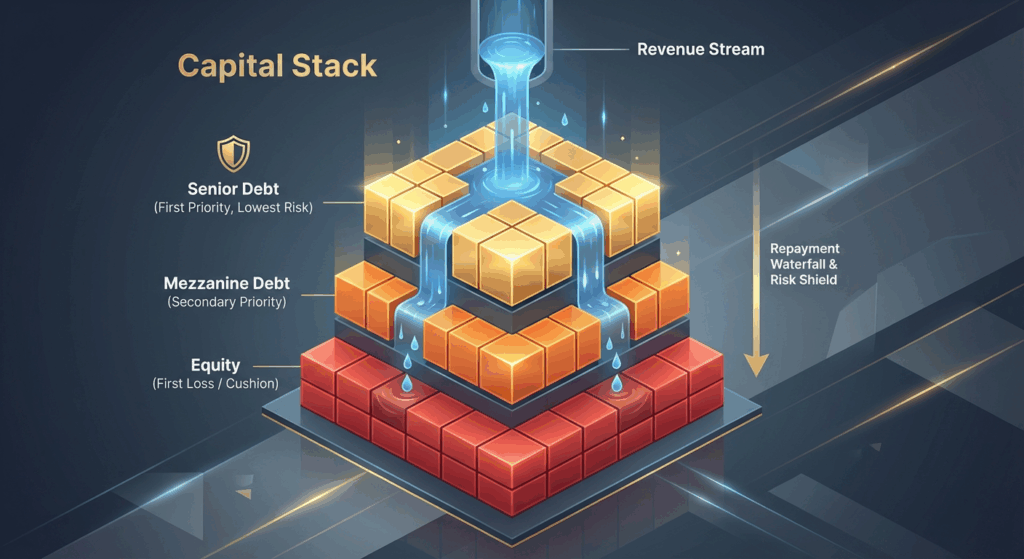
Imagine the capital stack as a waterfall of cash payments. Revenue enters at the top and trickles down. Those at the top of the stack (Senior Debt) catch the water first. Only after their cup is full does water flow to the next tier (Junior/Mezzanine Debt). Finally, whatever remains pools at the bottom for the owners (Equity).
This hierarchy creates two fundamental concepts:
- Payment Priority: Senior lenders must be fully repaid (principal and interest) before junior lenders or equity holders receive a single dollar.
- Equity Cushion: This is the buffer of value below the debt. It represents the amount of money equity holders have invested that must be wiped out completely before the debt is impaired.
How It Works: The $100 Million Scenario
To understand the mechanics, let’s look at a hypothetical acquisition of a stable middle-market manufacturing business, “Acme Corp,” valued at an Enterprise Value (EV) of $100 million.
The Structure:
- Senior Secured Debt ($45M): The lender provides 45% of the capital. They hold a first lien on assets.
- Subordinated/Mezzanine Debt ($15M): A junior lender provides 15%. They charge a higher rate for taking second position.
- Equity ($40M): The private equity sponsor or founder puts up 40%.
Scenario A: Success
Acme Corp is sold 5 years later for $120M.
The Senior Lender gets their principal back + interest (low risk, fixed return).
The Equity holder gets the remaining value: $120M – $60M (total debt) = $60M. They turned $40M into $60M (upside participation).
Scenario B: Distress (The Protection Mechanism)
Acme Corp loses a major client and is forced to liquidate for only $55 million.
- Senior Lender: Owed $45M. Paid 100% ($45M). The sales proceeds cover them fully.
- Mezzanine Lender: Owed $15M. Paid 66% ($10M). The remaining proceeds ($55M – $45M) are not enough to cover them fully.
- Equity Holder: Invested $40M. Paid 0%. Their “cushion” absorbed the first $40M of losses, and the mezzanine absorbed the next $5M.
This illustrates why senior debt is often termed “defensive” investing, the enterprise value had to drop by more than 55% before the senior loan lost a penny.
Current Market Relevance (2026 Snapshot)
As of March 2026, the distinction between capital stack layers has become vital due to diverging liquidity conditions. Following the stress tests seen in February 2026, where several major semi-liquid funds acted to limit redemptions, investors are re-evaluating risk.
- Yields remain attractive: According to Capital Founders (March 2026), senior direct lending yields are hovering between 10-12%, driven by a SOFR base rate of roughly 4.3% plus spreads. This offers equity-like returns with senior-secured protection.
- Allocation shifts: The UBS Global Family Office Report notes that family offices doubled their private credit allocations from 2% to 4% over the last year. However, smart money is scrutinizing “attachment points”, the point in the capital stack where their risk begins.
- Leverage Discipline: While deal volume is high, leverage multiples have stabilized. Capital Market Compass data indicates that senior debt typically covers 2.0x to 3.0x EBITDA, ensuring significant equity subordination below the lender.
- Liquidity Premium: Atlas Peak Research highlights that recent market stress is concentrated in semi-liquid structures holding illiquid middle-market loans. This reinforces the need for investors to understand not just the loan’s seniority, but the fund structure wrapping it.
Decision Framework
For Investors: Evaluating the Attachment Point
When reviewing a private credit opportunity, ask: “What is my Loan-to-Value (LTV) attachment point?”
- If a fund lends at 40% LTV, the underlying assets must drop 60% in value before principal is at risk.
- If a fund lends at 85% LTV (typical for mezzanine or junior debt), a 15% correction wipes out your protection.
- Decision Rule: In volatile consolidated markets (like 2026), prioritize Senior Secured positions where the “Equity Cushion” is at least 40-50%.
For Operators: Cost vs. Dilution
When raising capital, the trade-off is Cost of Capital vs. Equity Dilution.
- Senior Debt is the cheapest money (10-12% cost) but comes with strict covenants and 50% LTV limits.
- Mezzanine/Junior Debt is more expensive (13-16% + PIK) but fills the gap without forcing you to sell more shares.
- Equity is the most expensive capital (costing 20%+ in expected returns) because you are selling permanent ownership.
- Decision Rule: Use senior debt to fund predictable assets (accounts receivable, equipment, steady cash flow). Only use equity for high-risk growth initiatives.
Key Takeaways
- Seniority is Safety: In a liquidation event, senior lenders eat first. Equity eats last.
- The Cushion Matters: The thickness of the equity layer below you is your primary insurance policy against default losses.
- 2026 Reality Check: With base rates over 4%, senior debt currently offers double-digit yields without taking junior-level risks.
- Dilution Math: For founders, debt is cheaper than equity, but it carries the risk of foreclosure. Equity is safer for the business but reduces your upside.
- Check the Structure: As noted in recent market reports, ensure the liquidity terms of your investment vehicle match the illiquidity of the underlying loans.


