
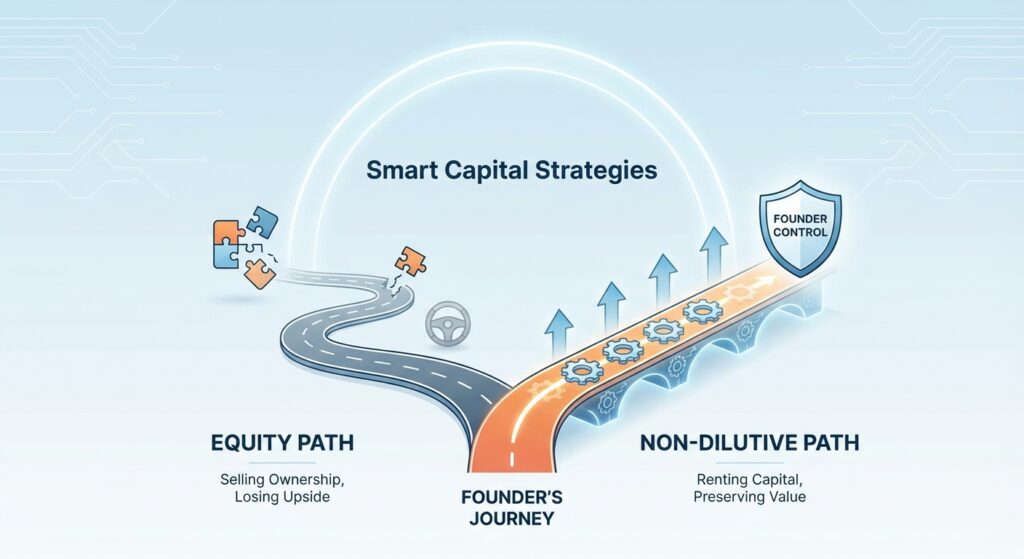
For many founders, the path to a liquidity event is assumed to be paved with equity. The narrative is standard: Raise a seed round, dilute 20%; raise a Series A, dilute another 20%; and hope the final “unicorn” exit is large enough to make the remaining slice of the pie worth the journey. But a quiet cohort of operators is proving that the “equity-first” default is often a mathematical error, one that costs founders control and millions in exit proceeds.
The Myagi Pivot: A Case Study in Discipline
The story of Myagi, a retail sales enablement platform, perfectly illustrates the “equity shield” strategy. In March 2020, co-founder Simon Turner was preparing for a significant equity round. The timing, however, collided with the global pandemic. While many startups scrambled or folded, Myagi found itself in a paradoxical position: the traditional retail world was freezing, but the demand for digital retail training was exploding.
Myagi had a choice. They could have forced an equity round in a volatile market to capitalize on the growth, likely accepting unfavorable terms and significant dilution to secure the “war chest.” Instead, they waited.
By early 2021, Myagi had posted its best six months of growth. They needed capital to double down on this momentum, but they no longer needed the validation of a VC lead investor. They needed fuel. Turner turned to TIMIA Capital for a $2.5 million non-dilutive investment facility. This decision was critical: instead of selling a permanent chunk of the company to fund temporary growth initiatives, Myagi “rented” the capital.
The Outcome: The debt capital allowed Myagi to invest in revenue-generating activities and enhance their software without altering the cap table. Roughly two years later, Myagi was acquired by Rallyware. Because the founders had utilized debt during their acceleration phase, they arrived at the exit table with their ownership stakes largely intact, maximizing the return on their years of effort.
UnityLab: The 10X Scale-Up
A similar principle played out at UnityLab (formerly Unity Laundry Systems). Founder Jonathan Benjamin faced the classic “chicken and egg” problem of hardware-heavy commerce: he needed inventory and product development to grow, but he was too small for traditional bank loans and too early for massive VC checks.
In 2020, with 47 customers and under $1 million in revenue, UnityLab opted for revenue-based financing rather than giving away early equity when the company’s valuation was lowest. This capital bridged the gap between concept and scale.
The Outcome: Over the next four years, UnityLab used this financing to expand its product line and grow 10x, serving over 25,000 customers. By using capital that was repaid from cash flow rather than equity, Benjamin maintained control over the company’s destiny, eventually reaching a scale where they could acquire other brands (like Hoffman) and dominate their niche.
The Strategic Recap: Buying Out the Room
Sometimes, leverage isn’t about growth, it’s about consolidation. In a recent 2026 transaction, an unnamed building products manufacturer utilized a $5 million facility from Fora Financial to execute a partner buyout.
Following an acquisition, one partner sought an exit while the remaining owners wanted to double down on a luxury condo development pipeline. The remaining owners faced a liquidity crunch: they couldn’t access traditional Asset-Based Lending (ABL) facilities until the ownership structure was cleaned up. By using a bridge debt facility, they bought out the exiting partner, consolidated control, and immediately unlocked a larger, cheaper ABL facility to fund their contracts. This maneuver cleared the cap table of misalignment without bringing in a new, potentially intrusive equity partner.
The Math of the “Rental” vs. the “Sale”
Founders often fear the interest rate of private credit (often 12–18% or more), but they rarely calculate the “interest rate” of equity. If a founder sells 10% of their company for $2 million, and the company exits for $100 million, that capital cost them $10 million. The “cost of capital” was 5x the principal.
In Myagi’s case, paying interest on $2.5 million was fundamentally cheaper than selling the equivalent equity stake that would have appreciated significantly by the time of the Rallyware acquisition.
Key Insights
- Dilution is Permanent, Debt is Temporary: Equity sold is gone forever. Debt, once repaid, leaves the founder with 100% of the upside again.
- Inflection Point Arbitrage: The best time to use debt is when you have clear visibility on near-term growth (like Myagi in 2021). You borrow against the future revenue to avoid pricing equity at today’s lower valuation.
- Exit alignment: Debt lenders generally just want their principal plus interest. They do not block “moderate” exits (e.g., $30M–$50M) that might be life-changing for founders but “failures” for VCs needing a 10x return.
- The “Clean Up” Trade: As seen in the Fora Financial example, debt is often the only instrument agile enough to remove misaligned partners quickly, unlocking future growth.
- Unit Economics Matter: This strategy only works if the underlying machine works. UnityLab could leverage debt because they had strong demand and unit economics to service the payments. Leveraging a burn-rate with no clear path to profitability is suicide.


