
On the second week of March 2026, two headlines broke within forty-eight hours of each other. They tell the same story about the future of technology, but they tell opposite stories about how to pay for it.
First, on March 9th, the voice-controlled gaming startup Weekend announced a $55 million Series C. Led by M12 and Lightspeed, the round was a classic venture capital play: selling unmatched upside potential to fuel product development and AI integration.
Then, on March 11th, Amazon executed the fourth-largest corporate bond sale in U.S. history. They raised $37 billion, not by selling shares, but by selling debt. The capital is earmarked explicitly for “AI infrastructure.”
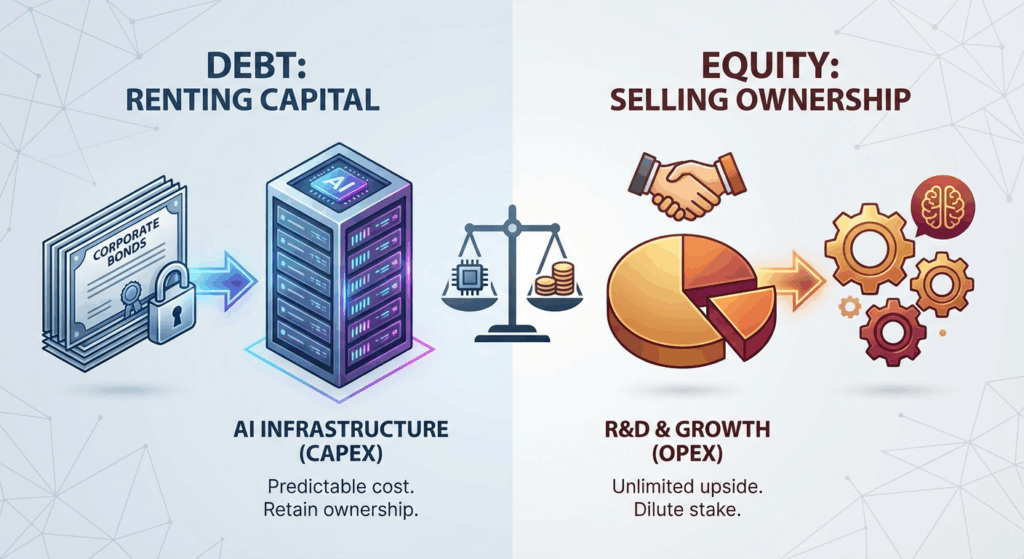
For the average founder, Amazon seems like a distant continent. But buried in Amazon’s decision is a critical lesson for any operator building in the hardware-intensive AI era: You should match your liability structure to your asset structure.
While startups like Weekend and the robotics company Sunday (which just raised $165M) are largely following the traditional equity path, the sheer capital intensity of the AI architecture buildout is forcing a rethink. Here is why the “Amazon Playbook” might matter more to your Series B than you think.
The Decision: Buying Assets vs. Funding Burn
Let’s analyze the capital decision through a Hypothetical Case Study of a mid-stage company we’ll call “Vertex AI.”
The Scenario:
Vertex AI is a vertical SaaS company generating $8M ARR. To remain competitive in 2026, they need to build a proprietary inference cluster. The cost of the GPUs and data center leases is $12 million upfront. They have two options to fund this CAPEX.
Option A: The “Weekend” Path (Equity)
Vertex raises a standard Venture round. Investors are excited about the AI story.
- Raise: $12M Equity
- Valuation: $60M Pre-Money
- Dilution: 16.7%
- Cost of Capital: Theoretically infinite (based on future exit value).
Option B: The “Amazon” Path (Private Credit / Asset-Backed)
Vertex treats the GPUs as tangible assets and finances them through a specialized credit facility, similar to how Amazon is using bonds to fund its data centers.
- Raise: $12M Debt Facility
- Structure: 3-year term, hardware as collateral.
- Interest Rate: 14% (High, but capped).
- Dilution: <1% (Warrants).
The Outcome: The $30 Million Swing
Fast forward four years. Vertex AI succeeds and exits for $250 million.
Under Option A (Equity):
The founders sold 16.7% of the company to buy hardware. That stake is now worth roughly $41.7 million. They effectively paid over $41 million for $12 million worth of chips.
Under Option B (Debt):
The debt has been repaid from cash flow. The total interest cost over three years was roughly $5 million. The founders retained that 16.7% equity block. Even after paying the interest, the founders are over $36 million richer than in the equity scenario.
Amazon’s CFO understands this math at a macro scale. As reported, Amazon’s shift to debt was driven by the realization that their $200 billion capital expenditure plan could not be efficiently funded solely by internal cash flow or equity without degrading shareholder returns. They chose to rent capital because the assets (Data Centers) generate predictable returns that can service that debt.
The Lesson: Don’t Buy Engines with Ownership
The “Venture Capital Only” mindset works best when capital is used for intangible growth: sales teams, marketing, and R&D. These burn cash and have no collateral value.
However, the 2026 tech landscape is different. AI companies are becoming asset-heavy. Whether it is Sunday’s warehouse robots or data center racks, these are depreciable assets.
Key Principles for Founders:
- Segregate Your Needs: If you are raising $50M, determine how much is for OPEX (people) and how much is for CAPEX (stuff).
- Finance CAPEX with Debt: Lenders love collateral. Using equity to buy hardware is the most expensive way to finance growth.
- Look for “Lender-Friendly” Revenue: If your new infrastructure guarantees a recurring contract (e.g., a compute-as-a-service model), you can often borrow against the future cash flows of that specific asset, similar to project finance.
While headlines celebrate the massive equity rounds of companies like Weekend, the smartest capital allocators are watching the bond markets. When the cost of the asset is fixed but the upside is unlimited, you want to be a borrower, not a seller.
Key Insights
- Regime Change: Amazon’s pivot to debt for AI infrastructure signals that internal cash flow is no longer sufficient for the current CAPEX super-cycle.
- Asset Matching: Equity is for risk (product/market fit); Debt is for certainty (assets/inventory). AI hardware falls into the latter.
- The Dilution Trap: Using VC dollars to purchase depreciating assets (GPUs) significantly depresses long-term founder returns compared to equipment financing.
- Hybrid Models: The most efficient capital structure for AI companies in 2026 is often a mix: Equity for the “Brain” (R&D), Debt for the “Body” (Compute/Hardware).
- Market Signal: Institutional demand for Amazon’s debt ($126B in orders) proves there is massive liquidity available for infrastructure-backed technology plays.


