
The 2024-2026 funding environment fundamentally shifted how founders calculate the cost of control. Through the lens of a detailed hypothetical case study, and contrasting it with recent real-world restructuring lessons, we break down the math of choosing debt over dilutive equity.
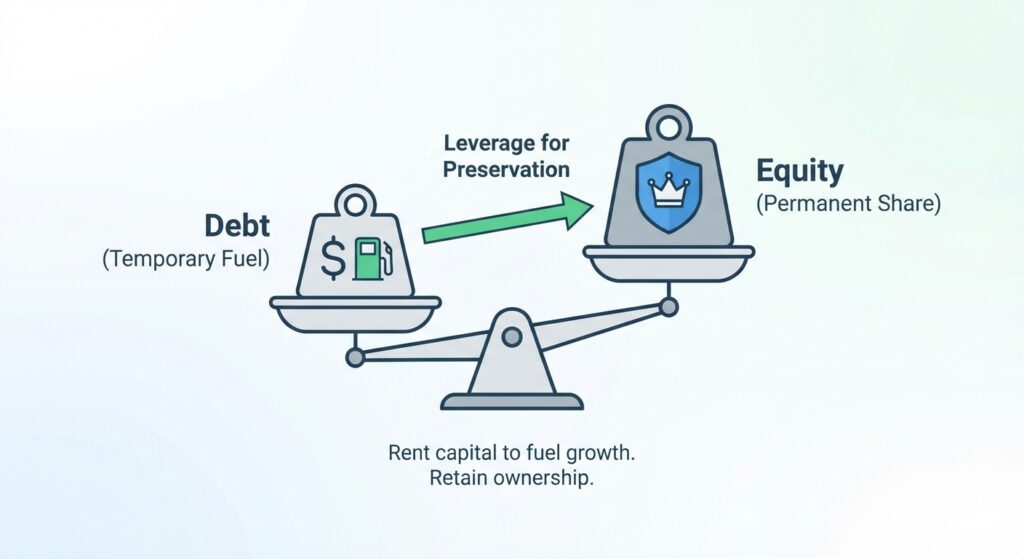
In the zero-interest rate era (ZIRP), equity was often viewed as “free” money, while debt was seen as a four-letter word. But as the cost of capital normalized between 2024 and 2026, sophisticated operators began flipping the script. The realization? Equity is permanent; debt is temporary.
To illustrate the mechanical impact of this decision, we consider a composite case study representing a common scenario seen in the B2B software market over the last 24 months. We call this company “LogicScale.”
The Case Study Example: LogicScale (Hypothetical)
The Situation:
It was Q3 2024. LogicScale, a bootstrapped vertical SaaS platform, had reached $12M in Annual Recurring Revenue (ARR) with 10% EBITDA margins. Growth was consistent at 30% YoY, but the founder, “Sarah,” spotted an opportunity to acquire a smaller competitor and ramp up a sales team to capture market share. The capital need was $20 million.
The Decision: Two Divergent Paths
Sarah ran a dual-track process, soliciting offers from both growth equity investors and private credit funds. The market conditions in late 2024 meant valuations were compressed, and heavy deal structure was common.
- Option A: Generally Accepted Venture Capital (The Dilutive path)
A top-tier firm offered $20M for a 20% stake. However, the terms included a 2x liquidation preference: meaning the VC gets 2x their money back ($40M) before common shareholders see a dime in a downside scenario. The post-money valuation was $100M. - Option B: Private Credit (The Leverage path)
A credit fund offered a $20M senior term loan. The cost was SOFR + 750bps (approx. 12.5% at the time). The loan included covenants on leverage ratios and a small 1% warrant coverage. No board seat, no liquidation preference.
The Choice:
Sarah chose Option B (Debt). Her logic was simple: “I believe our cash flows can service the debt. If I sell 20% of the company now at the bottom of the market, I can never buy it back. If I rent the money for three years, I keep the upside.”
The Outcome: A $200M Exit Analysis
Fast forward to March 2026. LogicScale successfully integrated the acquisition and grew ARR to $35M. A strategic buyer offers $200M for the business.
Scenario A Outcome (If she had taken VC):
The VC owns 20%. On a $200M exit, the VC receives $40M. The founder and employees share the remaining $160M. The founder (who owned 80% prior) now owns 64%.
Scenario B Outcome (Actual Debt Path):
Over roughly two years, LogicScale paid approximately $4.5M in interest. Upon exit, the $20M principal is repaid from proceeds. The total cost of capital was roughly $24.5M. The 1% warrant pays the lender $2M. The remaining equity value is $173.5M distributed to the founder and employees.
The Delta: The debt decision netted the common shareholders an additional $13.5M in proceeds. Furthermore, Sarah maintained full board control throughout the expansion, allowing for faster integration decisions without investor friction.
The Cautionary Contrast: When Leverage Bites
While the LogicScale example highlights the “upside lever,” leverage cuts both ways. For a contrast in execution and sector risk, we look to the retail sector.
Party City provides a stark real-world counter-example. As detailed in the Pari Passu Newsletter, Party City faced a “capital structure” problem rather than a pure business failure. While they had periods of moderate growth, their balance sheet was burdened with debt that could not be supported when retail headwinds and pandemic closures hit. The result was a complex restructuring process that wiped out equity holders, the exact opposite of the preservation goal.
The Difference? Cash Flow Reliability.
LogicScale (Software) had recurring, high-retention revenue (90%+ gross retention). Party City (Retail) faced cyclical consumer demand and high fixed costs (leases). Leverage magnifies the outcome of the underlying asset resilience.
Lessons & Frameworks
For founders navigating the 2026 capital markets, the decision comes down to the Reliability Ratio: How predictable is the incremental dollar of revenue generated by the new capital?
- Use Equity When: The capital is for R&D, exploring new markets, or binary risks where cash flow is years away. You need partners who share the downside risk.
- Use Debt When: The capital is for “Fuel on the Fire”: proven sales channels, M&A with immediate accretion, or working capital. You are confident in the cash flow coverage and want to minimize dilution.
As the market stabilizes, the most successful exits are coming from founders who treat their cap table as a scarce resource, “renting” capital for growth spurts rather than “selling” ownership permanently for temporary cash.


