
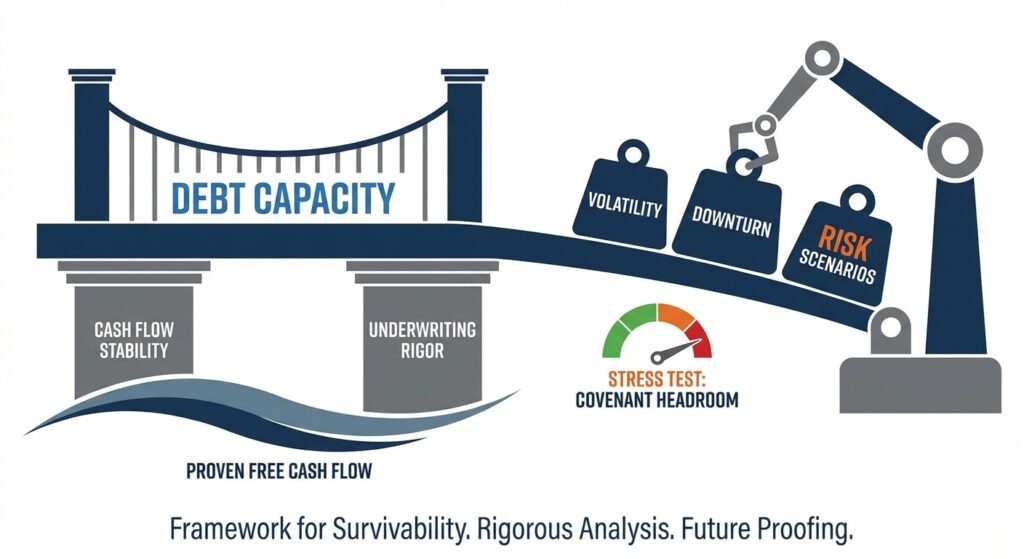
The Underwriting Challenge: Surviving the Downside
In the current credit environment, where deal structures are scrutinized and interest rate volatility remains a factor, the primary job of an underwriter is not to validate the “sunny day” forecast, but to ensure survivability during the storm. Recent market data indicates that leverage multiples for leveraged buyouts (LBOs) have settled in the 4.0x to 5.0x range, a contraction from previous highs that reflects a disciplined return to credit fundamentals. For lenders and credit risk managers, the critical differentiator is the ability to rigorously stress test cash flows against debt capacity.
True underwriting rigor moves beyond simple EBITDA multiples. It focuses on Debt Capacity Analysis: determining the maximum amount of leverage a company can support while meeting interest and principal obligations solely from operating cash flows. This article outlines a framework for stress testing capital structures to identify breaking points before capital is deployed.
The Framework: Debt Capacity and Stress Testing
Debt capacity is not determined by asset values, but by the stability and predictability of free cash flow (FCF). According to recent methodologies in LBO analysis, the debt capacity process follows a distinct sequence: assessing business characteristics, building cash flow projections, determining maximum debt load, and finally, stress testing the structure.
The foundational metric is Free Cash Flow to Debt Service. Unlike EBITDA, which is an accounting proxy, FCF represents the actual liquidity available to service debt. Underwriters must assess a borrower’s “Covenant Headroom”, the buffer between projected financial performance and the levels that would trigger a default. A robust underwriting framework typically requires:
- Base Case: Management’s projections, sensitized for optimism bias.
- Downside Case: A recessionary scenario (e.g., 15-20% revenue decline).
- Breakeven Analysis: The exact point of revenue or margin deterioration where Debt Service Coverage Ratio (DSCR) falls below 1.0x.
The Analysis: Stress Testing a Manufacturing Borrower
To illustrate, consider a hypothetical borrowing base analysis for a company in the structural wood products industry, a sector currently showing EBITDA margins of 7–11% and recovering demand.
Scenario:
- Borrower: Mid-sized Component Manufacturer
- LTM EBITDA: $10.0 Million
- Proposed Senior Debt: $40.0 Million (4.0x Leverage)
- Interest Rate: 8.0% (all-in)
- Maintenance Covenant: Max Total Leverage of 4.50x
Step 1: Calculate the Base Case Buffer
At close, the leverage is 4.0x. The covenant is set at 4.5x. The “Headroom” is 0.5 turns of leverage. Is this sufficient?
Step 2: Apply the Stress Test
Let’s apply a standard distinct stress scenario: a 15% decline in EBITDA due to raw material price volatility (a common risk in this sector).
- Stressed EBITDA: $10.0M \times (1 – 0.15) = $8.5 Million
- Debt (Constant): $40.0 Million
- Stressed Leverage: $40.0M / $8.5M = 4.7x
Result: Under a moderate 15% contraction, the borrower breaches the 4.5x leverage covenant. Despite having positive cash flow (assuming CapEx and taxes are managed), the company is in technical default. This analysis reveals that a 4.0x opening leverage with a 4.5x covenant provides insufficient cushion for cyclical industries.
Industry Standards & Benchmarks
Institutional lenders rely on specific benchmarks to gauge risk. According to IB Interview Questions, current deals often scrutinize the Fixed Charge Coverage Ratio (FCCR), ensuring it remains above 1.25x even in downside scenarios. Furthermore, recent market intelligence on manufacturing sectors (specifically Structural Wood Products) suggests a median EBITDA margin of 7% to 11% and an annual default rate of approximately 3.2%, significantly higher than the SBA baseline of ~1.5%.
Underwriting Data Box: Sector Benchmarks (2026)
- EBITDA Margins (Wood/Truss Mfg): 7% – 11%
- Avg Debt Service Coverage (DSCR): 1.28x (Near the 1.25x threshold)
- Annual Default Rate: 3.2% (vs 1.5% baseline)
- Standard Leverage Cap: 4.0x – 5.0x EBITDA
Source: COREView Market Intelligence / Lentati, 2026
Additionally, the Basel Committee regarding credit risk management emphasizes that banks must operate under a sound credit-granting process that explicitly considers economic changes, suggesting that static models are insufficient for 2026 risk environments.
Underwriting Checklist: The Diligence Defense
Before issuing a commitment letter, the underwriting team should complete the following diligence points to validate debt capacity:
- Quality of Earnings (QoE): Are the EBITDA add-backs legitimate? Non-recurring expenses must be truly non-recurring.
- Cyclicality Assessment: correlate historical revenue against industry cycles (e.g., housing starts for construction suppliers).
- Working Capital Analysis: In a downside scenario, will trapped working capital drain liquidity? Stress test the Net Working Capital (NWC) peg.
- Covenant Design: Set financial covenants (Leverage, FCCR) with 20-25% headroom off the Base Case model, not just the management model.
- Customer Concentration: If the top customer (10%+ revenue) leaves, does the DSCR stay above 1.1x?
Key Takeaways
- Cash Flow is King: Debt capacity is driven by FCF stability, not asset liquidation value.
- Monitor the Headroom: A 0.5x leverage buffer is often insufficient for cyclical industries; target 20-25% EBITDA cushion.
- Stress Test the Denominator: Leverage blow-ups usually happen because EBITDA (the denominator) shrinks, not because debt increases.
- Benchmarking Matters: Compare borrower margins against industry medians (e.g., 7-11% for manufacturing) to spot operational weakness.
- Discipline Over Deal Flow: Walk away if the downside case results in a payment default or covenant breach within 12 months.


