
The Allocator’s Dilemma: Speed vs. Cost in Capital Stacks
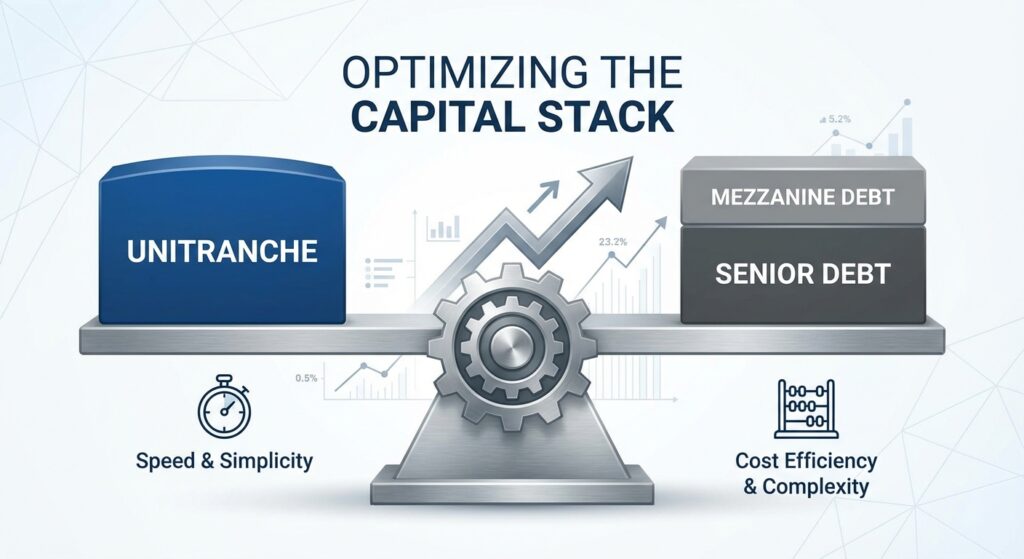
For middle-market sponsors and CFOs, the primary financing decision in 2026 remains a structural binary: choose the speed and simplicity of a unitranche facility, or engineer a layered capital stack with senior and mezzanine tranches to optimize the weighted average cost of capital (WACC).
While the syndicated loan market has seen bouts of volatility, private credit has solidified the unitranche structure as the dominant tool for buyouts and significant refinancings. The appeal is clear, execution certainty. However, as base rates stabilize, the premium paid for that certainty warrants scrutiny. This analysis breaks down the mechanics of modern unitranche structures compared to traditional subordinated debt stacks, using current market data to illustrate the trade-offs in pricing, dilution, and control.
Structure Breakdown: The Unitranche Mechanism
A unitranche facility combines senior and junior debt risk into a single instrument. Unlike a traditional structure where a borrower navigates distinct credit agreements with a senior bank lender and a junior mezzanine provider, a unitranche borrower signs one credit agreement with one blended interest rate.
Behind the Scenes: While the borrower interfaces with a single agent, the loan is often split internally among lenders via an Agreement Among Lenders (AAL). This “first-out/last-out” structure allocates risk without burdening the borrower with intercreditor negotiations. The “first-out” tranche (comparable to senior debt) takes a lower return for priority focused on safety, while the “last-out” tranche takes higher risk for higher yield.
Deal Example: Structuring a $60M Facility
Consider a software company with $10 million in EBITDA seeking $60 million in total leverage (6.0x) for an acquisition.
- The Unitranche Option: A single $60 million facility priced at SOFR + 550 bps. The borrower pays a 2.0% upfront fee and deals with one set of covenants.
- The Layered Option (Senior + Mezz): A commercial bank provides $40 million senior debt at SOFR + 350 bps. A mezzanine fund provides the remaining $20 million gap capital at a 12% fixed coupon plus 2% PIK (Payment-in-Kind) interest, potentially attaching equity warrants.
In the unitranche scenario, the blended cost is transparent. In the layered scenario, the theoretical interest savings are often offset by the complexity of two due diligence tracks and the economic drag of equity dilution from warrants.
How It Compares: Execution and Economics
The choice between these structures often comes down to the “cost of complexity” versus the “cost of capital.”
Speed and Certainty: Data from 2025-2026 indicates a significant divergence in execution timelines. Unitranche deals show a median sign-to-fund time of roughly 45 days, compared to 70 days for senior-mezzanine structures. In competitive auction processes, this 25-day delta can be the difference between winning and losing a bid.
Dilution Impact: Traditional mezzanine debt frequently requires an “equity kicker” to achieve target returns, often warrants representing 3% to 5% of the fully diluted equity. For a high-growth sponsor, giving up 5% of the upside to save 100 or 200 basis points on interest is rarely an accretive trade. Unitranche structures typically avoid warrants entirely, preserving full equity upside for the operator and sponsor.
Flexibility: Unitranche deals are often “cov-lite” or feature looser maintenance covenants compared to the strict amortization and leverage tests required by commercial banks in a senior position. This breathing room is critical for companies pursuing aggressive buy-and-build strategies.
Current Market Terms (2026)
Based on recent market benchmarks, structural terms have settled into defined ranges for middle-market borrowers ($20M – $100M EBITDA):
- Unitranche Pricing: Spreads govern the SOFR + 475–575 bps range for decent credits, expanding to 600+ for complex stories.
- Leverage Profiles: Lenders are comfortable writing checks for 55–65% Loan-to-Value (LTV), or up to 6.0x EBITDA for high-quality recurring revenue businesses.
- Upfront Fees: Arrangement fees have standardized between 1.5% and 2.0% of the facility amount.
- Documentation: The single credit agreement remains a primary selling point, eliminating the need for a complex intercreditor agreement that dictates “standstill” periods and enforcement rights between conflicting lender classes.
Structuring Guidance for Operators
For Sponsors & Borrowers:
When negotiating a unitranche term sheet, focus on the “incrementals.” Ensure the facility includes an “accordion feature” or delayed draw term loan (DDTL) to fund future acquisitions without renegotiating the entire credit agreement. This saves legal fees and locks in pricing for future growth. Furthermore, confirm if the lender intends to syndicate the paper or hold it. A bilateral (hold) deal offers more flexibility in workouts than a widely syndicated loan.
For Investors & Lenders:
In a unitranche stack, the Agreement Among Lenders (AAL) is your most vital document. If you are a “last-out” participant, verify your voting rights regarding material changes to the credit agreement. Ensure the “first-out” provider cannot waive key covenant breaches without your consent, as this erosion of protection can leave the junior capital exposed without recourse.
Key Takeaways
- Speed Premium: Unitranche deals close ~35% faster than bifurcated structures, crucial for competitive M&A.
- Dilution Defense: Choosing unitranche over mezzanine debt often saves 3-5% in equity dilution by avoiding warrants.
- Single Document Efficiency: One credit agreement reduces legal spend and eliminates intercreditor disputes during restructuring.
- Growth Capacity: Negotiate accordion features upfront to streamline future acquisition financing.
- Pricing Balance: While headline rates are higher than senior bank debt, the blended cost is competitive when factoring in mezzanine costs and warrant value.


