
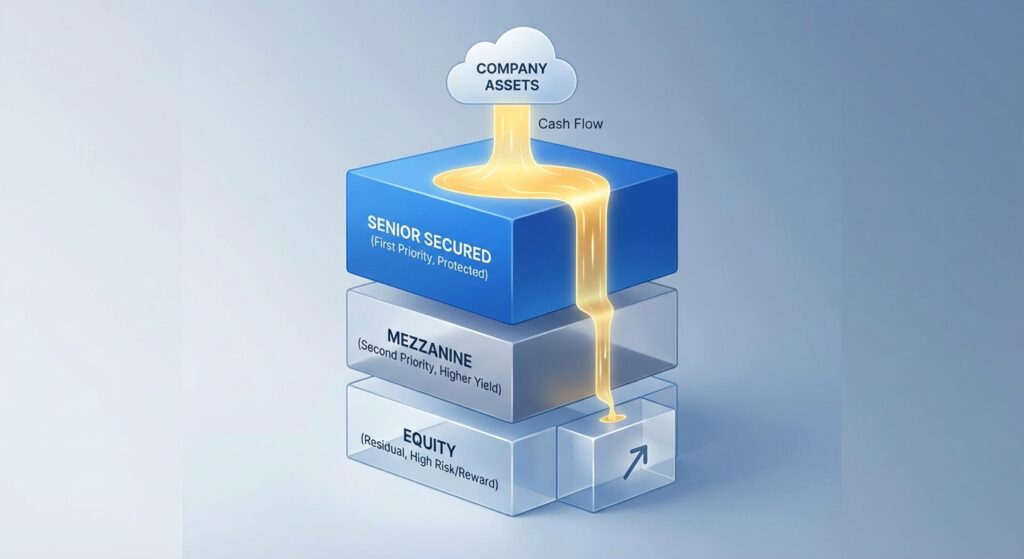
The Architecture of Risk: Understanding the Capital Stack
In private credit, the “capital stack” is the architectural blueprint of a company’s financing. It determines the hierarchy of payments, the distribution of risk, and arguably the most important factor in alternative investing: who gets paid first when things go wrong.
For years, low interest rates masked the structural differences between various layers of debt. Today, as the asset class undergoes what industry observers are calling its first real stress test in a decade, understanding these structural protections is no longer academic; it is vital. Whether you are an operator seeking non-dilutive capital or an allocator building a portfolio, your position in the stack defines your outcome.
This article dissects the mechanics of seniority, subordination, and security, explaining why senior secured loans, the bedrock of private credit, offer a distinctly different risk profile than mezzanine debt or equity.
The Concept: Seniority and Security
The capital stack is organized by priority of payment. Think of it as a waterfall:
- Senior Secured Debt: sits at the very top. It has the first claim on cash flows and implies a legal right to the company’s assets (collateral) in a default scenario. Because it takes the least risk, it offers the lowest cost of capital to the borrower, though yields remain attractive relative to public markets.
- Subordinated (Mezzanine) Debt: sits in the middle. It is “junior” to senior debt, meaning it only gets paid after senior lenders are satisfied. To compensate for this higher risk, it commands higher interest rates and often includes “equity kickers” (warrants).
- Equity: sits at the bottom. It absorbs the first dollar of loss and has the last claim on assets. In exchange for maximum risk, it enjoys uncapped upside potential.
How It Works: The $100 Million Scenario
To communicate the mathematical reality of subordination, let’s look at a hypothetical acquisition of Company X.
The Structure:
- Purchase Price (Enterprise Value): $100 Million
- Senior Debt: $50 Million (50% Loan-to-Value)
- Equity: $50 Million
Scenario A: Growth (Upside)
Five years later, the company is sold for $150 Million.
The Senior Lender receives their principal back ($50M) plus interest earned along the way. They do not share in the extra $50M of value creation. The Equity holders receive the remaining $100M, doubling their money.
Scenario B: Distress (Downside Protection)
Market shifts cause the company’s value to plummet to $60 Million.
The Senior Lender still receives their full $50 Million principal. Their “cushion” was sufficient to absorb the value drop. The Equity holders, however, see their $50M investment recover only $10M, an 80% loss.
Scenario C: Severe Distress
The company liquidates for $40 Million.
The Senior Lender recovers $40 Million (taking a $10M loss). The Equity holders are wiped out completely ($0 recovery). Because the senior lender has a secured claim, they control the liquidation process to maximize their recovery.
Current Market Relevance: The 2026 Landscape
As of March 2026, the divergence between performing loans and strained structures has made capital stack positioning critical. Following a period of aggressive fundraising, where family offices doubled their private credit allocations from 2% to 4% in a single year, the market is now focusing on liquidity and credit quality.
According to current market data:
- Yield-to-Risk Ratio: With SOFR hovering around 4.3%, senior direct lending strategies are currently generating yields of 10-12% on a gross basis. This allows investors to achieve double-digit returns while staying at the top of the capital stack, rather than reaching for yield in junior positions. Source: Capital Founders OS 2026.
- Market Growth vs. Quality: Global private credit assets under management reached approximately $1.7 trillion by late 2024 and are forecast to surpass $2.6 trillion by 2029. As the market expands, the “managers selection” becomes primarily about their discipline in maintaining senior attachment points. Source: Coller Capital / Preqin.
- Structural Leverage: Senior debt typically accounts for 50% of the capital structure, often capped at 2.0x to 3.0x EBITDA. This discipline ensures that there is a significant “equity cushion” beneath the lender to absorb economic shocks. Source: Capital Market Insights.
Decision Framework
For Investors: Evaluating “Attachment Points”
When reviewing a private credit fund or distinct deal, the primary metric is not just yield, but the attachment point. This is the point in the capital stack where your risk begins.
- Senior Lenders: Attach at 0% and detach at ~50% of value. You are safe as long as the company retains half its value.
- Junior Lenders: Might attach at 50% and detach at 65%. Your margin for error is significantly thinner.
In the current 2026 environment, where “redemption gates” have been tested at major firms, liquidity and asset quality take precedence. Senior secured exposure offers a defense mechanism against valuation volatility that equity or junior debt cannot provide.
For Operators: The Cost of Ownership
For founders and CFOs, the decision to utilize private credit stems from the cost of equity dilution. While a 12% interest rate on debt appears expensive compared to bank financing of the past, it is significantly cheaper than selling equity.
If a business grows 20% year-over-year, the “cost” of the equity sold to investors is effectively 20% compounded. By utilizing senior debt for expansion or acquisitions, operators retain that ownership upside. The debt is retired; the equity stake is permanent.
Key Takeaways
- Position Matters More Than Yield: In a stressed market, being at the top of the stack (Senior) ensures you are the first to be repaid and the last to absorb loss.
- The Equity Cushion is Your Shield: Senior lenders are protected by the equity beneath them. In a 50% LTV loan, the enterprise value must drop by more than half before the lender consumes principal.
- Current Yields Favor Seniority: With base rates effectively setting a floor, senior secured loans are offering equity-like returns (10-12%) without equity-like risk.
- Dilution vs. Interest: For operators, the high headline rate of private credit is often mathematically superior to the permanent loss of capitalization involved in raising equity.
- Documentation is Control: Private credit lenders benefit from stronger control over covenants and documentation compared to broadly syndicated markets, allowing for earlier intervention if performance wavers.


