
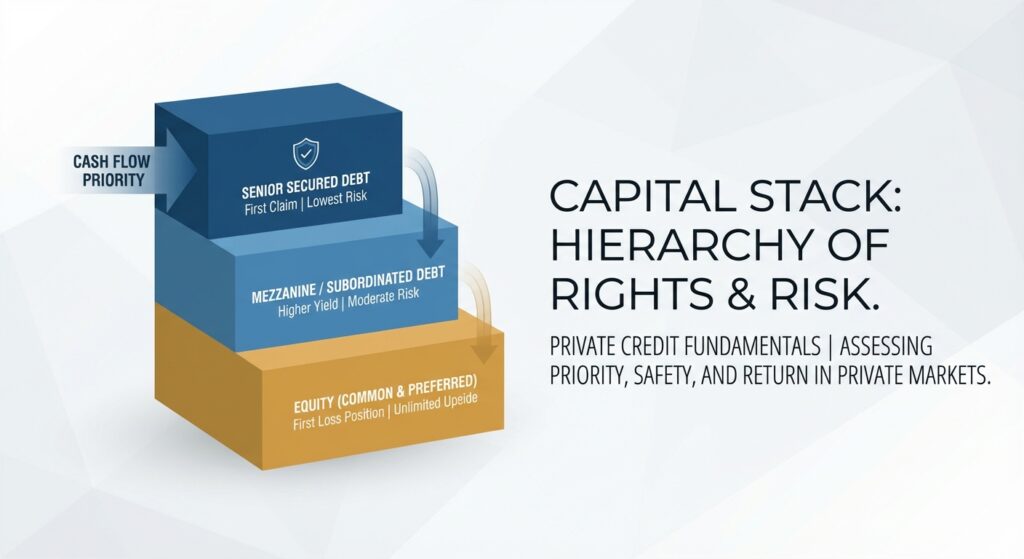
Understanding where you sit in the capital stack is the single most important factor in assessing risk and return in private markets.
In corporate finance, the "Capital Stack" is the hierarchy of rights that dictates who gets paid first, who gets paid last, and who controls the company if things go wrong. For investors, this hierarchy determines the safety of their principal. For business owners (operators), it determines their cost of capital and how much ownership they must give up to fund growth.
As of early 2026, with borrowing costs stabilizing and bank lending standards remaining tight, understanding this structure is no longer just a theoretical exercise; it is a critical tool for navigating the private market landscape.
The Concept: The Priority Waterfall
The capital stack is organized by seniority. Think of it as a waterfall: cash flows from the business fill the buckets at the top first before spilling over to the buckets below.
- Senior Secured Debt: Sits at the very top. It has the first claim on assets and cash flow. It typically carries the lowest risk and meant to generate stable income. Current markets favor “Unitranche” structures here, which combine senior and subordinated debt into one instrument.
- Mezzanine / Subordinated Debt: Sits in the middle. It is riskier than senior debt (paid second) but safer than equity. It demands a higher return to compensate for this position.
- Equity (Common & Preferred): Sits at the bottom. Equity holders enjoy unlimited upside potential but are in the "first loss" position. If a company liquidates for less than the value of its debts, equity holders get zero.
How It Works: A $100 Million Scenario
To understand the mechanics, let’s look at a hypothetical acquisition of a mid-market software company valued at $100 million.
The Transaction Structure:
- Private Credit Loan (Senior Linked): $40 million
- Equity Contribution: $60 million
Scenario A: The Exit (Success)
If the company sells for $150 million three years later, the lender gets their principal back plus interest (e.g., 10-12% annually). The equity holders keep the remaining proceeds, capturing all the appreciation.
Scenario B: The Downside (Protection)
Suppose the company struggles and is liquidated for only $50 million. Because of seniority and subordination:
- The Private Credit Lender is paid their full $40 million first. They recover 100% of their principal despite the company losing half its value.
- The Equity Holders split the remaining $10 million. They suffer an ~83% loss on their initial $60 million investment.
This "Equity Cushion" (the $60 million sitting below the debt) is what protects private credit investors. For the operator, utilizing debt allowed them to retain ownership, but it increased the risk to their equity value in a downside scenario.
Current Market Relevance (2026 Data)
The dynamics of the capital stack have shifted significantly over the last two years. Following the interest rate hikes of 2023-2024, the cost of seniority has increased, but so has the yield.
- Yields Remain Attractive: According to Capital Founders OS (March 2026), senior direct lending strategies are generating yields of 10-12%+, driven by a base SOFR rate of approximately 4.3%.
- Structural Discipline: While yields are high, the market is stress-testing structures. The Coller Capital Secondaries Primer (June 2025) notes that private credit Assets Under Management (AUM) reached $1.7 trillion by the end of 2024, with projections to surpass $2.6 trillion by 2029. This growth attracts scrutiny; specifically, sectors like AI and software are being modeled for default rates as high as 13% in disruption scenarios, making priority in the stack essential.
- Allocations Increasing: Institutional confidence in senior secured private credit remains strong. Family offices doubled their private credit holdings from 2% in 2023 to 4% in 2024, utilizing the asset class as a core income generator (UBS Global Family Office Report via Capital Founders).
Decision Framework
For Investors: Evaluating Safety
When reviewing a private credit opportunity, the primary question is not just “what is the yield?” but “where do I sit?”
- Look for Seniority: Ensure the fund focuses on first-lien, senior secured loans. This ensures you are at the top of the waterfall.
- Check the Cushion: Analyze the Loan-to-Value (LTV) ratio. A 40-50% LTV creates a massive equity cushion that must be eroded before your principal is touched.
For Operators: Weighing Cost vs. Dilution
For founders and CFOs, debt is a tool to minimize dilution.
- Cost of Capital: While 12% interest seems expensive compared to bank rates of the past, it is significantly cheaper than the cost of equity (often 20-30% IRR expectation).
- Preserving Upside: Taking debt lower in the stack (like recurring revenue financing) avoids selling shares at a potentially undervalued price today.
Key Takeaways
- Seniority is Safety: Being at the top of the capital stack protects principal even if the company’s value drops significantly.
- The Equity Cushion: The thick layer of equity below the debt serves as the primary risk buffer for lenders.
- Yield with Protection: In 2026, senior secured private credit offers double-digit yields (10-12%) while maintaining first-lien security.
- Strategic Debt for Founders: For operators, debt is non-dilutive capital; it costs interest but preserves ownership equity.
- Macro Context: With banks retreating from middle-market lending, private credit has become the standard mechanism for financing growth in the $10M-$100M EBITDA range.


