
The Efficiency Premium: Why Unitranche Structures Dominate 2026 Buyouts
In the current transactional environment of late 2026, speed and certainty often outweigh marginal cost savings. For middle-market private equity sponsors and operators, the financing challenge remains consistent: securing leverage to maximize returns without subjecting the deal to execution risk or restrictive inter-creditor dynamics.
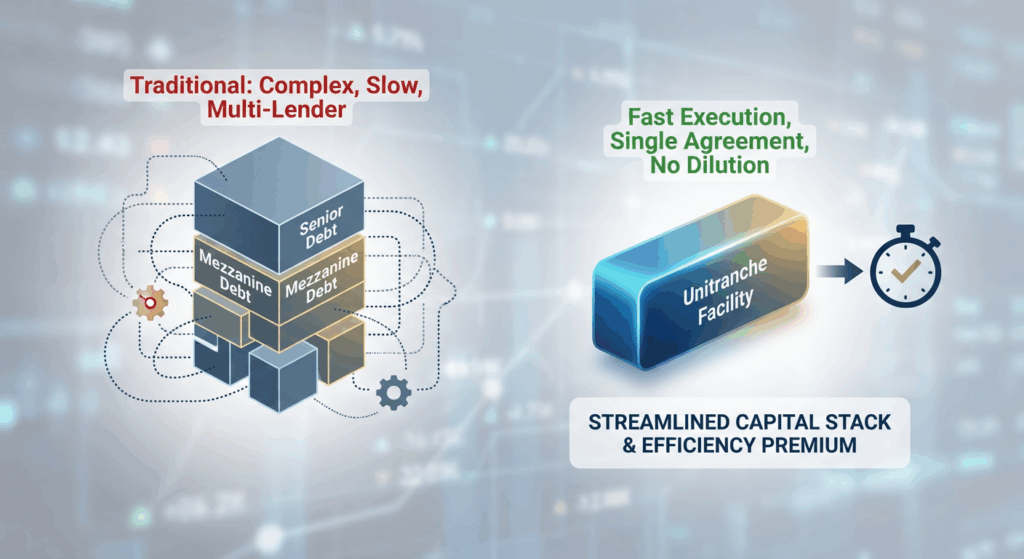
While traditional bank-led execution offers lower headline rates, the unitranche facility: a single layer of debt combining senior and subordinated risk, has cemented itself as the structural standard for acquisitions requiring speed and flexibility. This article deconstructs the mechanics of unitranche financing, provides a detailed term sheet example, and analyzes the trade-offs against traditional stratified capital stacks.
Structure Breakdown: The Mechanics of a “One-Stop” Solution
A unitranche facility is a hybrid loan structure that blends senior and junior debt into a single instrument governed by one credit agreement. While the borrower faces a single counterparty and pays a blended interest rate, the risk is often bifurcated behind the scenes.
Key Components:
- Single Liaison: The borrower interacts with one administrative agent, streamlining reporting and amendments.
- Agreement Among Lenders (AAL): In “bifurcated” unitranches, lenders privately sign an AAL that creates a “First Out” (lower risk, lower return) and “Last Out” (higher risk, higher return) waterfall. This effectively replicates a senior/mezzanine structure without the borrower needing to negotiate an inter-creditor agreement.
- Blended Pricing: The coupon reflects the weighted average of the underlying risk tranches.
Deal Example: The $50M Tech Buyout
Consider a hypothetical software company with $100M Enterprise Value (EV) and $10M EBITDA. A sponsor seeks $50M in debt financing (5.0x leverage) to close the acquisition.
Unitranche Term Sheet Elements:
- Facility Size: $50,000,000 Term Loan B
- Interest Rate: SOFR + 525 bps (Floating)
- Pricing Floor: 1.00% SOFR Floor
- OID / Upfront Fee: 2.0% ($1M)
- Amortization: 1.0% per annum (minimal required principal paydown)
- Covenants: Leverage covenant set with 25-30% “headroom” (e.g., tested at 6.5x vs. closing leverage of 5.0x).
In this structure, the borrower pays a single seamless rate (approx. 9-10% in a stabilized rate environment) and deals with one set of documents.
Comparative Analysis: Unitranche vs. Senior-Mezzanine
The alternative to unitranche is stacking a senior bank loan with mezzanine debt. While this can theoretically lower the Weighted Average Cost of Capital (WACC), it introduces complexity and friction.
Scenario A: Senior + Mezzanine
- Senior Tranche ($35M): Bank debt at SOFR + 350 bps. Rigid maintenance covenants.
- Mezzanine Tranche ($15M): Unsecured notes at 12% cash interest + 2% PIK.
- Equity Kicker: Mezzanine lenders often require warrants (1-3% fully diluted ownership) to juice returns.
- Complexity: Requires an inter-creditor agreement (ICA) to define standstill periods and payment priorities.
Scenario B: Unitranche ($50M)
- Structure: Single facility at SOFR + 525 bps.
- Dilution: Zero warrants (typically).
- Execution speed: ~45 days.
The Trade-off
According to 2025/2026 market data, the median time to close a unitranche deal is 45 days, compared to 70 days for a senior-mezzanine structure [Financely Group]. The unitranche borrower pays a slightly higher cash coupon (the “efficiency premium”) but avoids equity dilution from warrants and saves nearly a month of execution time, critical in competitive auctions.
Current Market Terms (2025-2026)
Market terms have stabilized following the volatility of previous years. For middle-market issuers ($10M-$50M EBITDA), current structural norms include:
- Spreads: SOFR + 475 to 575 bps remains the standard range for performing credits [Financely Group].
- Leverage: Lenders are comfortable with 5.0x-5.5x total leverage for stable cash-flowing businesses, with Loan-to-Value (LTV) ratios hovering around 55-65%.
- Documentation: “Cov-lite” terms, once reserved for the large syndicated market, have trickled down. Many customized unitranche deals now feature incurrence-based covenants (testing only upon taking action) rather than strict quarterly maintenance tests, provided leverage stays within reason [Private Equity Bro].
- Private Subordination: The bifurcation of risk (First-Out/Last-Out) is increasingly common, allowing lenders to deliver competitive blended rates while satisfying different internal risk mandates.
Structuring Guidance & Negotiation
For operators and sponsors navigating a debt raise, optimizing the unitranche structure requires focusing on flexibility rather than just rate.
For Borrowers (Operators/Sponsors)
- Negotiate the Accordion: Ensure the facility includes an “accordion feature” allowing for incremental pre-approved debt capacity (e.g., an additional $20M) for future bolt-on acquisitions. This avoids renogtiating the entire credit agreement later.
- Define “EBITDA” Carefully: In a covenant-based loan, the definition of EBITDA is mathematically more important than the leverage multiple. push for “Adjusted EBITDA” definitions that acknowledge credit for cost-savings and synergies.
- Buy-and-Hold Verification: Confirm if the lender intends to hold the entire paper or valid syndication rights. A pure “buy-and-hold” lender offers greater certainty during future rough patches than a lender group that may fragment.
For Lenders/Investors
- Call Protection: To protect yield, ensure standard call protection (e.g., 102, 101, par) is in place for the first 2-3 years to preventing early refinancing if rates drop.
- Covenant “Cushion”: While borrowers want flexibility, lenders must set covenants tight enough to force a conversation before liquidity is effectively zero. A 25-30% cushion against the base case model is standard.
Key Takeaways
- Speed is Value: Unitranche structures close ~35% faster than bifurcated senior-mezz deals, reducing deal risk.
- Dilution Defense: Paying a higher blended interest rate is often cheaper than granting equity warrants to mezzanine lenders.
- Simplicity Rules: A single credit agreement eliminates inter-creditor friction, making post-close administration and restructuring significantly easier.
- Flexibility Focus: Modern terms prioritize “incurrence” covenants and acquisition lines (accordions) over pure interest rate minimization.
- Private Allocation: The internal “First-Out/Last-Out” split allows lenders to blend cost of capital without complicating the borrower’s interface.


