
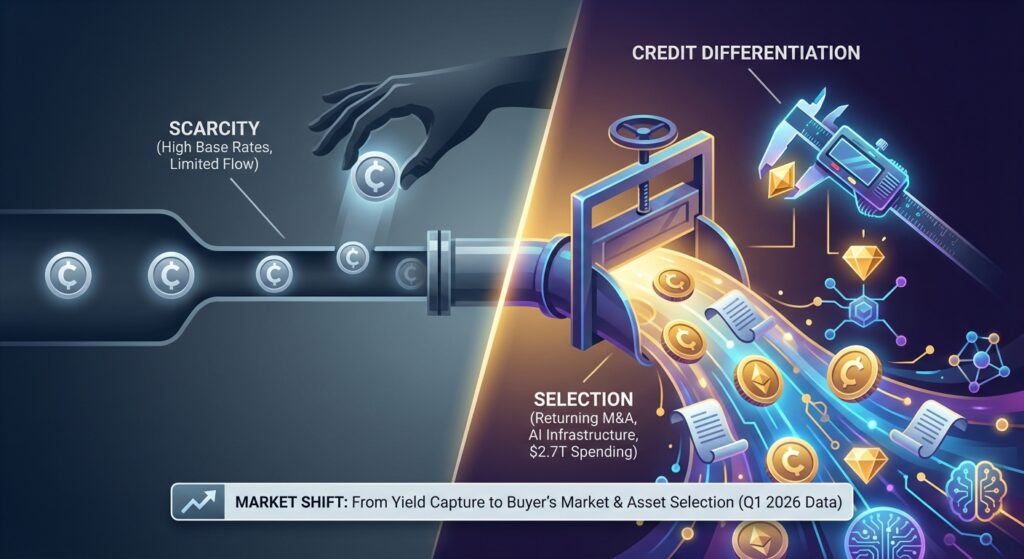
Market Headline: The Pivot From Scarcity to Selection
As of March 2026, the private credit market is undergoing a fundamental regime shift. After a period defined by capital scarcity and high base rates, the market has transitioned into a “buyer’s market” characterized by returning deal flow, tightening spreads, and intense competition for high-quality assets. The resurgence of M&A activity, combined with massive capital needs for AI infrastructure, is reshaping the supply pipeline, pushing lenders to move from purely accessing credit to aggressively selecting it.
While headline metrics remain healthy, with loan-to-value (LTV) ratios holding steady at 40%, underlying currents suggest increased dispersion. Non-accruals are ticking up marginally, and the “easy beta” of direct lending is fading as spreads compress. The dominant narrative for Q1 2026 is no longer just about yield capture, but about credit differentiation in a high-velocity origination environment.
Quantitative Snapshot: Q1 2026 Data
| Metric | Current Level | Trend / Comparison | Source |
|---|---|---|---|
| IG Private Spreads | Tightened ~5-10 bps | Compression vs. Q4 2025 guidance | Sun Life |
| Non-Accrual Rate | 0.9% | Marginally higher vs. 2025 avg | Heron Finance |
| Loan-to-Value (LTV) | ~40% | Stable / Healthy equity cushion | Heron Finance |
| IG Deal Volume | >$170bn (2025 Run-rate) | Record issuance levels | Sun Life |
| Deal Oversubscription | 5x – 10x | High demand for BDC/IG deals | Sun Life |
Sector Analysis: The AI “Arms Race” and Software Saturation
Hot Sector: AI & Infrastructure
The most significant capital allocator in 2026 is the artificial intelligence ecosystem. What began as a self-funded capex cycle for hyperscalers has evolved into a broad-based financing event. Apollo notes that cumulative AI-related spending is expected to exceed $2.7 trillion through 2029, making it the dominant source of incremental credit supply. This is creating a “concentration risk” where apparent diversification across issuers may actually reflect a single macro bet on AI adoption.
Cold Sector: Traditional Software Direct Lending
Heavy exposure to software in direct lending portfolios is increasingly seen as a performance cap. PIMCO warns that the dense overlap of software credits across manager portfolios has compressed performance dispersion, limiting alpha. Investors are being urged to rotate away from crowded corporate direct lending into Asset-Based Finance (ABF) and specialty finance to avoid saturation.
M&A Resurgence
Deal activity is returning at scale, driven by lower financing costs and workable valuations. Larger transactions are now tapping multiple segments of the credit market simultaneously, reinforcing supply dynamics across both investment-grade and leveraged finance.
Implications for the Market
For Borrowers: A Buyer’s Market
The supply-demand imbalance has firmly tipped in favor of issuers. Competitive tension among lenders has led to spread compression, particularly in investment-grade private placements where deals are pricing 5-10 bps inside initial guidance. With leverage metrics improving due to declining reference rates, borrowers have significant pricing power heading into Q2 2026.
For Lenders: The Selection Necessity
The “scarcity premium” is gone. Lenders can no longer rely on broad market beta for outsized returns. The focus must shift to structural protections and avoiding negative selection. While realized losses remain historically low (approx. 1%), the tick-up in non-accruals to 0.9% signals that the credit cycle is not dormant. Lenders must differentiate through sourcing unique origination in less crowded lanes like equipment finance or residential credit.
Key Market Insights
- Spread Compression is Real: Expect continued tightening (5-10 bps) as record dry powder chases returning M&A deal flow.
- AI is the New Macro: Portfolio diversification is being challenged by the correlations inherent in the $2.7T AI infrastructure build-out.
- Credit Quality Divergence: While LTVs (40%) and first-lien seniority (90%) protect principal, non-accruals are slowly rising, watch lower middle market funds closely.
- Volume over Yield: 2026 will be defined by high issuance volumes rather than the peak yields seen in 2023-2024.
- Rotation to ABF: Smart money is moving from crowded corporate direct lending to asset-based finance for better relative value.


