
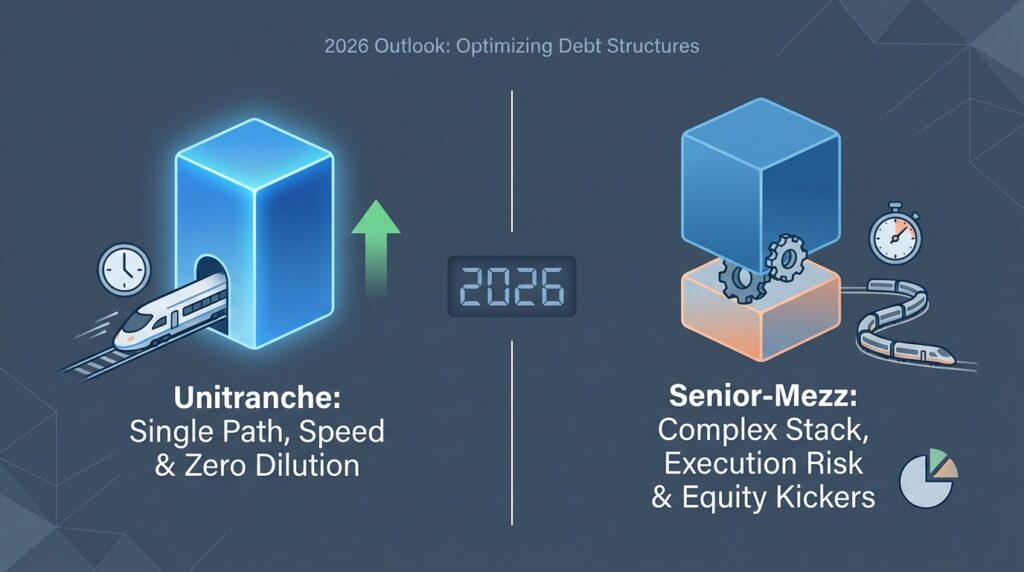
The Financing Challenge: Speed vs. Cost of Capital
In the current 2026 private credit landscape, sponsors and operators typically face a binary choice when structuring acquisition debt: the unitranche facility or the traditional senior-mezzanine stack. While the senior-mezzanine approach can sometimes offer a lower weighted average cost of capital (WACC), it comes with increased structural complexity, intercreditor negotiations, and execution risk.
For middle-market transactions ranging from $50 million to $500 million in enterprise value, the unitranche has become the dominant instrument. The premium paid in interest rate is increasingly viewed not as a cost, but as insurance against execution delays and equity dilution. This deep dive examines the mechanics of the unitranche structure, how it prices in today’s market, and why it often displaces traditional bank-led operational financing.
Structure Breakdown: Mechanics of the Unitranche
A unitranche facility combines senior and subordinated risk into a single debt instrument. Unlike a syndicated loan or a senior-mezzanine structure, there is only one credit agreement, one security agent, and one interest rate facing the borrower.
Check under the hood, however, and the structure is more complex. While the borrower pays a blended rate, the lenders often utilize an Agreement Among Lenders (AAL) to create a “First-Out / Last-Out” (FOLO) waterfall. This effectively bifurcates the loan into a lower-risk senior tranche and a higher-risk junior tranche behind the scenes, without complicating the borrower’s interface.
Detailed Term Sheet Example
Consider a hypothetical $100M Enterprise Value (EV) software company creating $10M in EBITDA. A typical 2026 unitranche structure for a buyout might look like this:
- Facility Size: $55M (5.5x Leverage)
- Pricing (Blended): SOFR + 550 basis points (bps)
- Floor: 1.0% SOFR Floor
- OID / Upfront Fee: 2.0%
- Amortization: 1.0% per annum (minimal required principal paydown)
- Call Protection: 103 / 102 / 101 / Par (hard call for year 1, soft call thereafter)
- Equity Kickers: None (0% warrant coverage)
In this scenario, the borrower deals with a single counterparty for future amendments, such as a “portability” clause or an acquisition line, simplifying post-close governance.
How It Compares: Unitranche vs. Senior-Mezz
The primary alternative is splitting the debt into two distinct tranches: a senior bank loan and a junior mezzanine note.
1. Execution Speed
Recent data indicates a significant time advantage for unitranche structures. Median closing times for unitranche deals clock in at roughly 45 days, compared to 70 days for senior-mezzanine executions. The lag in traditional structures stems from the need to negotiate an intercreditor deed and satisfy two separate credit committees with different risk appetites.
2. Dilution and Cost
A senior-mezz stack might offer a senior rate of SOFR + 350 bps and a mezzanine rate of 12% cash + 2% PIK. While the blended cash interest might be slightly lower than the unitranche, mezzanine lenders frequently require warrant coverage (often 5-15% of the fully diluted equity) to achieve their target IRR. The unitranche structure, despite a higher headline rate (e.g., SOFR + 575), typically demands zero equity dilution, preserving full upside for the sponsor.
3. Governance
The “one-stop” nature of unitranche financing eliminates the friction of competing creditor classes. In a downside scenario, a borrower doesn’t have to navigate a “standstill period” where a mezzanine lender is blocked from acting by a senior bank. Instead, they negotiate with a single agent.
Current Market Terms (2025/2026)
Following the stabilization of interest rates in late 2025, private credit terms have normalized. Based on recent market activity, current standard terms for middle-market unitranche deals include:
- Spreads: SOFR + 475 to 575 bps for high-quality credits.
- Total Leverage: 5.0x to 5.5x EBITDA for tech and services; 4.0x to 4.5x for industrial/manufacturing.
- Loan-to-Value (LTV): Lenders are comfortable up to 60-65% LTV, relying on equity cushions of 35%+.
- Yields: All-in yields for new deals are hovering in the 11% to 13% range, driven by base rates and spreads.
Notably, the “jumbo unitranche” market (deals >$1B) has seen increased activity, with direct lenders forming clubs to take down massive checks that previously required the broadly syndicated loan (BSL) market.
Structuring Guidance
For Operators & Borrowers
When negotiating a unitranche, focus on flexibility rather than just price. Since you are paying a premium spread, extract value through:
- Expanded EBITDA Definitions: Negotiate credit for pro-forma cost savings and synergies (capping usually at 20-25% of EBITDA).
- Acquisition Lines: Pre-bake a “delayed draw term loan” (DDTL) to fund future M&A without triggering a full re-underwriting process.
- Covenant Holidays: Request a step-up in leverage covenants for 12 months following a material acquisition to allow for integration.
For Investors & Lenders
The critical structural protection in a unitranche is the Maintenance Covenant (usually a leverage ratio tested quarterly). Unlike “covenant-lite” syndicated loans which only test upon debt incurrence, middle-market unitranches should retain quarterly testing to provide early warning signals of distress.
Key Takeaways
- Speed Premium: Unitranche deals close ~25 days faster than multi-tranche alternatives, reducing deal uncertainty.
- Zero Dilution: Higher interest spreads are often offset by the absence of warrant coverage or equity kickers.
- Single Document: One credit agreement streamlines legal costs and simplifies future amendments.
- Hidden Structures: Behind the scenes, Agreement Among Lenders (AAL) documents may split risk, but the borrower remains shielded from this complexity.
- Market Standard: Spreads of SOFR + 475-575 bps generally define the current market for healthy middle-market credits.


