
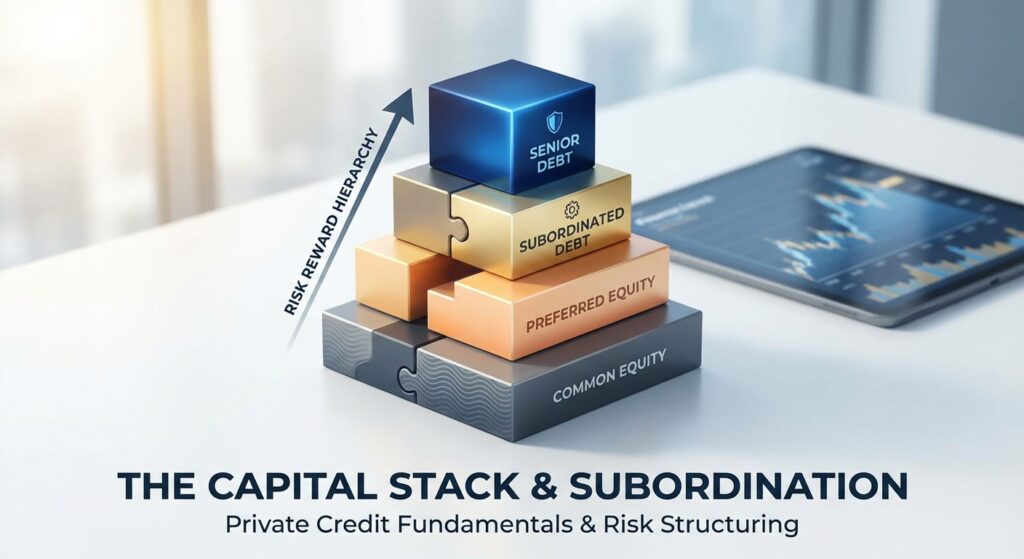
The Foundation Subordinated by Risk
In the world of corporate finance and private credit, the way a company funds its operations is rarely as simple as taking out a single loan or issuing a block of shares. Instead, companies rely on a carefully engineered hierarchy of financing known as the capital stack. For both institutional investors deploying capital and business operators seeking growth funding, the capital stack is the fundamental blueprint that governs risk, reward, and control.
Understanding this legal hierarchy is essential because it dictates exactly who gets paid first when cash flows are strong, and who bears the brunt of the losses when a company stumbles. As the private credit market rapidly expands, stepping in where traditional banking institutions have retreated, knowing how to navigate the specific layers of the capital stack, particularly the mechanics of subordination, has become a structural imperative.
The Concept: Strict Hierarchies & Legal Waterfalls
The capital stack represents the absolute priority of financial claims against a company’s cash flows and assets. It is organized by seniority, functioning as a strict legal waterfall for both periodic interest payments and principal repayment.
At the very top of execution priority sits Senior Debt. This layer has the absolute first claim on assets in the event of liquidation and the first right to cash flows for scheduled interest payments. Because it is mathematically the safest position in the capital stack, it logically carries the lowest cost of capital. Sitting directly below this is Subordinated Debt (often referred to as mezzanine debt). Subordination is the legal agreement stipulating that this debt will only be serviced after all senior obligations are fully met. Because subordination inherently increases the risk of loss, these lenders demand higher interest rates or equity kickers to compensate for their junior position.
Below the debt layers sits Preferred Equity, which contractually guarantees a specific dividend payout before any common shareholders are compensated. Finally, at the very bottom, is Common Equity. Common equity is the most strictly subordinated layer of the entire stack. Equity holders are the absolute last to receive any proceeds during a liquidation event, but they hold the contractual right to the company’s unlimited upside and enterprise value growth.
How It Works: Building a $100 Million Capital Stack
To understand how subordination drastically alters risk profiles, consider a practical example of a software company being acquired for $100 million. The buyers must construct a structured capital stack to fund the purchase. They might assemble it as follows:
- Senior Debt: $50 million, secured by the company’s physical assets and intellectual property, carrying an 8% interest rate.
- Subordinated Debt: $20 million, unsecured, carrying a 12% interest rate.
- Preferred Equity: $10 million, offering an 8% preferred dividend.
- Common Equity: $20 million, representing the private equity sponsor’s at-risk cash investment.
In a growth scenario, the company generates robust cash flows. The first dollars out the door pay the 8% interest on the $50 million senior debt. The next dollars flow down the waterfall to pay the 12% on the subordinated debt, followed by the preferred dividends. Any remaining cash flow or enterprise value appreciation accrues entirely to the $20 million common equity layer. Over a five-year holding period, as the senior debt is amortized and paid down, the equity footprint organically expands, driving high internal rates of return (IRR).
However, consider a downside scenario where the company unexpectedly loses a major contract and is forced into liquidation, selling off its assets in bankruptcy for a total of $60 million. The strict hierarchy of the capital stack activates immediately. The senior debt holders are paid their full $50 million. Only $10 million remains. The subordinated debt holders, who are owed $20 million, receive this remaining $10 million, taking a severe 50% loss. The preferred equity and common equity holders are entirely wiped out, receiving exactly zero. This is the stark mathematical reality of subordination.
Current Market Relevance: Yield Demands Drive Structure
The structural mechanics of the capital stack are increasingly vital as non-bank lending captures unprecedented market share. According to a National Association of Insurance Commissioners (NAIC) primer, the total private credit market structurally ranges between $1.3 trillion and $1.7 trillion. This represents roughly 4.5% of the overall U.S. credit ecosystem.
Within this rapidly expanding space, specific layers of the capital stack dominate the flow of funds. The exact same NAIC report notes that direct lending: which almost exclusively occupies the senior secured portion of the capital stack, is the largest overall segment, accounting for approximately 40% of the U.S. private credit transaction volume. When originating these senior positions, private credit funds operate with specific fundamental underwriting metrics.
According to Capital Market Insights, senior debt essentially acts as the primary component of capital funding, typically making up 50% of the entire capital stack. Lenders secure these senior layers by aggressively targeting an aggregate debt load of 2.0x to 3.0x EBITDA, enforcing a strict 2.0x interest coverage ratio. This ensures the borrower generates exactly twice the free cash flow required to satisfy the senior interest expense. This meticulously structured asset class has successfully attracted massive institutional capital pools; the NAIC confirms that the largest investors driving private credit are currently major pension funds, insurance companies, and sovereign wealth funds, all fundamentally migrating toward the premium yields achievable through careful debt subordination.
The Decision Framework: Positioning within the Stack
For Investors Evaluating Opportunities: Your position in the capital stack must directly align with your institutional mandate for portfolio yield versus capital preservation. If your primary objective is downside protection and capturing steady, predictable current income, target the senior secured debt layers. You mathematically sacrifice total return upside but gain a robust first-lien claim on corporate assets. If your mandate demands high, double-digit returns and you possess the restructuring capabilities to legally endure potential defaults, subordinated and mezzanine debt positions offer outsized yields that specifically compensate for their structurally junior status.
For Operators Seeking Capital: Business operators must carefully weigh the absolute cash cost of debt capital against the permanent economic cost of equity dilution. Senior debt is mathematically the cheapest external capital available and entirely preserves founder ownership, but it introduces strict financial covenants and demands rigid, mandatory cash flow obligations. If a rapidly scaling company currently lacks the stable, recurring EBITDA required to guarantee a 2.0x interest coverage ratio, exploring subordinated debt can selectively ease immediate cash burdens, often structured with Payment-in-Kind (PIK) interest that compounds rather than requiring cash, albeit at a substantially higher nominal interest rate. Operators must strategically select the specific layer of the stack that aligns perfectly with their current cash flow stability.
Key Takeaways
- Risk Dictates Hierarchy: The capital stack is a strict legal waterfall; senior debt rigidly prioritizes capital safety and first repayment, while deeply subordinated lower layers prioritize higher potential yields and equity upside.
- Subordination Carries a Price: Subordinated debt is strictly junior to senior claims, meaning these non-bank lenders will universally require higher interest rates to mathematically offset their significantly increased risk of principal loss.
- Senior Debt Dominates Private Credit: Senior secured direct lending currently accounts for roughly 40% of the massive, structural $1.3 to $1.7 trillion alternative private credit market.
- Equity Bears Extreme Risk: In downside corporate liquidation scenarios, common and preferred equity positions are completely legally wiped out before subordinated debt lenders absorb their first dollar of losses.
- Coverage is Critical: Typical senior debt layers expect exceptionally robust covenant protection, generally requiring corporate borrowers to maintain at least 2.0x interest coverage on their core operating EBITDA.


