
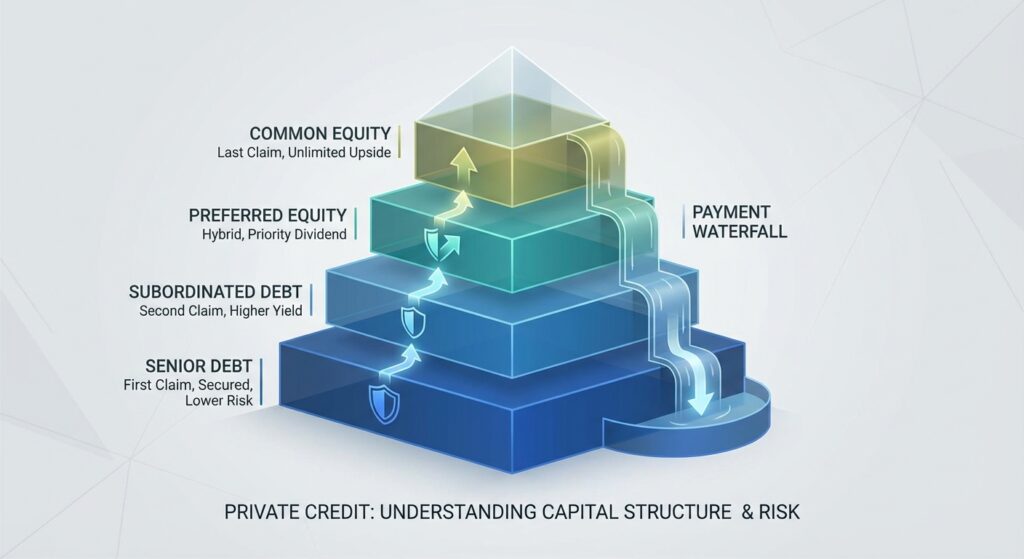
Understanding the Hierarchy of Repayment
Behind every skyscraper, middle-market buyout, or infrastructure project lies a meticulously engineered financial structure known as the Capital Stack. For both investors seeking yield and business owners seeking growth capital, understanding where they sit in this stack is the single most important factor in determining their risk exposure and potential return.
In the private credit ecosystem, the capital stack acts as the blueprint for financial rights. It dictates who gets paid first when things go well, and more importantly, who absorbs the losses when they don’t. While the market for private credit has evolved into a projected $3 trillion asset class, the fundamental physics of seniority remain unchanged.
The Concept: The Layered Cake of Finance
Imagine the capital structure of a company as a layered cake. The top layers representing equity offer the most sweetness (upside potential) but are the first to be eaten (wiped out) if the company fails. The bottom layers representing senior debt are the structural foundation; they support the rest of the stack and are the last to crumble.
In technical terms, the capital stack defines structural subordination. It establishes the “waterfall” of payments:
- Senior Secured Debt: The foundation. Holders have the first claim on assets and cash flows. They accept lower specific returns for higher safety.
- Subordinated (Mezzanine) Debt: The middle layer. These lenders get paid only after senior lenders are satisfied. To compensate for this increased risk, they command higher interest rates and often equity “kickers” (warrants).
- Preferred Equity: A hybrid layer. Pays a fixed dividend like a bond but sits below all debt in priority.
- Common Equity: The top layer. The business owners and sponsors. They have the last claim on assets but enjoy unlimited upside if the company grows.
How It Works: A $100 Million Deal Example
To see these mechanics in action, let’s look at a hypothetical acquisition of a manufacturing company valued at $100 million. According to a 2025 structuring analysis by Umbrex, a typical private equity sponsor might structure the stack as follows:
- $50 Million Senior Debt (50%): Provided by a direct lender or bank. Secured by the factory and inventory. Receives SOFR + 5% interest.
- $20 Million Subordinated Debt (20%): Unsecured. Receives 12% cash interest plus PIK (Payment-in-Kind) interest.
- $10 Million Preferred Equity (10%): Priority return of 8% before common shareholders see a dime.
- $20 Million Common Equity (20%): The private equity sponsor’s check.
Scenario A: Success
The company is sold five years later for $150 million. The debt providers simply get their principal back plus the interest they collected along the way. The equity holders, however, capture the entire $50 million in value appreciation. Their initial $20 million investment has grown substantially because they used leverage to amplify returns.
Scenario B: Distress
The company hits hard times and is liquidated for only $60 million.
1. Senior lenders are paid their full $50 million first.
2. Subordinated lenders are owed $20 million, but only $10 million remains. They suffer a 50% loss.
3. Preferred and Common Equity holders are wiped out completely.
This illustrates the “Equity Cushion”, the 50% of value sitting above the senior debt protects the senior lender from loss.
Current Market Relevance
As of 2026, the distinctions within the capital stack have become even more critical due to the sheer volume of capital entering the space. Data from Mayer Brown notes that the asset class managed over $1.7 trillion by the end of 2023, with projections hitting $3 trillion by 2028.
Current lending standards reflect a disciplined approach to this growth:
- Leverage Ratios: Senior debt tranches are typically capped at 2.0x to 3.0x EBITDA, ensuring feasible interest coverage ratios.
- Unitranche Evolution: We are seeing more “Unitranche” facilities, which combine senior and subordinated debt into a single instrument. While this simplifies the structure for borrowers, it requires a blended interest rate and rigorous intercreditor agreements.
- Private vs. Public: Unlike public markets where prices fluctuate daily, private credit assets are not marked-to-market daily. This lowers perceived volatility, as noted by Lord Abbett, but it places a premium on initial underwriting discipline since the lender typically holds the asset to maturity.
Decision Framework
For Investors: Evaluating the Stack
When allocating to private credit, the primary question is not just “what is the yield?” but “where is the detachment point?”
- Conservative Allocators: Should focus on Senior Secured Direct Lending. You accept a yield spread (e.g., SOFR + 550-600 bps) in exchange for being at the bottom of the stack, protected by the equity cushion below you.
- Yield Seekers: May look at Mezzanine or Preferred Equity strategies. You are effectively betting that the enterprise value will not drop by more than 20-30%. If the company stays solvent, you earn double-digit returns; if it defaults, you are at risk.
For Operators: Sizing the Ask
For business owners raising capital, the trade-off is Cost of Capital vs. Dilution.
- Maximizing Senior Debt: This is your cheapest capital. Taking on debt allows you to retain ownership. However, over-leveraging creates a rigid fixed-cost structure that can threaten the business during a downturn.
- Accepting Equity/Mezzanine: While expensive (costing 15-25% IRR in expected returns), this capital is patient. It doesn’t trigger default as easily as a missed bank payment, providing breathing room for growth initiatives.
Key Takeaways
- Seniority is Safety: In a liquidation event, senior lenders lay claim to assets before anyone else.
- The Equity Cushion: The thickness of the junior capital layers protects the senior debt. A 50% LTV loan means the business value must drop by half before the lender loses principal.
- Risk/Return Trade-off: You cannot have high safety and high returns. Senior debt offers income stability; equity offers capital appreciation.
- Structure Dictates Survival: In 2026, with higher base rates, the ability of a company to service the specific layer of debt it has taken on is the primary metric of health.
- Documentation Matters: The “intercreditor agreement” is what legally binds this stack together, investors must understand their rights relative to other creditors.


