
The Financing Challenge: Certainty vs. Cost
In the high-velocity buyout market of 2026, the primary trade-off for sponsors and corporate borrowers remains constant: speed versus cost of capital. While potentially cheaper on a weighted-average basis, traditional senior-subordinated structures often introduce execution risks (intercreditor negotiations, distinct syndication processes, and potential flex terms) that can derail tight closing timelines.
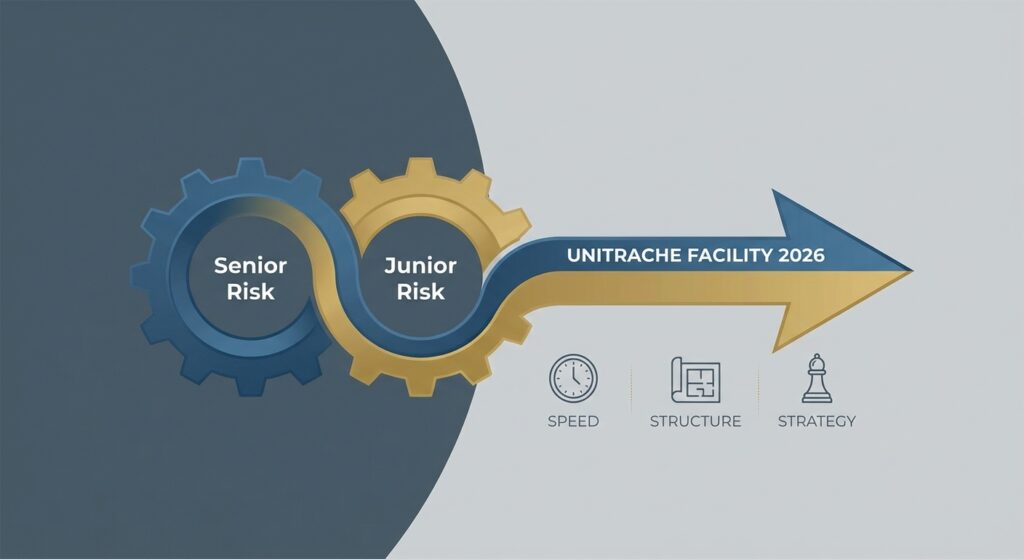
For middle-market operators and private equity sponsors, the unitranche facility: a blended debt instrument combining senior and junior risk into a single loan, has solidified its position as the dominant financing tool. With private credit assets reaching approximately $2.1 trillion by 2025, the depth of the market now allows for “mega-unitranches” exceeding $2 billion, challenging the broadly syndicated loan (BSL) market. This deep dive examines the mechanics, current market terms, and strategic rationale for deploying unitranche structures in today’s environment.
Structure Breakdown: Components and Mechanics
A unitranche facility simplifies the capital stack by replacing distinct first-lien and second-lien (or mezzanine) tranches with a single credit agreement. The borrower interfaces with one administrative agent and pays one blended interest rate. Behind the scenes, the lenders may bifurcate the risk through an Agreement Among Lenders (AAL), creating “first-out” and “last-out” positions, but this complexity is invisible to the borrower.
Detailed Term Sheet Example
Consider a hypothetical $50 million financing for a software services company with $10 million in EBITDA (5.0x leverage). A typical 2026 unitranche term sheet would feature:
- Facility Size: $50 million Term Loan B.
- Interest Rate: SOFR + 525 bps (floating).
- OID (Original Issue Discount): 98.0 (2% upfront fee).
- Amortization: 1.0% per annum (minimal required principal payments).
- Maturity: 5 to 6 years.
- Covenants: A single financial maintenance covenant, typically Total Net Leverage Ratio, set with a 25-30% cushion to the closing model (e.g., tested at 6.5x).
- Accordion Feature: Ability to upsizing the facility by an additional $10-15 million for acquisitions, subject to pro forma compliance.
In this structure, the “first-out” lender might be a bank taking a lower return (e.g., SOFR + 300) on the safer portion, while a private credit fund takes the “last-out” risk at a higher return. The borrower, however, simply sees a blended cost of SOFR + 525.
How It Compares: Unitranche vs. Senior-Mezzanine
The choice between unitranche and a traditional senior-mezzanine stack often comes down to execution certainty and dilution.
1. Execution Speed
Data from 2025 indicates a significant speed advantage for unitranche execution. The median “sign-to-fund” timeline for unitranche deals is approximately 45 days, compared to 70 days for senior-mezzanine structures. This 25-day difference is often critical in competitive auction processes where financing certainty must be demonstrated prior to exclusivity.
2. Dilution and Economics
While a senior loan (SOFR + 325-400 bps) paired with mezzanine debt (10-14% cash + PIK) might offer a lower weighted average cost of capital, mezzanine lenders frequently require equity warrants (often 5-15% coverage) to achieve their target returns. Unitranche lenders typically do not require equity kickers. For sponsors, paying a slightly higher cash coupon (the “unitranche premium”) is often preferable to suffering permanent equity dilution.
3. Documentation Efficiency
Senior-mezzanine deals require two credit agreements and a complex Intercreditor Agreement. Unitranche requires only one credit agreement. This reduces legal fees and administrative burden post-close, as the borrower only needs to submit one set of compliance certificates and navigate one amendment process if business conditions change.
Current Market Terms (2025/2026)
As of early 2026, the unitranche market has stabilized around the following terms for middle-market issuers:
- Pricing: Spreads typically range from SOFR + 475 to 575 bps. This represents a 50-100 bps premium over syndicated first-lien solutions, justified by the speed and certainty of the private execution.
- Leverage Profiles: Total leverage for sponsored deals averages around 5.0x EBITDA, though higher attachment points (up to 6.0x) are available for high-recurring-revenue businesses (software/SaaS) with strong retention metrics.
- Loan-to-Value (LTV): Lenders are generally writing checks up to 55-65% LTV, signaling a discipline in asset coverage despite high liquidity in the private credit market.
- Upfront Fees: Arrangement fees hover between 1.5% and 2.0%, which is slightly higher than traditional bank markets (1.0-1.5%).
Structuring Guidance & Negotiation
For Operators and Sponsors:
When negotiating a unitranche facility, focus less on the headline rate, which is market-driven, and more on flexibility. Key negotiation points include:
- EBITDA Add-Backs: Ensure the definition of “Adjusted EBITDA” includes 12-18 months of credit for realized synergies and restructuring costs. This “covenant EBITDA” directly impacts your leverage capacity and covenant cushion.
- Scalability: Negotiate a committed “delayed draw term loan” (DDTL) or uncommitted accordion feature to fund future M&A without incurring new origination fees or needing a full refinancing.
- Call Protection: Most direct lenders require 1-2 years of call protection (e.g., 102, 101, par). Try to negotiate a “soft call” exception if a refinancing occurs due to an IPO or sale of the business.
For Investors:
The single-document nature of unitranche removes the structural protections of a second lien. Attention must be paid to the “definition of remedial action” in the credit agreement: ensure that as a lender, you have adequate controls if the borrower underperforms, without the friction of a competing lender class blocking enforcement.
Key Takeaways
- Speed Premium: Borrowers pay ~50-100 bps more for unitranche to save ~25 days in closing time.
- No Equity Dilution: Unlike mezzanine financing, unitranche rarely involves warrants, preserving equity upside.
- Simple Governance: One credit agreement and one agent streamline post-close administration and amendments.
- Deep Market: Capable of funding $2B+ transactions, making it a viable alternative to BSL for large caps.
- Behind the Scenes: The AAL (Agreement Among Lenders) dictates lender risk, not the borrower’s credit agreement.


